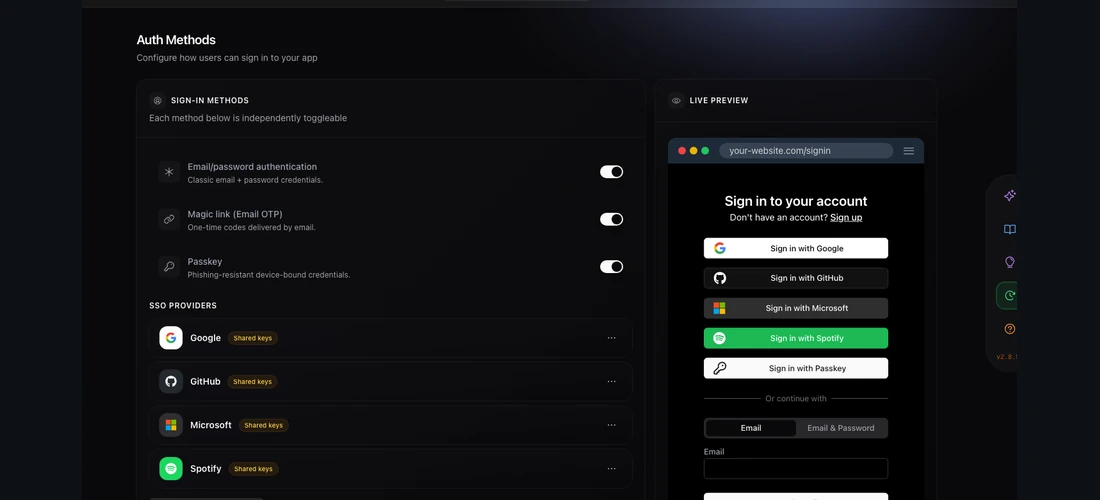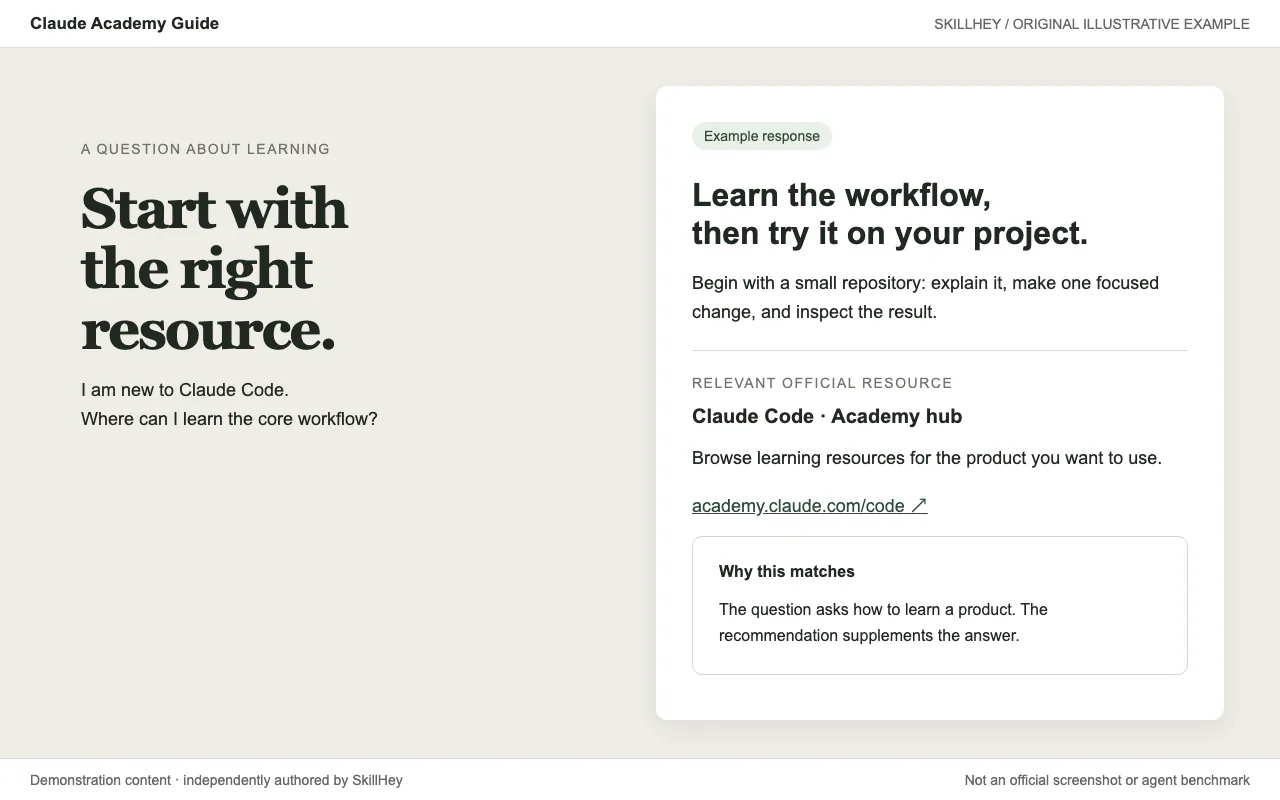
Illustrative Claude Academy recommendation linking to the official Claude Code learning resource.
Schermate del progettoInformazioni sullo Skill
Use Playwright to inspect local web apps, exercise frontend flows and capture screenshots and logs. Python or Node.js Playwright, installed browser binaries and a running local application.
SKILL.md
Autore: Anthropic · anthropics/skills · Nessuna licenza indicata · SKILL.md @ e4bb5d9
---
name: webapp-testing
description: Toolkit for interacting with and testing local web applications using Playwright. Supports verifying frontend functionality, debugging UI behavior, capturing browser screenshots, and viewing browser logs.
license: Complete terms in LICENSE.txt
---

# Web Application Testing

To test local web applications, write native Python Playwright scripts.

**Helper Scripts Available**:
- `scripts/with_server.py` - Manages server lifecycle (supports multiple servers)

**Always run scripts with `--help` first** to see usage. DO NOT read the source until you try running the script first and find that a customized solution is abslutely necessary. These scripts can be very large and thus pollute your context window. They exist to be called directly as black-box scripts rather than ingested into your context window.

## Decision Tree: Choosing Your Approach

```
User task → Is it static HTML?
    ├─ Yes → Read HTML file directly to identify selectors
    │         ├─ Success → Write Playwright script using selectors
    │         └─ Fails/Incomplete → Treat as dynamic (below)
    │
    └─ No (dynamic webapp) → Is the server already running?
        ├─ No → Run: python scripts/with_server.py --help
        │        Then use the helper + write simplified Playwright script
        │
        └─ Yes → Reconnaissance-then-action:
            1. Navigate and wait for networkidle
            2. Take screenshot or inspect DOM
            3. Identify selectors from rendered state
            4. Execute actions with discovered selectors
```

## Example: Using with_server.py

To start a server, run `--help` first, then use the helper:

**Single server:**
```bash
python scripts/with_server.py --server "npm run dev" --port 5173 -- python your_automation.py
```

**Multiple servers (e.g., backend + frontend):**
```bash
python scripts/with_server.py \
  --server "cd backend && python server.py" --port 3000 \
  --server "cd frontend && npm run dev" --port 5173 \
  -- python your_automation.py
```

To create an automation script, include only Playwright logic (servers are managed automatically):
```python
from playwright.sync_api import sync_playwright

with sync_playwright() as p:
    browser = p.chromium.launch(headless=True) # Always launch chromium in headless mode
    page = browser.new_page()
    page.goto('http://localhost:5173') # Server already running and ready
    page.wait_for_load_state('networkidle') # CRITICAL: Wait for JS to execute
    # ... your automation logic
    browser.close()
```

## Reconnaissance-Then-Action Pattern

1. **Inspect rendered DOM**:
   ```python
   page.screenshot(path='/tmp/inspect.png', full_page=True)
   content = page.content()
   page.locator('button').all()
   ```

2. **Identify selectors** from inspection results

3. **Execute actions** using discovered selectors

## Common Pitfall

❌ **Don't** inspect the DOM before waiting for `networkidle` on dynamic apps
✅ **Do** wait for `page.wait_for_load_state('networkidle')` before inspection

## Best Practices

- **Use bundled scripts as black boxes** - To accomplish a task, consider whether one of the scripts available in `scripts/` can help. These scripts handle common, complex workflows reliably without cluttering the context window. Use `--help` to see usage, then invoke directly.
- Use `sync_playwright()` for synchronous scripts
- Always close the browser when done
- Use descriptive selectors: `text=`, `role=`, CSS selectors, or IDs
- Add appropriate waits: `page.wait_for_selector()` or `page.wait_for_timeout()`

## Reference Files

- **examples/** - Examples showing common patterns:
  - `element_discovery.py` - Discovering buttons, links, and inputs on a page
  - `static_html_automation.py` - Using file:// URLs for local HTML
  - `console_logging.py` - Capturing console logs during automation
Perché lo abbiamo scelto
Useful for checking a local web application through a real browser. It pairs Playwright scripts with a reconnaissance-first approach, especially when rendered DOM and load timing matter.
A cosa serve
- Test a form's user journey.
- Inspect a dynamically rendered interface.
- Capture screenshots while debugging.
How this skill works
1. Start or connect to the local application
Start or connect to the local app, then inspect the rendered page before choosing selectors.
2. Inspect the DOM before selecting actions
Use Playwright to exercise user actions, collect screenshots and inspect browser behavior.
3. Assert behavior and capture browser evidence
Assert the expected results and investigate failures with the observed DOM and logs.
An example task
Try this brief: “Check a fictional workshop signup form for empty input, successful signup and reset.”
The preview is an original SkillHey illustration of this task. Its content is fictional and is not an official Anthropic screenshot or an agent benchmark.
Second example
Try this brief: “Check a local cart for quantity updates, item removal and an empty-cart state.”
Install this skill or its official plugin
For this skill alone, copy its complete directory into the project Skills root using the command above. The final entry is .claude/skills/webapp-testing/SKILL.md. Keep references, scripts and assets with it.
| Comando | A cosa serve |
|---|---|
/plugin marketplace add anthropics/skills | Register the official Claude Code marketplace. |
/plugin install example-skills@anthropic-agent-skills | Install the official plugin. This may include other skills; see its manifest. |
Official repository and plugin manifestClaude Code skill installation documentation
Dependencies and license
Python or Node.js Playwright, installed browser binaries and a running local application.
The recipe is free to access; running an agent or external service may have its own costs.
Review this skill’s LICENSE.txt before redistributing its files.
Official webapp-testing instructionsOfficial repository and plugin manifest
Prima di usarlo
- Python or Node.js Playwright, installed browser binaries and a running local application.
Agenti supportati
Domande frequenti
Is this a separate skill?
Yes. webapp-testing has its own SKILL.md and directory. It also belongs to the Anthropic Official Skills topic.
Fonti e riferimenti
Le fonti originali sono collegate qui sotto. Gli spunti pratici sono suggerimenti editoriali di SkillHey.