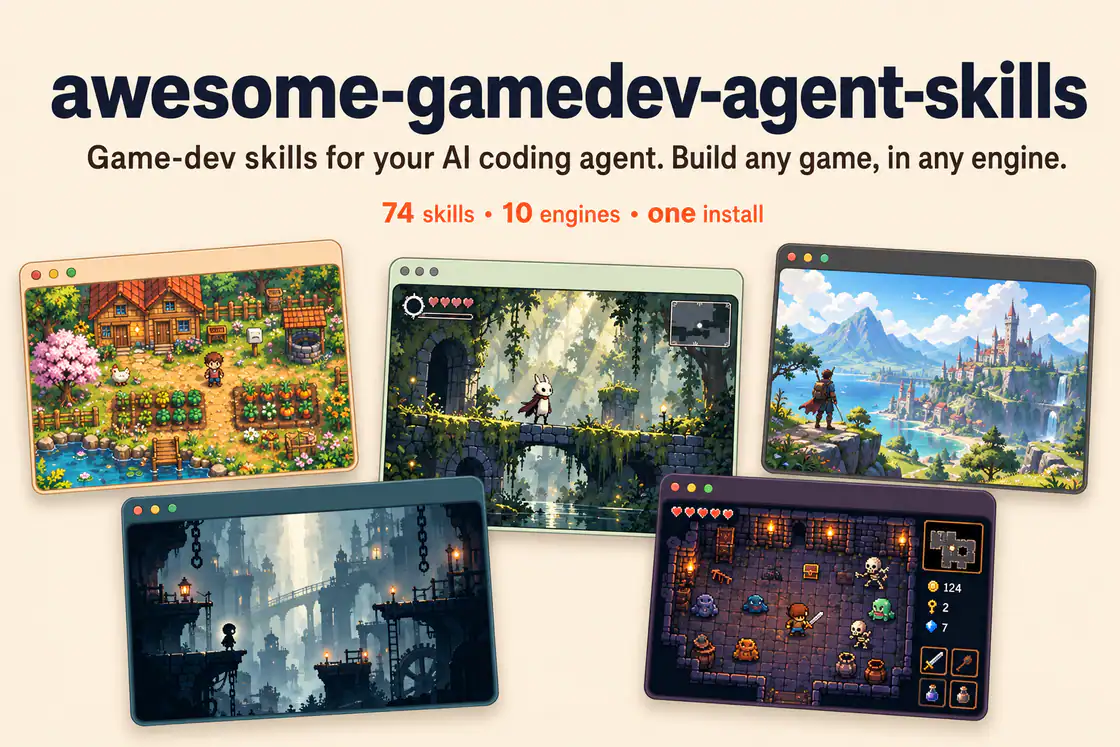
Author-provided banner showing five game scenes. Its 74-skill label reflects an earlier edition; the reviewed catalog contains 76 specialized skills plus a router.
Schermate del progettoInformazioni sullo Skill
Implement NPC decision systems with blackboards, reusable behavior-tree nodes, utility scores, response curves, and hybrid agents.
SKILL.md
Autore: Abhishek Barali · gamedev-skills/awesome-gamedev-agent-skills · Apache-2.0 · SKILL.md @ c6ca6c4
---
name: ai-behavior-trees-utility-ai
description: >
  Engine-neutral behavior tree and utility AI code for NPCs in any language: Blackboard, reactive
  composites, decorators and response-curve scoring. Use when an enemy keeps chasing after losing
  sight, restarts its action every frame or flip-flops between choices. Not for FSMs, steering or
  pathfinding (`game-ai`) or Unreal BT, EQS and StateTree (`unreal-behavior-trees`).
---

# Behavior trees and Utility AI

A behavior tree (BT) gives an agent ordered, interruptible priorities; Utility AI scores every
option and picks the most wanted one. The code is plain C# so it ports to any engine; the
non-obvious part is the lifecycle contract (who resets what, and when), which is where almost
every BT bug lives.

## When to use

- Build or fix a reusable BT runtime: Blackboard, leaves, composites, decorators.
- Build a utility decider: curves, considerations, a selector with hysteresis.
- Combine them: a BT branch that hands a graded choice (which attack, which target) to utility.

**Not this skill:** choosing FSM vs BT, steering, A*, flow fields and perception belong to
`game-ai`. Unreal's `BehaviorTree`/`Blackboard` assets, `BTTask`/`BTService`, EQS and StateTree
belong to `unreal-behavior-trees`. The agent that physically moves (`NavMeshAgent`,
`NavigationAgent3D`) belongs to the engine navigation skill.

## Workflow

1. **Read what exists.** Find the current AI code, its tick site and how it reads the world. If
   the project already ships a BT plugin (Godot LimboAI or Beehave, Unity Behavior, NodeCanvas),
   extend it instead of adding a second runtime.
2. **Pick the default shape: BT outside, utility inside.** The BT decides engage, flee or patrol;
   a utility node inside the engage branch picks how. Use utility at the top only when every
   top-level behavior is a graded trade-off (needs-driven villagers), because it is harder to
   debug and prone to thrashing.
3. **Design the Blackboard first.** Perception writes facts (`targetPos`, `health01`,
   `distToPlayer`); leaves read them. Nodes never hold references to each other.
4. **Choose memory or reactive per composite.** Priority selectors at the top are reactive so
   a higher branch can preempt; a `Sequence` whose first child is a guard condition must be a
   `ReactiveSequence`, or the guard stops being checked once the action runs.
5. **Normalize every utility input to 0..1** through a curve before combining; multiply with
   compensation so a 0 still vetoes.
6. **Tick on a decision cadence** (5-15 Hz for most NPCs) from an accumulator, staggered across
   agents. Movement and animation still run every frame.
7. **Prove it with a headless tick test** (below): script the Blackboard, tick N times and
   assert the status sequence and reset counts. Then draw the running leaf and per-action
   scores on screen while tuning.

## The lifecycle contract

Every node returns `Success`, `Failure` or `Running`. Parents reset a child as soon as it returns
a terminal status and when they abandon it while `Running`; the tree resets a terminal root.
`Reset()` must be idempotent and must clear only execution-local state (timers, reservations),
never persistent state such as a cooldown deadline.

```csharp
// Selector = fallback/OR: return the first child that is not Failure.
// `Current` (from Composite) remembers a Running child so the next tick resumes there.
public sealed class Selector : Composite
{
    public override Status Tick(Blackboard bb, float dt)
    {
        for (; Current < Children.Count; Current++)
        {
            var s = Children[Current].Tick(bb, dt);
            if (s == Status.Running) return Status.Running;            // resume here next tick
            Children[Current].Reset();                                // terminal child can re-enter cleanly
            if (s == Status.Success) { Current = 0; return Status.Success; }
        }
        Current = 0;
        return Status.Failure;                                         // every child failed
    }
}
```

This is the memory variant: it cannot be preempted. `Sequence`, `ReactiveSelector`,
`ReactiveSequence`, `Parallel`, the decorators and `BehaviorTree` follow the same contract in
`references/behavior-tree-core.md`.

## Utility scoring in one snippet

```csharp
// A consideration maps one raw fact to 0..1 through a response curve.
float Score(Blackboard bb)
{
    float distance01 = Curves.InverseLerp01(bb.Get<float>("distToPlayer"), 20f, 2f); // near = 1
    float health01   = Curves.Sigmoid(bb.Get<float>("health01"), k: 8f, mid: 0.4f);  // hurt = low
    // A 0 in any factor still vetoes the action; compensation stops each extra
    // consideration from dragging every score toward 0. No allocation per call.
    return Curves.Compensate(distance01 * health01, count: 2);
}
```

Selection: argmax with an inertia bonus of about 0.05 for the running action is the default;
softmax (temperature about 0.2) when designers want variety without silly picks.

## Headless tick test

Run this shape in the project's test runner (Unity Test Framework, GdUnit4, xUnit) before
tuning by eye; `Assert` stands for the framework's assertion. A probe leaf counts ticks and
resets, so lifecycle bugs show up as numbers.

```csharp
sealed class Probe : Leaf
{
    public int Ticks, Resets; readonly int _after; readonly Status _end;
    public Probe(int after, Status end = Status.Success) { _after = after; _end = end; }
    public override Status Tick(Blackboard bb, float dt) => ++Ticks >= _after ? _end : Status.Running;
    public override void Reset() { Ticks = 0; Resets++; }
}
// Guard lost mid-action: the running action must be aborted, not resumed.
var bb = new Blackboard(); var chase = new Probe(after: 3);
var seq = new ReactiveSequence().Add(new Condition(b => b.Get<bool>("sees"))).Add(chase);
bb.Set("sees", true);  Assert(seq.Tick(bb, 0.1f) == Status.Running);
bb.Set("sees", false); Assert(seq.Tick(bb, 0.1f) == Status.Failure && chase.Ticks == 0);
```

Cover at least: a `Wait` that runs twice in a row takes full time both runs; a lost guard
aborts its action; a cooldown still blocks after its branch is aborted; utility returns `null`
(and the caller copes) when every action scores 0.

## Gotchas

- **Guard not re-checked.** A memory `Sequence` resumes at its running child, so
  `[CanSeePlayer?, Chase]` chases forever after sight is lost. Use `ReactiveSequence`, or make
  the action fail when its Blackboard input disappears.
- **Priority never preempts.** A memory `Selector` at the root keeps resuming a running Patrol
  and never re-asks Attack. Top-level priority selectors are reactive, and they must `Reset()`
  the branch they abandon or its move or animation keeps running.
- **Timed actions finish instantly the second time.** `Wait`/`Repeat` accumulators were not
  cleared because the parent skipped `Reset()` on a terminal child.
- **Cooldown bypass.** A `Cooldown` that clears its ready-time in `Reset()` lets an agent attack
  every time it flickers between branches. Keep the deadline across resets.
- **`Parallel` restarts finished children.** Re-ticking a child that already succeeded restarts
  it, and `RequireAll` then never sees all children succeed on one tick. Store per-child results.
- **Cooldown inside a `Sequence` makes the agent step back to patrol** for a tick each time it is
  blocked. Wrap it in `ForceSuccess` when "wait for the cooldown" should hold the branch.
- **Mixed ranges.** One consideration in 0..100 next to others in 0..1 dominates and makes
  weights meaningless. Clamp every curve output to 0..1.
- **Plain products sink with more considerations.** Five factors of 0.8 give 0.33. Apply the
  compensation factor (`Curves.Compensate`), which keeps an exact 0 as a veto.
- **Inertia revives a vetoed action.** Add the hysteresis bonus only to positive raw scores.
- **Softmax overflows** at small temperatures (`exp(score / 0.01)` is infinity in float). Subtract
  the best score before `exp`.
- **GC spikes.** Build the tree once at spawn; `Tick` allocates nothing (no LINQ, no closures
  capturing locals, no boxing in hot Blackboards). Use a fields class instead of a
  `Dictionary<string, object>` for agents that tick often.
- **Cost lives in the leaves.** Raycasts and path queries inside conditions dominate CPU; let
  perception cache facts on the Blackboard and pathfind on a timer.

## References

- `references/behavior-tree-core.md`: read when writing or reviewing the runtime itself
  (Blackboard, base classes, every composite including the reactive ones, `Parallel`,
  decorators, `BehaviorTree`).
- `references/utility-ai-system.md`: read when building the scorer (curve library,
  compensation, `Consideration`, `UtilityAction`, argmax and softmax selection).
- `references/practical-examples.md`: read when you need a full agent to adapt (guard
  Patrol/Combat BT, needs-driven villager, hybrid `UtilitySelectorNode`).
- `references/best-practices-and-pitfalls.md`: read when scaling to many agents or debugging
  (time-slicing, AI LOD, event-driven aborts, debug overlays, reproducible randomness).

## Related skills

- `game-ai`: decision-model choice, FSMs, steering, pathfinding, perception.
- `unreal-behavior-trees`: Unreal's asset-based BT, Blackboard, EQS and StateTree.
- `unity-navmesh`: the `NavMeshAgent` that carries out "move to" intents.

## Version notes

Last verified: 2026-11-11.

- The C# compiles with no engine types. Example leaves use Unity 6 `Vector2` member names
  (`magnitude`, `normalized`, `sqrMagnitude`); Godot 4 C# uses `Length()`, `Normalized()`,
  `LengthSquared()`; `System.Numerics.Vector2` uses `Length()` and `Vector2.Normalize(v)`.
- The repository test `tests/test_ai_examples.py` compiles the published blocks with the .NET 10
  SDK and runs the lifecycle scenarios.
- BT plugins worth extending instead of replacing (latest releases at check): Unity Behavior
  `com.unity.behavior` 1.0.17, LimboAI 1.8.1 and Beehave 2.9.3 for Godot.
- Sources: compensation factor from Dave Mark and Mike Lewis, "Building a Better Centaur: AI at
  Massive Scale", GDC 2015 AI Summit (https://www.gdcvault.com/play/1021848); Unity package
  registry (https://packages.unity.com/com.unity.behavior); GitHub releases of
  limbonaut/limboai and bitbrain/beehave.
Perché lo abbiamo scelto
Provides a focused workflow, implementation patterns, and common failure checks for behavior trees & utility ai. Pair it with the detected engine and any related systems required by the task.
A cosa serve
- Use when your game task needs behavior trees & utility ai.
What this skill helps you build
Implement NPC decision systems with blackboards, reusable behavior-tree nodes, utility scores, response curves, and hybrid agents.
Use it in your project
Inspect the existing project
Describe the desired behavior and share the relevant project files, engine version, and current failure or target result.
Apply the focused playbook
Implement NPC decision systems with blackboards, reusable behavior-tree nodes, utility scores, response curves, and hybrid agents.
Verify in the matching runtime
Run the project or workflow with its actual dependencies and check the changed behavior before accepting the result.
Original ai-behavior-trees-utility-ai instructionsEngine versions and upgrade policy
Shared collection installation
Install the complete upstream collection with its router and keep each skill’s bundled references, scripts, and assets. The dispatcher selects an engine and the smallest relevant task set; a member listing is a focused entry into that shared package.
| Comando | A cosa serve |
|---|---|
npx skills add gamedev-skills/awesome-gamedev-agent-skills | Keep the router and supporting skill folders available together. |
Prima di usarlo
- An existing or planned game and an Agent Skills-compatible coding agent. Pair engine-neutral concepts with the engine-specific entrypoints when writing code.
Agenti supportati
Fonti e riferimenti
Le fonti originali sono collegate qui sotto. Gli spunti pratici sono suggerimenti editoriali di SkillHey.