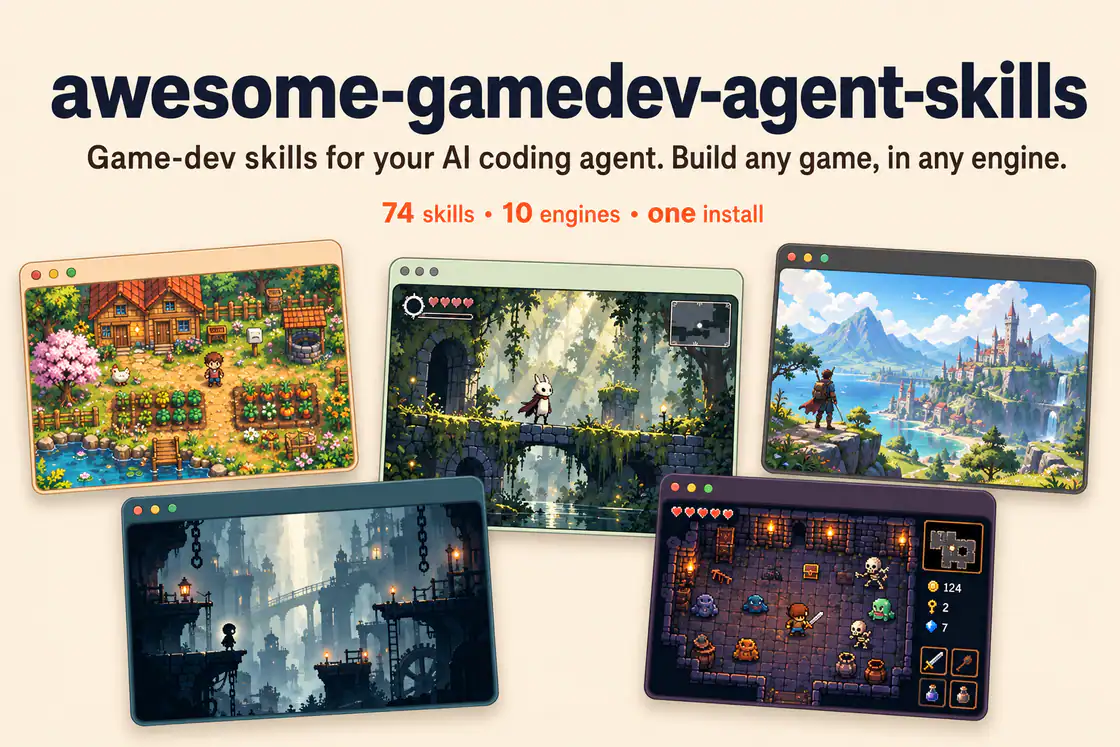
Author-provided banner showing five game scenes. Its 74-skill label reflects an earlier edition; the reviewed catalog contains 76 specialized skills plus a router.
Schermate del progettoInformazioni sullo Skill
Plan audio buses, decibel controls, dialogue ducking, adaptive music, sound variation, and beat-synchronized events.
SKILL.md
Autore: Abhishek Barali · gamedev-skills/awesome-gamedev-agent-skills · Apache-2.0 · SKILL.md @ c6ca6c4
---
name: audio-design
description: >
  Engine-neutral game audio technique: bus layout, volume sliders in decibels, loudness, ducking
  music under dialogue, adaptive music and SFX variation, with Godot, Unity and FMOD/Wwise
  mappings. Use when mixing a game, making music react to combat, fixing repetitive footsteps or
  beat sync, or a mix that clips or pumps. Not for the Godot audio API (`godot-audio`).
---

# Audio design

Game audio is a mixing graph plus a music system. Every sound plays into a small set of buses
that the settings sliders and ducking act on, and music reacts to play through layers and
segments instead of one loop. This skill owns those decisions; `godot-audio`, Unity's
AudioMixer or FMOD/Wwise supply the API.

## When to use

- Design a bus layout, volume sliders, group effects and a loudness target.
- Duck music and ambience under voice or big impacts.
- Build adaptive music, SFX variation, or beat-quantized gameplay.

**Not this skill:** Godot node, bus and stream API questions go to `godot-audio`; settings menu
layout goes to `game-ui-ux`; triggering sounds from hits goes through `game-feel`'s feedback
bundle.

## Workflow

1. **Inventory first.** List every player or `AudioSource` and the bus or mixer group it
   outputs to; anything on Master or with no group bypasses the sliders.
2. **Lay out buses**: `Master ← Music ← MusicDuck`, `SFX`, `Ambience`, `UI`, `Voice`. Sliders map
   to bus gain; nobody sets per-clip volumes by hand.
3. **Map sliders to decibels**: square the 0..1 slider, convert with `linear_to_db`, mute at 0.
4. **Set headroom and a loudness target**: true peak at or below -1 dBTP; integrated loudness
   about -24 LUFS (±2) for console/PC on TV or speakers and about -18 LUFS (±2) for handheld and
   mobile. Streaming-music targets such as -14 LUFS are not game targets.
5. **Duck** music under voice with a sidechain compressor or by tweening a dedicated duck bus.
6. **Make music adaptive**: vertical layers for intensity, horizontal segments switched on bar
   lines for state changes, stingers for one-off events (see the reference).
7. **Vary repeated SFX** with sample pools and small pitch and volume offsets.
8. **Measure, then listen.** Capture a representative 2-5 minute session and meter it:
   - Godot: `xvfb-run -a godot --path . --write-movie capture.avi --fixed-fps 60 --quit-after 9000`
     (needs a renderer; Movie Maker crashes under `--headless`). Other engines: ask the user to
     record the game's output to a WAV and share the path.
   - `ffmpeg -hide_banner -nostats -i capture.avi -vn -af ebur128=peak=true:framelog=quiet -f null -`
     prints integrated loudness (`I:`) and true peak (`Peak:`). Compare with step 4.
   - Then ask the user to listen on headphones and speakers and report whether ducking is
     audible but not pumping and whether music transitions land on the beat.

## Patterns

Snippets are Godot 4.7 GDScript; the Unity 6.3 LTS and middleware equivalents follow each one.

### 1. Bus routing and slider-to-gain mapping

```gdscript
# Route sounds to named buses; control GROUPS, not individual clips.
sfx_player.bus = &"SFX"
music_player.bus = &"Music"

# Map a 0..1 settings slider to bus gain. Squaring the slider first spreads the
# audible change over the whole travel; a raw linear-amplitude slider puts most of
# the change in the bottom fifth.
func set_bus_volume(bus_name: StringName, slider01: float) -> void:
    var idx := AudioServer.get_bus_index(bus_name)
    var gain := clampf(slider01, 0.0, 1.0)
    AudioServer.set_bus_mute(idx, gain <= 0.0)             # true silence at 0
    AudioServer.set_bus_volume_linear(idx, gain * gain)    # = set_bus_volume_db(idx, linear_to_db(gain * gain))
# WRONG: AudioServer.set_bus_volume_db(idx, slider01): "0.5" is +0.5 dB (no audible
# change) and 0 is 0 dB (full volume).
```

Unity 6.3 LTS: expose the group's Volume as a mixer parameter, then
`mixer.SetFloat("MusicVolume", 20f * Mathf.Log10(Mathf.Max(gain * gain, 0.0001f)))` (the mixer
floor is -80 dB). An `AudioSource` whose Output group is empty plays outside your mixer groups,
so no category slider or snapshot affects it: route every source.

### 2. Ducking via sidechain (music dips under voice)

A compressor on the music bus, keyed by the voice bus, lowers the music while dialogue plays and
releases afterwards. Starting values: threshold about -30 dB on the voice signal, ratio 4:1 to
8:1, attack as fast as the effect allows (up to ~10 ms), release 300-500 ms.

```gdscript
# Godot 4.7: AudioEffectCompressor reads its sidechain bus for threshold detection.
func _ready() -> void:
    var duck := AudioEffectCompressor.new()
    duck.sidechain = &"Voice"      # the bus that triggers the dip
    duck.threshold = -30.0         # dB, range -60..0
    duck.ratio = 8.0               # range 1..48
    duck.attack_us = 2000.0        # MICROseconds, range 20..2000 (2 ms is the maximum)
    duck.release_ms = 400.0        # milliseconds, range 20..2000
    AudioServer.add_bus_effect(AudioServer.get_bus_index(&"Music"), duck)

# No-compressor alternative: tween a dedicated "MusicDuck" bus that sits between
# Music and Master, so ducking never overwrites the player's Music slider.
func duck_music(active: bool) -> void:
    var idx := AudioServer.get_bus_index(&"MusicDuck")
    var from := AudioServer.get_bus_volume_db(idx)
    var to := -12.0 if active else 0.0
    create_tween().tween_method(
        func(db: float) -> void: AudioServer.set_bus_volume_db(idx, db), from, to, 0.25)
```

Unity 6.3 LTS: add a **Duck Volume** effect to the Music group and a **Send** effect on the Voice
group targeting it. FMOD Studio and Wwise have sidechain/auto-ducking on buses; prefer those over
script tweens when the project already uses middleware.

### 3. SFX variation (kill the "machine gun" repeat)

```gdscript
# Godot 4.7: AudioStreamRandomizer picks a take (no immediate repeats by default)
# and randomizes pitch and volume on every play. No per-shot node allocation.
func make_footsteps(samples: Array[AudioStream]) -> void:
    var rnd := AudioStreamRandomizer.new()
    for s in samples:
        rnd.add_stream(-1, s)                 # -1 appends; optional third arg = weight
    rnd.random_pitch_semitones = 1.0          # up to +/-1 semitone (about 6%)
    rnd.random_volume_offset_db = 2.0         # up to +/-2 dB
    $Footsteps.stream = rnd
    $Footsteps.max_polyphony = 4              # overlapping steps without new players
```

Unity 6.3 LTS: put the takes in an **Audio Random Container** asset (Random or Shuffle playback,
Avoid Repeating Last, volume and pitch randomization) and assign it to the `AudioSource`'s
Audio Resource (`AudioSource.resource`); with Manual trigger each `Play()` picks a new take. For
full script control, keep an array of clips, pick one that differs from the last, set `pitch` in
a small range, and call `PlayOneShot` on a pooled `AudioSource`.

### 4. Beat-synced events (quantize to the music grid)

```gdscript
# Schedule gameplay/visuals on musical time, not frame time, so they land on beat.
const BPM := 120.0
const SECONDS_PER_BEAT := 60.0 / BPM

# What the player HEARS now: playback position, plus time since the last mix
# (the position only updates once per mixed chunk), minus output latency.
func song_time() -> float:
    return ($Music.get_playback_position() + AudioServer.get_time_since_last_mix()
            - AudioServer.get_output_latency())

func current_beat() -> int:
    return floori(song_time() / SECONDS_PER_BEAT)  # negative means beat 0 is not audible yet

# Quantize an action to the NEXT beat boundary instead of firing immediately.
func time_until_next_beat() -> float:
    var time := song_time()
    if time < 0.0:
        return -time                             # pre-roll: wait for the first audible beat
    return SECONDS_PER_BEAT - fposmod(time, SECONDS_PER_BEAT)
# At an exact non-negative beat boundary, NEXT means one full beat later.
```

Unity 6.3 LTS: read `AudioSettings.dspTime` and schedule with `AudioSource.PlayScheduled(dspTime)`
for sample-accurate starts.

## Gotchas

- **Slider values used as dB.** `set_bus_volume_db(idx, 0.5)` is +0.5 dB, and 0 is full volume.
  Convert, and square or cube the slider first: a raw linear-amplitude slider barely changes over
  most of its travel and then drops off at the bottom.
- **Sources that bypass the mix.** A Unity `AudioSource` with an empty Output, or a Godot player
  left on `Master`, ignores the category sliders and snapshots.
- **Ducking that overwrites the player's slider.** Tweening the Music bus back to 0 dB discards
  their setting. Duck a separate bus between Music and Master, or use the compressor.
- **Godot `attack_us` is in microseconds** (20-2000), while `release_ms` is milliseconds; a value
  of 10 means 10 µs, not 10 ms.
- **Pumping.** A fast release or high ratio makes the music audibly breathe after every line.
  Lengthen release (300-500 ms) or lower the ratio.
- **Clipping the master.** Summed sounds pass 0 dBFS and distort. Leave headroom; a limiter on
  Master is a safety net, not the mixer.
- **Beat sync from frame time** drifts within seconds. Use the playback position, plus time since
  the last mix, minus output latency (Unity: `AudioSettings.dspTime` and `PlayScheduled`).
- **Stems started by separate players** drift apart over a long loop. Use one synchronized
  stream (Godot `AudioStreamSynchronized`) or middleware.
- **Bar-quantized switches on `AudioStreamWAV`** never quantize: only Ogg Vorbis and MP3 streams
  carry `bpm` and `bar_beats` for `AudioStreamInteractive`.
- **Unbounded one-shot players** leak and stack. Use `max_polyphony`, a randomizer stream, or a
  pool; free on `finished`.
- **Measuring in the editor** with the meters alone. Editor meters show peak per bus, not
  integrated loudness over a session; meter a capture as in step 8.

## References

- `references/adaptive-music.md`: read when building layered or segmented music (stem sync,
  bar-quantized switches, `AudioStreamSynchronized`, `AudioStreamInteractive`, stingers, an
  intensity value with hysteresis).

## Related skills

- `godot-audio`: Godot players, buses, effects and import settings.
- `game-feel`: the feedback bundles that trigger impact sounds.
- `game-ui-ux`: the settings screen that holds the volume sliders.

## Version notes

Last verified: 2026-11-11.

- Loudness targets: Sony ASWG-R001 (2013), -24 LUFS home and -18 LUFS portable, measured to
  ITU-R BS.1770; summarised at
  https://audiomediainternational.com/mobile-loudness-an-adaptive-approach (the original PDF is
  not publicly hosted by Sony).
- Godot 4.7: `AudioServer.set_bus_volume_linear`, `AudioEffectCompressor.sidechain`/`attack_us`/
  `release_ms`, `AudioStreamRandomizer`, `AudioStreamSynchronized` (`MAX_STREAMS` = 32),
  `AudioStreamInteractive` with `TRANSITION_FROM_TIME_NEXT_BAR`; `bpm`/`bar_beats` exist on
  `AudioStreamOggVorbis` and `AudioStreamMP3` only (Godot 4.7.2 class reference). Movie Maker
  under `--headless` crashed in a local 4.7.2 test; it worked under `xvfb-run`.
- Unity 6.3 LTS: Audio Random Container assigned via `AudioSource.resource`; mixer floor -80 dB;
  `AudioSettings.dspTime` with `AudioSource.PlayScheduled`.
- ffmpeg `ebur128` filter with `peak=true` reports BS.1770 integrated loudness and true peak
  (https://ffmpeg.org/ffmpeg-filters.html#ebur128); tested with ffmpeg 6.1.
Perché lo abbiamo scelto
Provides a focused workflow, implementation patterns, and common failure checks for game audio design. Pair it with the detected engine and any related systems required by the task.
A cosa serve
- Use when your game task needs game audio design.
What this skill helps you build
Plan audio buses, decibel controls, dialogue ducking, adaptive music, sound variation, and beat-synchronized events.
Patterns in the upstream playbook
The entrypoint covers: Bus routing and dB gain; Ducking via sidechain (music dips under voice); SFX variation (kill the "machine gun" repeat); Beat-synced events (quantize to the music grid).
Use it in your project
Inspect the existing project
Describe the desired behavior and share the relevant project files, engine version, and current failure or target result.
Apply the focused playbook
Plan audio buses, decibel controls, dialogue ducking, adaptive music, sound variation, and beat-synchronized events.
Verify in the matching runtime
Run the project or workflow with its actual dependencies and check the changed behavior before accepting the result.
Original audio-design instructionsEngine versions and upgrade policy
Shared collection installation
Install the complete upstream collection with its router and keep each skill’s bundled references, scripts, and assets. The dispatcher selects an engine and the smallest relevant task set; a member listing is a focused entry into that shared package.
| Comando | A cosa serve |
|---|---|
npx skills add gamedev-skills/awesome-gamedev-agent-skills | Keep the router and supporting skill folders available together. |
Prima di usarlo
- An existing or planned game and an Agent Skills-compatible coding agent. Pair engine-neutral concepts with the engine-specific entrypoints when writing code.
Agenti supportati
Fonti e riferimenti
Le fonti originali sono collegate qui sotto. Gli spunti pratici sono suggerimenti editoriali di SkillHey.