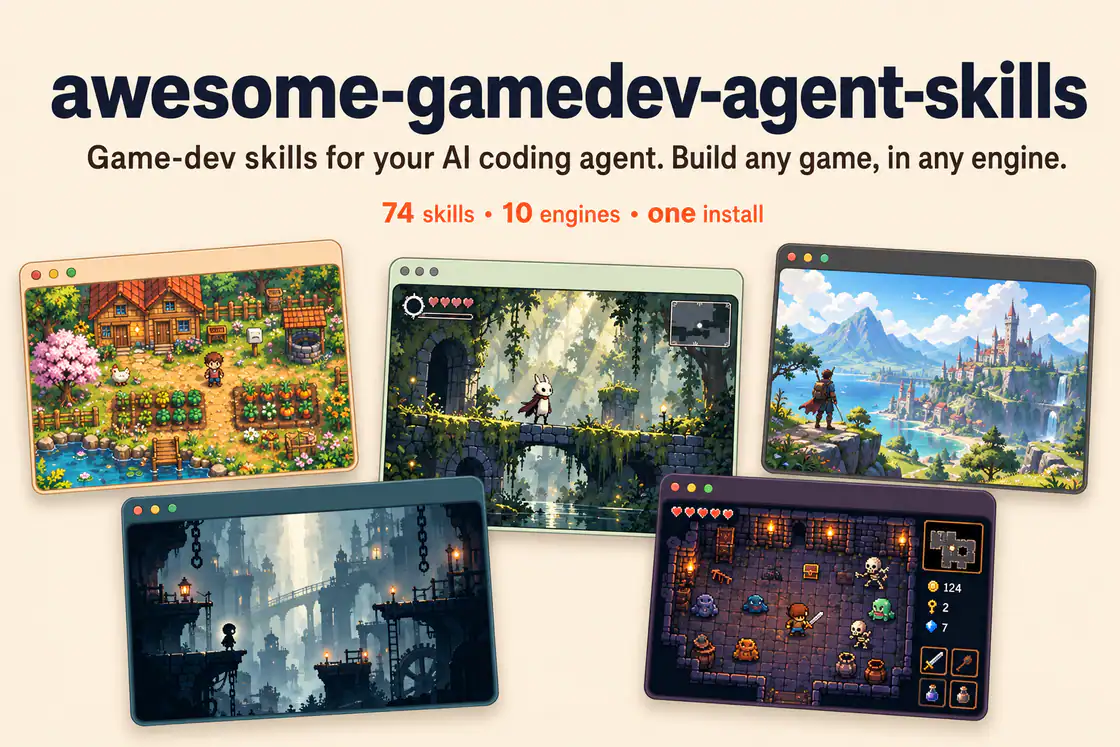
Author-provided banner showing five game scenes. Its 74-skill label reflects an earlier edition; the reviewed catalog contains 76 specialized skills plus a router.
Schermate del progettoInformazioni sullo Skill
Structure Rust games with components, resources, queries, schedules, plugins, and frame-independent systems.
SKILL.md
Autore: Abhishek Barali · gamedev-skills/awesome-gamedev-agent-skills · Apache-2.0 · SKILL.md @ c6ca6c4
---
name: bevy-ecs
description: >
  Builds and debugs Bevy 0.20 games in Rust: components, Query and Commands systems, schedules,
  States, observers and headless tests. Use when Cargo.toml depends on bevy, on a B0001
  query-conflict panic, or pre-0.20 code (EventReader, SpriteBundle). Not for engine-neutral AI,
  generation, physics or shaders (`game-ai`, `procedural-gen`, `physics-tuning`,
  `shader-programming`).
---

# Bevy ECS

Structure and debug a Bevy game around its ECS. New code targets **Bevy 0.20** (`bevy =
"0.20"`, which resolves to the latest 0.20.x patch). Bevy breaks APIs in every minor
release, so the version the project pins decides which syntax is right.

## When to use

- Wiring an `App`, defining components and resources, writing systems, ordering them,
  gating them on state or timers, or passing data with messages and observers.
- Fixing query-conflict panics, entities that seem missing, order bugs, or code copied from
  an older Bevy release.

**When not to use:** rendering pipelines, custom shaders, UI layout and audio are outside
this skill; AI and generation algorithms go to `game-ai` / `procedural-gen`.

## Workflow

1. **Read the pinned version first.** `Cargo.toml` gives the requirement and `Cargo.lock`
   the resolved `bevy` version. Keep it; a minor-release migration is a separate task that
   follows that release's migration guide. Never mix snippets from two minors.
2. **Model the data.** Per-entity data is a `#[derive(Component)]`; one-of-a-kind data
   (score, settings) is a `#[derive(Resource)]`. Spawn entities as tuples of components;
   required components fill in the rest (`commands.spawn(Camera2d)` adds `Transform`,
   `Camera` and friends).
3. **Write systems as plain functions** whose parameters declare access: `Query<D, F>`,
   `Res`/`ResMut`, `Commands`, `MessageReader`/`MessageWriter`, `Single`. Systems with
   non-conflicting access run in parallel, in no guaranteed order.
4. **Order only what must be ordered** (`.chain()`, `.before`/`.after`, `SystemSet`s) and
   gate with `run_if`. Group features into `Plugin`s. Scale motion by `time.delta_secs()`
   or put it in `FixedUpdate`.
5. **Verify.** Run `cargo check`, then `cargo test` with a headless `App` test (pattern
   below) for each rule you changed, then `cargo run` and read the first panic: Bevy
   reports conflicting system parameters when a schedule first runs, with an error code
   and a link. Report which of these you ran; a clean `cargo check` proves only that it
   compiles. When the change is visual, ask the user to run the game and report what they
   see.

## Patterns

### Spawning and filtering

```rust
#[derive(Component)]
struct Player;
#[derive(Component)]
struct Velocity(Vec2);

fn setup(mut commands: Commands) {
    commands.spawn(Camera2d);
    commands.spawn((Player, Velocity(Vec2::new(150.0, 0.0)), Transform::default()));
}

fn move_players(time: Res<Time>, mut q: Query<(&Velocity, &mut Transform)>) {
    for (v, mut t) in &mut q {
        t.translation += v.0.extend(0.0) * time.delta_secs();
    }
}

// Two &mut Transform queries in one system must be provably disjoint.
fn separate(
    mut players: Query<&mut Transform, With<Player>>,
    mut others: Query<&mut Transform, Without<Player>>,
) { /* ... */ }
```

### Ordering, run conditions, plugins

```rust
struct GameplayPlugin;
impl Plugin for GameplayPlugin {
    fn build(&self, app: &mut App) {
        app.insert_resource(Score(0))
            .add_systems(Startup, setup)
            // damage must resolve before deaths are checked
            .add_systems(Update, (apply_damage, check_deaths).chain())
            .add_systems(Update, spawn_wave.run_if(in_state(AppState::Playing)));
    }
}
```

### Headless test (the check to run)

`MinimalPlugins` gives time and a schedule runner with no window or GPU, so this runs under
plain `cargo test`. Drive time by hand to make movement deterministic.

```rust
#[cfg(test)]
mod tests {
    use super::*;
    use bevy::time::TimeUpdateStrategy;
    use std::time::Duration;

    #[test]
    fn player_moves_at_its_velocity() {
        let mut app = App::new();
        app.add_plugins(MinimalPlugins)
            .insert_resource(TimeUpdateStrategy::ManualDuration(Duration::from_millis(100)))
            .add_systems(Update, move_players);
        let id = app.world_mut().spawn((Velocity(Vec2::X * 10.0), Transform::default())).id();
        for _ in 0..5 {
            app.update();
        }
        // The first update has a zero delta, so 5 updates advance 4 x 0.1 s.
        let x = app.world().get::<Transform>(id).unwrap().translation.x;
        assert!((x - 4.0).abs() < 1e-4, "x = {x}");
    }
}
```

For whole-world assertions use `app.world_mut().query_filtered::<&Health, With<Player>>()`
and `.single(world)`. States need `bevy::state::app::StatesPlugin` next to `MinimalPlugins`.

## Gotchas

- **Panic `error[B0001]: Query<…> in system … accesses component(s) Transform in a way
  that conflicts with a previous system parameter`** → two queries in one system can both
  reach the same component mutably. Make them disjoint with `With`/`Without`, or use
  `ParamSet`.
- **`Query<EntityMut>` (or a broad `Query<Entity>` despawn loop) next to a `Res<T>`
  panics** → since 0.19 every resource lives on an entity tagged `IsResource`, so broad
  queries match resources too. The error is `B0002` when the `Res` comes after the query
  and `B0001` when it comes first. Query your own marker, or add `Without<IsResource>`
  (`use bevy::ecs::resource::IsResource`).
- **"conflicting implementations of trait `Component`"** after deriving `Resource` and
  `Component` on one type → since 0.19 `Resource` implies `Component`; derive `Resource`
  alone.
- **A spawned entity is missing from a query in the same system** → `Commands` are
  deferred to the next sync point. Read it in a later system, or order the reader after
  the spawner.
- **Something works only by luck of system order** → unordered systems run in an
  arbitrary but stable order, which an unrelated change can reshuffle. Add a real
  constraint, and shake out hidden ones in tests with `ScheduleBuildSettings::shuffle_seed`
  (0.20, `debug` feature; see the reference).
- **Headless test sees no movement on the first update** → the first `app.update()` has a
  zero delta. Run one extra update or assert on N−1 steps, as in the test above.
- **`delta_seconds()` not found** → renamed to `delta_secs()` / `elapsed_secs()` in 0.15;
  the old names are gone.
- **`Camera2dBundle` / `SpriteBundle` not found** → bundles were removed in 0.16. Spawn
  the components (`Camera2d`, `Sprite`, `Transform`) and let required components fill in.
- **`EventReader` / `EventWriter` / `add_event` not found** → buffered events became
  messages: `#[derive(Message)]`, `MessageReader`, `MessageWriter::write`,
  `app.add_message::<T>()`. Push-style events use `#[derive(Event)]` with observers.
- **`On<Add, Player>`: "struct takes 1 generic argument but 2 generic arguments were
  supplied"** → 0.20 moved the component into the lifecycle event: `On<Add<Player>>`
  (also `Insert<T>`, `Discard<T>`, `Remove<T>`, `Despawn<T>`).
- **`Pointer<Click>` not found in a picking observer** → 0.20 flattened pointer events:
  observe `On<PointerClick>` / `On<PointerPress>` and read `click.pointer.position`
  (a `Vec2`).
- **`OnExit`/`OnEnter` run when "switching" to the current state** → `NextState::set`
  always transitions. Use `set_if_different` (0.20 name). The old `set_if_neq` now
  resolves to an unrelated change-detection method and fails with "can't compare
  `NextState<S>`".
- **"`text` does not live long enough" from `Name::new(text.as_str())`** → since 0.20
  `Name` takes a `&'static str` or an owned `String`: `Name::new(format!("Enemy {id}"))`.
- **Overlapping sprites swap draw order after moving to 0.20** → sprites render through the
  `Mesh2d` path and equal-`z` order was never guaranteed. Give overlapping sprites distinct
  `z` values.

## References

- Read `references/queries-and-scheduling.md` when the task needs more than the patterns
  above: query filters and `single()`, `iter_many` results, `ParamSet`, schedules and
  `SystemSet`s, 0.20 weak ordering and schedule shuffling, `States` with `DespawnOnExit`,
  change detection and summary ticks, the `Commands` lifecycle and `despawn_all`, exclusive
  `&mut World` systems, and message/observer syntax.

## Related skills

- `game-ai`, `procedural-gen` — portable algorithms to implement as systems.
- `physics-tuning` — fixed-step and collision feel; `shader-programming` — shader technique.
- `pygame-core`, `love2d-core` — lighter engines for small projects.

## Version notes

Last verified: 2026-11-11.

- Bevy 0.20.0 shipped on 2026-10-08 and 0.20.1 on 2026-10-28. 0.20.1 is a maintenance
  release (bug fixes, no API changes this skill relies on); 0.19.0 shipped 2026-06-19.
- Every 0.20 API in this skill and its reference, the panic texts in Gotchas and the
  headless test were compiled and run against `bevy = "=0.20.1"` (default features off,
  `bevy_state`, `bevy_log`, `debug`) with Rust 1.99. `Camera2d`, `Sprite` and pointer
  events were checked against the release notes and migration guide only.
- Sources: [crates.io bevy](https://crates.io/crates/bevy),
  [v0.20.1 release](https://github.com/bevyengine/bevy/releases/tag/v0.20.1),
  [Bevy 0.20 release notes](https://bevy.org/news/bevy-0-20/),
  [0.19 to 0.20 migration guide](https://bevy.org/learn/migration-guides/0-19-to-0-20/).
Perché lo abbiamo scelto
Provides a focused workflow, implementation patterns, and common failure checks for bevy ecs game architecture. Pair it with the detected engine and any related systems required by the task.
A cosa serve
- Use when your game task needs bevy ecs game architecture.
What this skill helps you build
Structure Rust games with components, resources, queries, schedules, plugins, and frame-independent systems.
Patterns in the upstream playbook
The entrypoint covers: Cargo.toml + minimal App; Components, resources, and spawning; A system with a query + the Time resource; Query filters (With / Without / Changed); Resources: read and write; Ordering, run conditions, and plugins.
Use it in your project
Inspect the existing project
Describe the desired behavior and share the relevant project files, engine version, and current failure or target result.
Apply the focused playbook
Structure Rust games with components, resources, queries, schedules, plugins, and frame-independent systems.
Verify in the matching runtime
Run the project or workflow with its actual dependencies and check the changed behavior before accepting the result.
Original bevy-ecs instructionsEngine versions and upgrade policy
Shared collection installation
Install the complete upstream collection with its router and keep each skill’s bundled references, scripts, and assets. The dispatcher selects an engine and the smallest relevant task set; a member listing is a focused entry into that shared package.
| Comando | A cosa serve |
|---|---|
npx skills add gamedev-skills/awesome-gamedev-agent-skills | Keep the router and supporting skill folders available together. |
Prima di usarlo
- The matching game engine or framework and its normal development environment; this skill supplies agent instructions rather than an engine executable.
Agenti supportati
Fonti e riferimenti
Le fonti originali sono collegate qui sotto. Gli spunti pratici sono suggerimenti editoriali di SkillHey.