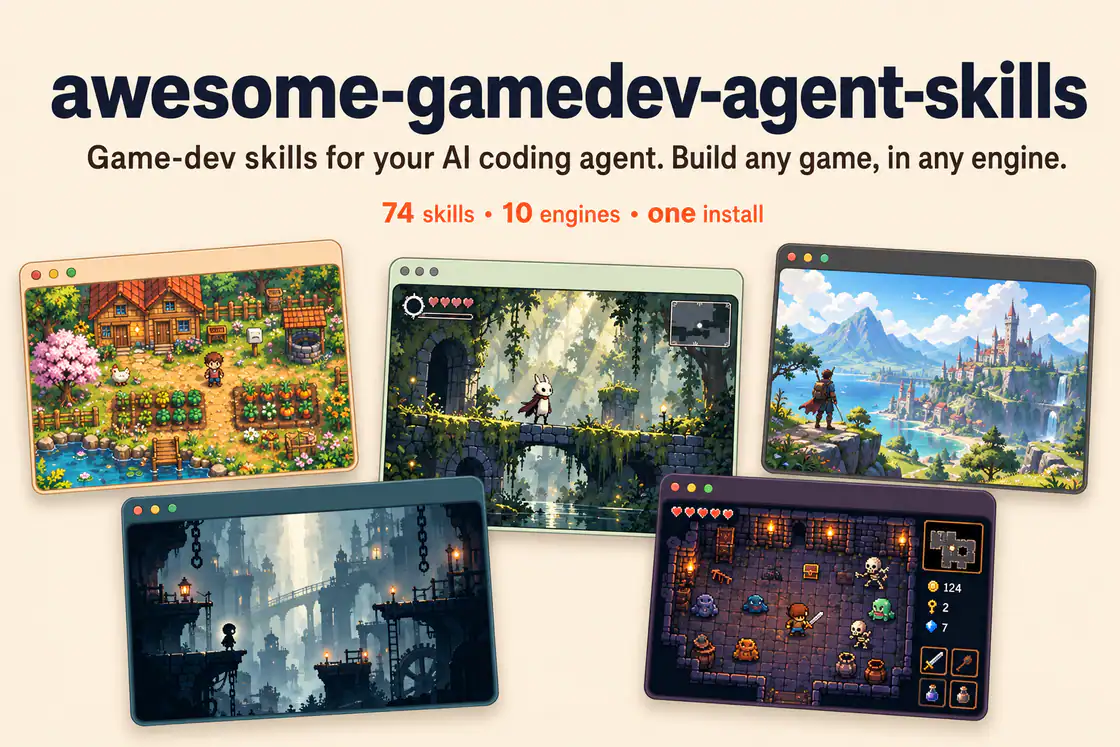
Author-provided banner showing five game scenes. Its 74-skill label reflects an earlier edition; the reviewed catalog contains 76 specialized skills plus a router.
Schermate del progettoInformazioni sullo Skill
Build node-based conversations with choices, conditions, variables, localization hooks, and Ink or Yarn Spinner integration.
SKILL.md
Autore: Abhishek Barali · gamedev-skills/awesome-gamedev-agent-skills · Apache-2.0 · SKILL.md @ c6ca6c4
---
name: dialogue-systems
description: >
  Builds engine-neutral branching dialogue with Ink, Yarn Spinner or a small JSON graph runner:
  lines, choices, conditions, variables and localization IDs. Use for NPC conversations, dialogue
  trees, barks, .ink or .yarn files, or dialogue that dead-ends. Not for visual-novel backlog and
  skip (`visual-novel`), quests (`rpg`) or text box widgets (`godot-ui-control`, `game-ui-ux`).
---

# Dialogue systems

Model conversations as a graph: nodes hold lines, choices branch, conditions gate options and
a variable store remembers what the player did. The first decision is build or adopt: Ink or
Yarn Spinner when writers need real flow control, a small data-driven runner when lines,
choices and flags are enough. Never build a new scripting language.

## When to use

- Designing branching conversations, choice menus or narrative state that later lines read.
- Choosing between Ink, Yarn Spinner and a custom JSON/resource graph.
- Wiring a dialogue runtime into the game loop: advance, show choices, run commands, persist.

**Not this skill:** VN presentation and flow (`visual-novel`), quest logic (`rpg`), widget
code (`godot-ui-control`, `roblox-ui`) and UI layout rules (`game-ui-ux`), persisting variables
across sessions (`save-systems`).

## Core workflow

1. **Inspect the project**: existing `.ink`/`.yarn`/`.yarnproject` files, an installed
   integration (ink-unity-integration, inkjs, Yarn Spinner for Unity or Godot), or a JSON graph.
   Keep what exists.
2. **Choose the tool.**
   - **Ink**: prose-first, weave and gather flow, read counts as free flags; best for
     dialogue-heavy or choose-your-own-adventure narrative.
   - **Yarn Spinner**: node-based, explicit `<<commands>>` dispatched to game code, built-in
     line IDs for localization; best for game-driven dialogue with many engine hooks.
   - **Custom runner**: a JSON graph plus about 100 lines of interpreter, when you need full
     control or no dependency.
3. **Define the node contract**: a node yields a line (speaker plus line ID), a choice set, a
   command, or an end/jump. The runner hands lines and choices to the UI and waits.
4. **Keep variables outside the UI** in one store the dialogue reads and writes, so cutscenes,
   tests and saves see the same state.
5. **Author line IDs from day one**; display text comes from a per-locale string table.
6. **Apply costs on the transition** (the choice), not on a node the player can revisit.
7. **Validate before handing back:**
   - Ink: `inklecate -o story.json story.ink` exits 1 on compile errors.
   - Yarn: `ysc compile story.yarn` reports errors; `ysc run --auto-advance story.yarn` plays it
     in the terminal.
   - Custom graph: run `validate_graph()` from `references/runner.md`; it must return no
     problems (missing targets, nodes without an exit, undeclared variables, unreachable nodes).
   - Then walk each choice path once with a script that picks choices in order.

## Patterns

### 1. Engine-neutral dialogue graph (data, not code)

```json
{
  "start": "guard_intro",
  "vars": { "gold": 0, "gate_open": false },
  "nodes": {
    "guard_intro": {
      "speaker": "Guard", "line": "DLG_GUARD_001",
      "choices": [
        { "text": "DLG_OPT_BRIBE", "to": "bribe", "if": "gold >= 50",
          "set": { "gold": "gold - 50" } },
        { "text": "DLG_OPT_LEAVE", "to": "end" }
      ]
    },
    "bribe": {
      "speaker": "Guard", "line": "DLG_GUARD_BRIBED",
      "set": { "gate_open": true },
      "next": "end"
    },
    "end": { "end": true }
  }
}
```

`line`/`text` are **string-table IDs** (localization), not literal text. `if`
gates a choice; `set` mutates the variable store. The gold cost sits on the
*choice*, so it is paid once per pick even if the `bribe` node is revisited; the
idempotent `gate_open` write can live on the node. A string `set` value is an
expression, so a literal string needs inner quotes: `"mood": "'angry'"`. The full
interpreter that walks this graph is in `references/runner.md`. Its variable store
starts from `vars`; replace those defaults with the player's saved narrative state
when starting a real conversation. Declare every referenced variable so unknown
names still expose authoring mistakes.

### 2. Runner step (a state machine over the graph)

```gdscript
# Godot 4.7. The runner holds the current node and a variable store. Every line
# waits for the player: the UI calls choose() or the continue callback.
func goto(id: String) -> void:
    current = graph.nodes[id]
    apply_set(current.get("set", {}))
    if current.get("end", false):
        ui.close()
        return
    if current.has("line"):
        ui.show_line(current.get("speaker", ""), localize(current.line))
    if current.has("choices"):
        var shown = current.choices.filter(func(c): return eval_cond(c.get("if", "")))
        ui.show_choices(shown)            # only choices whose condition passes
    elif current.has("next"):
        var next_id: String = current.next
        ui.show_continue(func(): goto(next_id))   # advance when the player continues

func choose(choice: Dictionary) -> void:   # called when the player picks a choice
    apply_set(choice.get("set", {}))       # write on the transition (revisit-safe)
    goto(choice.to)
```

### 3. Ink — branching with knots, choices, and variables (inkle)

```ink
// Ink: '*' = once-only choice, '+' = sticky. [bracketed] text shows only in the
// choice, not the printed result. '->' diverts; '-> END' stops the flow.
VAR gold = 60
-> guard_intro                    // the story starts at the top: divert into a knot

=== guard_intro ===
The guard blocks the gate.
* {gold >= 50} [Offer 50 gold]   "Here, take it."
    ~ gold = gold - 50
    The guard pockets it and steps aside. -> END
* [Leave]   You turn back. -> END
```

Ink tracks how often each knot was seen, so `{visited_knot}` is a built-in
condition. Variables are global (`VAR`) or temporary (`~ temp`).

### 4. Yarn Spinner — nodes, options, and commands (Yarn Spinner 3.x)

```yarn
title: GuardIntro
---
<<declare $gold = 60>>
<<declare $gate_open = false>>
Guard: You can't pass.
-> Offer 50 gold <<if $gold >= 50>>
    <<set $gold = $gold - 50>>
    Guard: ...fine. Go on through.
    <<set $gate_open to true>>
-> Leave
    Guard: Good choice.
===
```

Yarn lines may start with `Speaker:`; options use `->`; `<<set>>`/`<<declare>>`
manage `$variables`; `<<if>>` gates an option; `<<jump NodeName>>` moves between
nodes. Interpolate values in text with `{$gold}`. Declare every variable before first
use: an undeclared one still compiles (Yarn infers its type and a zero/false/empty
start value) with only a warning, which hides typos. These constructs are unchanged from
Yarn Spinner 2.x.

## Gotchas

- **Display strings in the script** instead of line IDs turn localization into a rewrite.
  Yarn tags lines with `#line:` IDs (`ysc tag` adds them); Ink has no line IDs, so tag lines
  yourself (`#id:guard_01`) or translate whole files.
- **A cost on a revisitable node** (`gold - 50` on `bribe`) is paid again on every visit. Put it
  on the choice, or guard it with a seen-flag.
- **Ink `*` versus `+`.** `*` choices vanish after one use, so a looping hub menu built from `*`
  empties itself. Hub menus use sticky `+`.
- **Ink choice text printed twice or not at all.** Text inside `[brackets]` shows only in the
  choice; text before them shows in both; text after only in the output.
- **Ink runtime loop stops after a choice.** After `ChooseChoiceIndex(i)` call `Continue()` (or
  `ContinueMaximally()`) again; the chosen branch prints nothing until you do.
- **Yarn undeclared variables compile with only a warning** and start at 0, false or "", which
  hides typos. `<<declare>>` everything.
- **Yarn 3 syntax in a Yarn 2 project** (`<<once>>`, `<<detour>>`, `when:` node groups) fails
  with "requires version 3 or later". Check the `.yarnproject` language version.
- **Ink Unity integration 2.0** imports `.ink` as an `InkFile` asset; code that loaded the old
  generated `.json` `TextAsset` must switch to `new Story(inkFile.storyJson)`.
- **Dead ends** (a node with no next, choices or end) silently stall the conversation. The
  validation step catches them.
- **`eval()` on dialogue expressions** runs arbitrary code from data files and mods. Use a
  whitelisting evaluator (the runner's `evaluate`).

## References

- `references/ink-and-yarn.md`: read when writing or reviewing `.ink` or `.yarn` (side-by-side
  syntax, Ink weave features, Yarn 3 additions, runtime integration and localization).
- `references/runner.md`: read when building or fixing a custom runner (schema, sandboxed
  `evaluate`, `DialogueRunner`, localization lookup, `validate_graph`).

## Related skills

- `save-systems`: persist narrative variables and seen-flags.
- `godot-resources`, `unity-scriptableobjects`: store dialogue as engine data.
- `godot-ui-control`, `game-ui-ux`: text boxes, portraits and choice buttons.
- `visual-novel`, `rpg`: genres that compose this skill.

## Version notes

Last verified: 2026-11-11.

- Ink 1.2.1 (May 2026) with ink-unity-integration 2.0.0 (July 2026); `inklecate` exits with code
  1 on compile errors and defaults its output to `<name>.ink.json`
  (https://github.com/inkle/ink/releases, inklecate `CommandLineTool.cs`).
- Yarn Spinner 3.2.1 compiler (May 2026), Yarn Spinner for Unity 3.2.8 (August 2026), `ysc`
  3.2.2 with `compile`, `run`, `tag` and `extract`
  (https://github.com/YarnSpinnerTool/YarnSpinner-Console).
- Yarn Spinner engine status: Unity stable; Godot GDScript edition in Early Access (3.3 docs,
  Godot 4.6 or later, not yet recommended for shipping); Godot C# edition marked
  work-in-progress without official support; Unreal listed as a pre-release for UE 5.7 or later
  (https://yarnspinner.dev, https://github.com/YarnSpinnerTool/YarnSpinner-Godot-GDScript,
  https://github.com/YarnSpinnerTool/YarnSpinner-Godot).
Perché lo abbiamo scelto
Provides a focused workflow, implementation patterns, and common failure checks for branching dialogue systems. Pair it with the detected engine and any related systems required by the task.
A cosa serve
- Use when your game task needs branching dialogue systems.
What this skill helps you build
Build node-based conversations with choices, conditions, variables, localization hooks, and Ink or Yarn Spinner integration.
Patterns in the upstream playbook
The entrypoint covers: Engine-neutral dialogue graph (data, not code); Runner step (a state machine over the graph); Ink — branching with knots, choices, and variables (inkle); Yarn Spinner — nodes, options, and commands (Yarn Spinner 3.x).
Use it in your project
Inspect the existing project
Describe the desired behavior and share the relevant project files, engine version, and current failure or target result.
Apply the focused playbook
Build node-based conversations with choices, conditions, variables, localization hooks, and Ink or Yarn Spinner integration.
Verify in the matching runtime
Run the project or workflow with its actual dependencies and check the changed behavior before accepting the result.
Original dialogue-systems instructionsEngine versions and upgrade policy
Shared collection installation
Install the complete upstream collection with its router and keep each skill’s bundled references, scripts, and assets. The dispatcher selects an engine and the smallest relevant task set; a member listing is a focused entry into that shared package.
| Comando | A cosa serve |
|---|---|
npx skills add gamedev-skills/awesome-gamedev-agent-skills | Keep the router and supporting skill folders available together. |
Prima di usarlo
- An existing or planned game and an Agent Skills-compatible coding agent. Pair engine-neutral concepts with the engine-specific entrypoints when writing code.
Agenti supportati
Fonti e riferimenti
Le fonti originali sono collegate qui sotto. Gli spunti pratici sono suggerimenti editoriali di SkillHey.