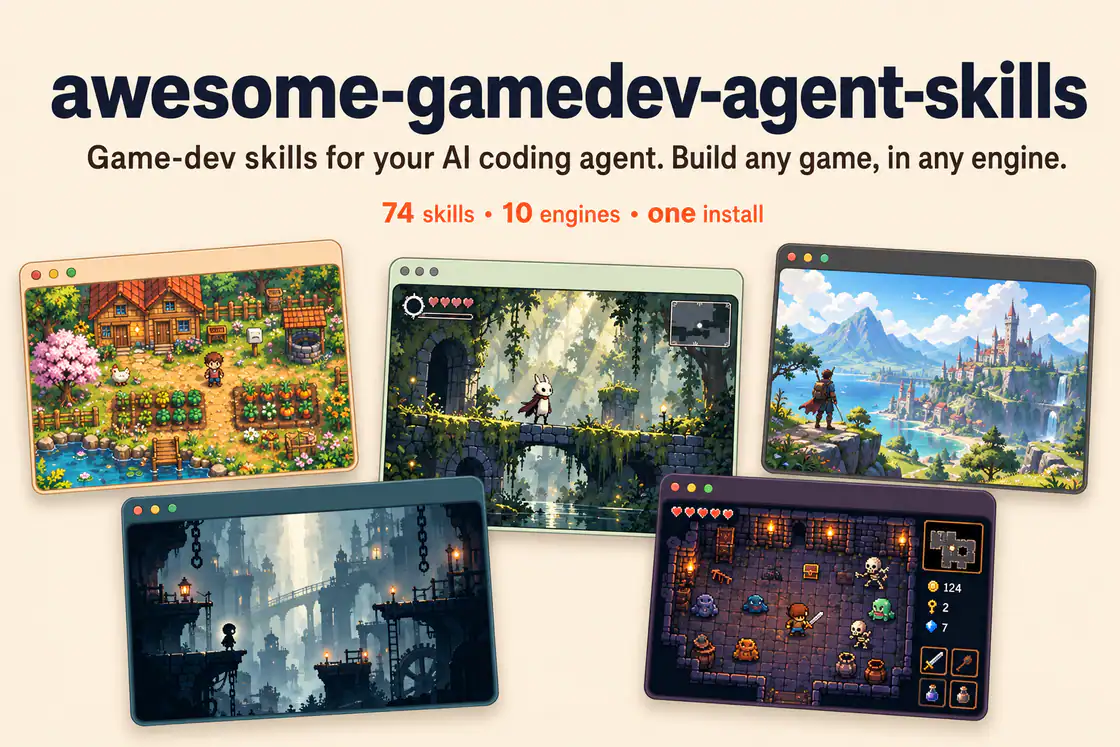
Author-provided banner showing five game scenes. Its 74-skill label reflects an earlier edition; the reviewed catalog contains 76 specialized skills plus a router.
Schermate del progettoInformazioni sullo Skill
Assemble Node3D scenes, cameras, light rigs, environments, mesh materials, and GridMap-based level blockouts.
SKILL.md
Autore: Abhishek Barali · gamedev-skills/awesome-gamedev-agent-skills · Apache-2.0 · SKILL.md @ c6ca6c4
---
name: godot-3d-essentials
description: >
  Godot 4.7 3D scene setup: Camera3D, lights, WorldEnvironment (sky, ambient, tonemap, fog),
  StandardMaterial3D, GridMap and local vs global transforms, with a headless scene check. Use
  when a 3D scene renders black or washed out, a mesh is invisible, or a child rotates on the
  wrong axis. Not for spatial shaders (`godot-shaders`), bodies and raycasts (`godot-physics`) or
  camera feel (`camera-systems`).
---

# Godot 3D Essentials (4.x)

Assemble a 3D scene that shows what it should in the running game: a current camera, real
lights, an environment, materials and GridMap blockouts. Targets **Godot 4.7**; read
`config/features` and `rendering/renderer/rendering_method` in `project.godot` first,
because Forward+, Mobile and Compatibility differ in what they draw.

## Workflow

1. **Check the renderer** (`rendering/renderer/rendering_method`: `forward_plus`, `mobile`
   or `gl_compatibility`). Mobile and Compatibility (web, low-end) have no SDFGI, SSIL,
   screen-space reflections or volumetric fog, and Mobile also has no SSAO, so do not build
   the look on them for those targets. The reference has the renderer table.
2. **One current `Camera3D` per viewport.** Set `current = true` on the one you want.
   Godot's convention is -Z forward, +Y up.
3. **Light the scene in the scene itself.** The editor viewport's preview sun and preview
   environment (toolbar toggles) do not exist at runtime. Add a `DirectionalLight3D` and a
   `WorldEnvironment` to the main scene, or set
   `rendering/environment/defaults/default_environment`.
4. **Configure the `Environment`:** background (sky or colour), ambient source, tonemapper,
   then post effects. Pick the tonemapper before tuning light energy or glow.
5. **Materials:** `StandardMaterial3D` on `MeshInstance3D.material_override` (all surfaces)
   or `set_surface_override_material(i, mat)`; `ShaderMaterial` for custom looks.
6. **Block out with `GridMap`** and a `MeshLibrary`.
7. **Verify before you finish** (paths are relative to this skill's folder):
   - If `godot-nodes-scenes` is installed, run `python3 ../godot-nodes-scenes/scripts/check_godot_project.py <project>`
     and fix every `ERROR`.
   - Run `godot --headless --path <project> --script <this skill>/assets/check_3d_scene.gd -- res://level.tscn`
     (no scene argument means the main scene). It needs no GPU and exits 1 when there is no
     current camera, nothing lights the meshes, a sky background has no `Sky`, or a mesh is
     hidden by the camera's `cull_mask`, behind the camera or past `far`.
   - To see a frame without a GPU, render one in software with Movie Maker:
     `xvfb-run -a godot --path <project> --rendering-driver opengl3 --write-movie shots/f.png --quit-after 3 res://level.tscn`
     writes `shots/f00000000.png` and up, which you can open and inspect. This draws with
     the Compatibility renderer, so judge Forward+ looks by asking the user for a screenshot.

## Patterns

### 1. Sun and environment from code

```gdscript
func _ready() -> void:
    var sun := DirectionalLight3D.new()
    sun.rotation_degrees = Vector3(-50, -30, 0)   # pointing down: -X tilt
    sun.shadow_enabled = true
    add_child(sun)

    var env := Environment.new()
    env.background_mode = Environment.BG_SKY
    env.sky = Sky.new()
    env.sky.sky_material = ProceduralSkyMaterial.new()
    env.ambient_light_source = Environment.AMBIENT_SOURCE_SKY
    env.tonemap_mode = Environment.TONE_MAPPER_AGX
    var world_env := WorldEnvironment.new()
    world_env.environment = env
    add_child(world_env)
```

Only one `WorldEnvironment` applies per world: the first one keeps control and a later one
is ignored without a runtime message (the editor shows a node warning).

### 2. A material from code

```gdscript
func tint(mesh: MeshInstance3D, color: Color) -> void:
    var mat := StandardMaterial3D.new()
    mat.albedo_color = color
    mat.roughness = 0.6
    mesh.material_override = mat   # wins over surface and mesh materials
```

### 3. Fill a GridMap from code

```gdscript
@onready var grid: GridMap = $GridMap   # mesh_library and cell_size set on the node

func build_floor(width: int, depth: int, item_id: int) -> void:
    for x in width:
        for z in depth:
            grid.set_cell_item(Vector3i(x, 0, z), item_id)   # -1 clears a cell
```

## Gotchas

- **Fine in the editor, dark or flat in the game** → the editor preview sun and environment
  were doing the lighting. Put a light and a `WorldEnvironment` in the scene.
- **Meshes are black** → nothing lights them. With no `Environment`, Forward+ and Mobile still
  add flat ambient from `rendering/environment/defaults/default_clear_color`, but
  Compatibility adds none, so the same scene is dim grey on desktop and black on web. An
  `Environment` with ambient `Disabled` or a black colour background does the same.
- **Plain grey screen** → no current camera, so you only see the clear colour; or the camera
  sits inside a mesh, whose back faces are culled.
- **Wrong camera renders** → a camera in an instanced sub-scene also has `current = true`.
  Keep `current` on one camera, or call `make_current()` after the scene loads.
- **A mesh is missing** → its `layers` do not overlap the camera's `cull_mask`, it is past
  `far`, or an imported mesh has flipped normals (try `cull_mode = CULL_DISABLED` to test).
- **`look_at()` errors and does nothing** → the target equals the node's position, the up
  vector is parallel to the view direction (looking straight down with `Vector3.UP`), or the
  node is not in the tree yet; use `look_at_from_position()` before `add_child()`.
- **Local vs global mix-ups** → `position`/`rotation` are parent-relative; `look_at()` and
  `global_position` are world space.
- **Non-uniform scale distorts collision and lights** → scale the mesh resource or use uniform
  scale on bodies.
- **Washed-out or blown highlights** → the tonemapper is `Linear` (no tonemapping) or glow
  thresholds are low; switch to AgX or Filmic and lower `glow_intensity`.
- **GridMap places nothing** → no `MeshLibrary` assigned, or the item id is not in it.

## References

- Read `references/scene-and-environment.md` for Transform3D math, camera projection and
  picking, the light table (including AreaLight3D costs), every Environment option, material
  fields, building a `MeshLibrary`, and baked or real-time GI.
- `assets/check_3d_scene.gd` is the headless check used in step 7.

## Related skills

- `camera-systems`: orbit, follow and first-person camera feel.
- `godot-physics`: 3D bodies, CharacterBody3D, areas and raycasts.
- `godot-shaders`: spatial shaders.
- `godot-animation`: AnimationTree for 3D characters.
- `performance-optimization`: draw calls, lights, LOD and frame budget.
- `fps-shooter`: a full 3D game on top of these pieces.

## Version notes

Last verified: 2026-11-11 against the Godot 4.7.2 class reference, renderer source and a
4.7.2 headless and Movie Maker run.

- Godot 4.7.2 (August 2026) is the current stable release; 4.8 is in beta.
- `AreaLight3D` and the dedicated MeshLibrary editor are new in 4.7.
- The AgX tonemapper exists since 4.4.
- No-environment ambient: Forward+/Mobile fall back to the default clear colour
  (`render_scene_data_rd.cpp`); Compatibility has no fallback (`rasterizer_scene_gles3.cpp`).
- Sources: [Godot releases](https://github.com/godotengine/godot/releases),
  [Godot 4.7 release page](https://godotengine.org/releases/4.7),
  [Environment and post-processing](https://docs.godotengine.org/en/stable/tutorials/3d/environment_and_post_processing.html),
  [render_scene_data_rd.cpp @ 4.7.2](https://github.com/godotengine/godot/blob/4.7.2-stable/servers/rendering/renderer_rd/storage_rd/render_scene_data_rd.cpp),
  [rasterizer_scene_gles3.cpp @ 4.7.2](https://github.com/godotengine/godot/blob/4.7.2-stable/drivers/gles3/rasterizer_scene_gles3.cpp).
Perché lo abbiamo scelto
Provides a focused workflow, implementation patterns, and common failure checks for godot 3d scene essentials. Pair it with the detected engine and any related systems required by the task.
A cosa serve
- Use when your game task needs godot 3d scene essentials.
What this skill helps you build
Assemble Node3D scenes, cameras, light rigs, environments, mesh materials, and GridMap-based level blockouts.
Patterns in the upstream playbook
The entrypoint covers: A follow camera (third-person, smoothed); Sun + environment in code; Assign a StandardMaterial3D from code; Place tiles into a GridMap.
Use it in your project
Inspect the existing project
Describe the desired behavior and share the relevant project files, engine version, and current failure or target result.
Apply the focused playbook
Assemble Node3D scenes, cameras, light rigs, environments, mesh materials, and GridMap-based level blockouts.
Verify in the matching runtime
Run the project or workflow with its actual dependencies and check the changed behavior before accepting the result.
Original godot-3d-essentials instructionsEngine versions and upgrade policy
Shared collection installation
Install the complete upstream collection with its router and keep each skill’s bundled references, scripts, and assets. The dispatcher selects an engine and the smallest relevant task set; a member listing is a focused entry into that shared package.
| Comando | A cosa serve |
|---|---|
npx skills add gamedev-skills/awesome-gamedev-agent-skills | Keep the router and supporting skill folders available together. |
Prima di usarlo
- A Godot project and matching editor/runtime; use the .NET build and SDK for C# work. Preserve the project’s existing engine version.
Agenti supportati
Fonti e riferimenti
Le fonti originali sono collegate qui sotto. Gli spunti pratici sono suggerimenti editoriali di SkillHey.