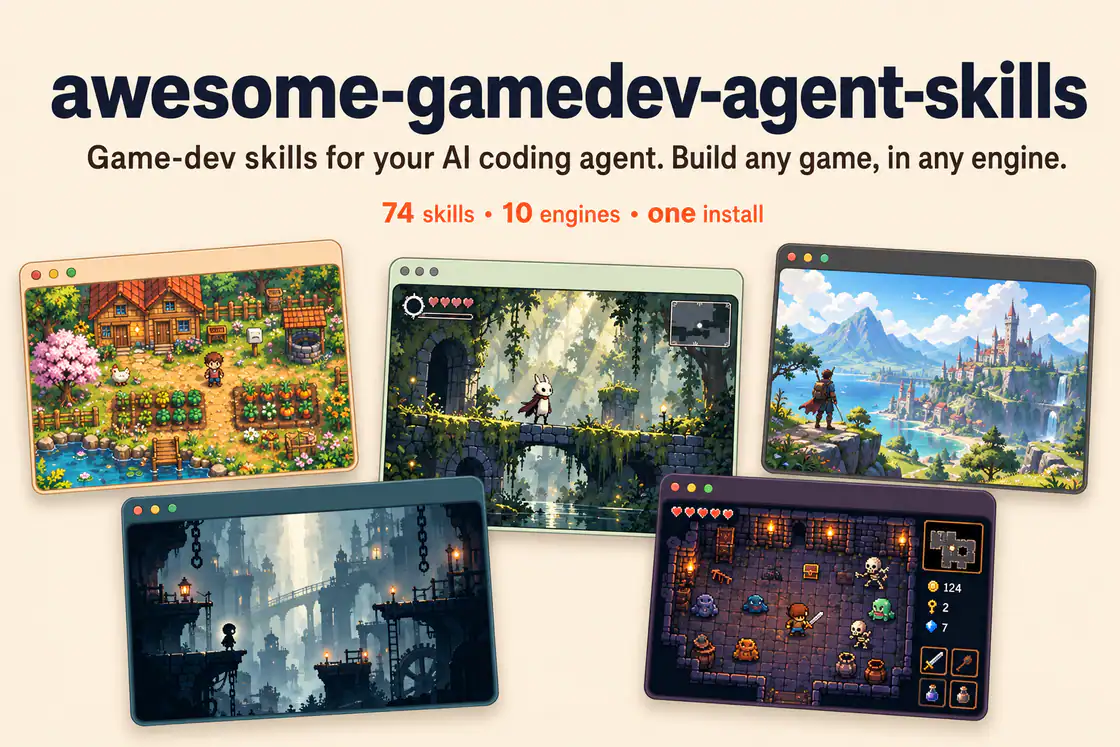
Author-provided banner showing five game scenes. Its 74-skill label reflects an earlier edition; the reviewed catalog contains 76 specialized skills plus a router.
Schermate del progettoInformazioni sullo Skill
Decouple node communication through typed signals, callable connections, one-shot events, bound arguments, and groups.
SKILL.md
Autore: Abhishek Barali · gamedev-skills/awesome-gamedev-agent-skills · Apache-2.0 · SKILL.md @ c6ca6c4
---
name: godot-signals-groups
description: >
  Godot 4.7 signals and node groups: typed signals, connect() with Callables, one-shot and
  deferred connections, event-bus autoloads and call_group broadcasts. Use when nodes must talk
  without hard references, a handler fires twice or never, or the log says "already connected".
  Not for GDScript syntax (`godot-gdscript`) or autoload setup (`godot-nodes-scenes`).
---

# Godot Signals & Groups (4.x)

Decouple nodes with signals and act on many nodes at once with groups, instead of
hard-coding references between scenes. Targets **Godot 4.7** (see Version notes).

## When to use

- A node must announce "something happened" (player died, item picked up, wave
  cleared) without holding references to its listeners.
- A whole category of nodes needs one call ("pause all enemies", "save every
  checkpoint").

**When *not* to use:** general GDScript syntax → `godot-gdscript`; scene structure and
autoload registration → `godot-nodes-scenes`.

## Core workflow

1. **Decide the direction.** A child or sub-scene *emits* upward; the parent *connects*.
   The child stays reusable and ignorant of who listens. Calling down into a child you own
   is a plain method call, not a signal.
2. **Declare typed signals** on the emitter and `emit()` exactly the declared arguments.
3. **Connect with a Callable** (`sig.connect(_on_sig)`). Use `CONNECT_ONE_SHOT` for
   fire-once and `bind()` to pass extra context.
4. **Editor connections and groups are plain text in the `.tscn`**, so you can read and
   write them without the Node dock:

   ```ini
   [node name="Goblin" type="CharacterBody2D" parent="Enemies" groups=["enemies"]]

   [connection signal="pressed" from="UI/StartButton" to="." method="_on_start_pressed"]
   ```

   `from`/`to` are paths relative to the scene root, and the `method` must exist on the
   `to` node's script.
5. **Use groups for broadcast**: `add_to_group()`, then `get_tree().call_group(...)` or
   iterate `get_nodes_in_group(...)`.
6. **For cross-scene events, put signals on an autoload** (event bus, see the reference).
7. **Check before you finish.**
   - If you edited `.tscn` connections, run the `godot-nodes-scenes` skill's
     `scripts/check_godot_project.py <project-dir>`; it reports `[connection]` entries
     whose `from`/`to` node does not exist. It does not check method names.
   - Prove the wiring at runtime with a headless test (Pattern 4), or smoke-run the scene
     and grep the log:

     ```bash
     godot --headless --path . --fixed-fps 60 --quit-after 300 --scene res://level.tscn > run.log 2>&1
     grep -nE "^ *(SCRIPT ERROR|ERROR):" run.log   # signal errors print as ERROR: lines
     ```

     With no Godot binary (`godot`, `godot4` or `$GODOT_BIN`), ask the user to run it and
     paste `run.log`.

## Patterns

### 1. Emit upward, connect from the parent

```gdscript
# coin.gd (reusable pickup; knows nothing about the player or HUD)
extends Area2D
signal collected(value: int)

func _ready() -> void:
    body_entered.connect(_on_body_entered)

func _on_body_entered(body: Node2D) -> void:
    if body.is_in_group("player"):
        collected.emit(10)
        queue_free()
```

```gdscript
# level.gd (the parent wires coins to game state)
func _ready() -> void:
    for coin in get_tree().get_nodes_in_group("coins"):
        coin.collected.connect(_on_coin_collected)

func _on_coin_collected(value: int) -> void:
    GameState.add_score(value)
```

### 2. One-shot and bound arguments

```gdscript
func _ready() -> void:
    $Door.opened.connect(_on_door_opened, CONNECT_ONE_SHOT)   # auto-disconnects
    # bind() appends its arguments after the signal's own arguments.
    $RedButton.pressed.connect(_on_button.bind("red"))

func _on_button(color: String) -> void:
    print("Pressed the %s button" % color)
```

### 3. Groups: broadcast to many nodes

```gdscript
func pause_all_enemies() -> void:
    get_tree().call_group("enemies", "set_paused", true)   # skips nodes without the method
```

### 4. Headless test that a signal reaches its handler once

```gdscript
# res://tests/test_signals.gd
extends SceneTree

func _initialize() -> void:
    var level: Node = load("res://level.tscn").instantiate()
    root.add_child(level)                          # parent _ready() connects the coins
    await process_frame
    var coin: Node = get_first_node_in_group("coins")
    var failed := 0
    if coin == null or coin.collected.get_connections().size() != 1:
        failed += 1
        push_error("coin.collected should have exactly one connection")
    print("Results: %d failed" % failed)
    quit(1 if failed > 0 else 0)
```

Run it with `godot --headless --path . --script res://tests/test_signals.gd` and read the
exit code. To check the handler's effect, emit the signal in the test and assert on the
state it should change.

## Gotchas

- **3.x connect signature is gone.** `connect("died", self, "_on_died")` →
  `died.connect(_on_died)`. `Object.connect("died", Callable(self, "_on_died"))` still
  works; the method-name string form does not. Prefer `died.emit()` over
  `emit_signal("died")`: a misspelled signal name is then a parse error, not a runtime one.
- **Connecting the same method twice** prints "Signal '...' is already connected to given
  callable" and keeps one connection. A new lambda each time is a *different* Callable, so
  it stacks silently and the handler fires once per connect. Keep the lambda in a variable,
  or guard with `if not sig.is_connected(cb):`.
- **A lambda outlives the nodes it captures.** Godot removes a connection when the emitter
  or the Callable's owner is freed, but a lambda belongs to the script that created it; one
  that captures a node freed later keeps firing and errors. Connect listener methods, or
  disconnect stored lambdas yourself.
- **Argument mismatch fails at emit time.** `emit()` does not validate arguments against
  the `signal` declaration; a handler with a different count logs "Error calling from
  signal ... Method expected N argument(s)". Declare typed params and emit exactly those.
- **Groups are global to the SceneTree**, not per scene. Two levels using the same group
  name share membership; namespace names if that matters.
- **`call_group` silently ignores nodes lacking the method**, so a typo fails quietly.
  Prefer a typed signal when the contract matters.
- **`[connection]` to a method that doesn't exist** is not caught by the checker; Godot
  prints a "Cannot connect" error when the scene is instantiated, so the smoke run catches
  it.
- **Handlers that change the tree during physics** ("flushing queries" errors) → connect
  with `CONNECT_DEFERRED` or `call_deferred` the change.

## References

- Read `references/signal-patterns.md` when you need every connection flag, `unbind()`,
  awaiting a signal with a timeout, safe disconnection and lambda lifetime, the full
  groups API, an autoload event bus, or a signals-vs-direct-calls decision.

## Related skills

- `godot-gdscript` for signal and `await` syntax.
- `godot-nodes-scenes` for autoloads used as global event buses, and the checker.
- `godot-gdscript-headless-testing` to keep Pattern 4 in CI.
- `game-ai` for state machines that drive and consume these events.

## Version notes

Last verified: 2026-11-11 against Godot 4.7.2-stable (released 2026-08-18).

- Variadic rest parameters (`..._args`), used by the reference's timeout helper, exist
  since GDScript 4.5.
- The "already connected" and "Method expected N argument(s)" messages match 4.7.2's
  `object.cpp` and `variant.cpp`.

Sources: [object.cpp @ 4.7.2-stable](https://github.com/godotengine/godot/blob/4.7.2-stable/core/object/object.cpp),
[variant.cpp @ 4.7.2-stable](https://github.com/godotengine/godot/blob/4.7.2-stable/core/variant/variant.cpp),
[Signal @ 4.7.2-stable](https://github.com/godotengine/godot/blob/4.7.2-stable/doc/classes/Signal.xml),
[Using signals](https://docs.godotengine.org/en/stable/getting_started/step_by_step/signals.html).
Perché lo abbiamo scelto
Provides a focused workflow, implementation patterns, and common failure checks for godot signals & groups. Pair it with the detected engine and any related systems required by the task.
A cosa serve
- Use when your game task needs godot signals & groups.
What this skill helps you build
Decouple node communication through typed signals, callable connections, one-shot events, bound arguments, and groups.
Patterns in the upstream playbook
The entrypoint covers: Emit upward, connect from the parent; Connect flags: one-shot and bind extra arguments; Groups: broadcast to many nodes; Await a signal inline.
Use it in your project
Inspect the existing project
Describe the desired behavior and share the relevant project files, engine version, and current failure or target result.
Apply the focused playbook
Decouple node communication through typed signals, callable connections, one-shot events, bound arguments, and groups.
Verify in the matching runtime
Run the project or workflow with its actual dependencies and check the changed behavior before accepting the result.
Original godot-signals-groups instructionsEngine versions and upgrade policy
Shared collection installation
Install the complete upstream collection with its router and keep each skill’s bundled references, scripts, and assets. The dispatcher selects an engine and the smallest relevant task set; a member listing is a focused entry into that shared package.
| Comando | A cosa serve |
|---|---|
npx skills add gamedev-skills/awesome-gamedev-agent-skills | Keep the router and supporting skill folders available together. |
Prima di usarlo
- A Godot project and matching editor/runtime; use the .NET build and SDK for C# work. Preserve the project’s existing engine version.
Agenti supportati
Fonti e riferimenti
Le fonti originali sono collegate qui sotto. Gli spunti pratici sono suggerimenti editoriali di SkillHey.