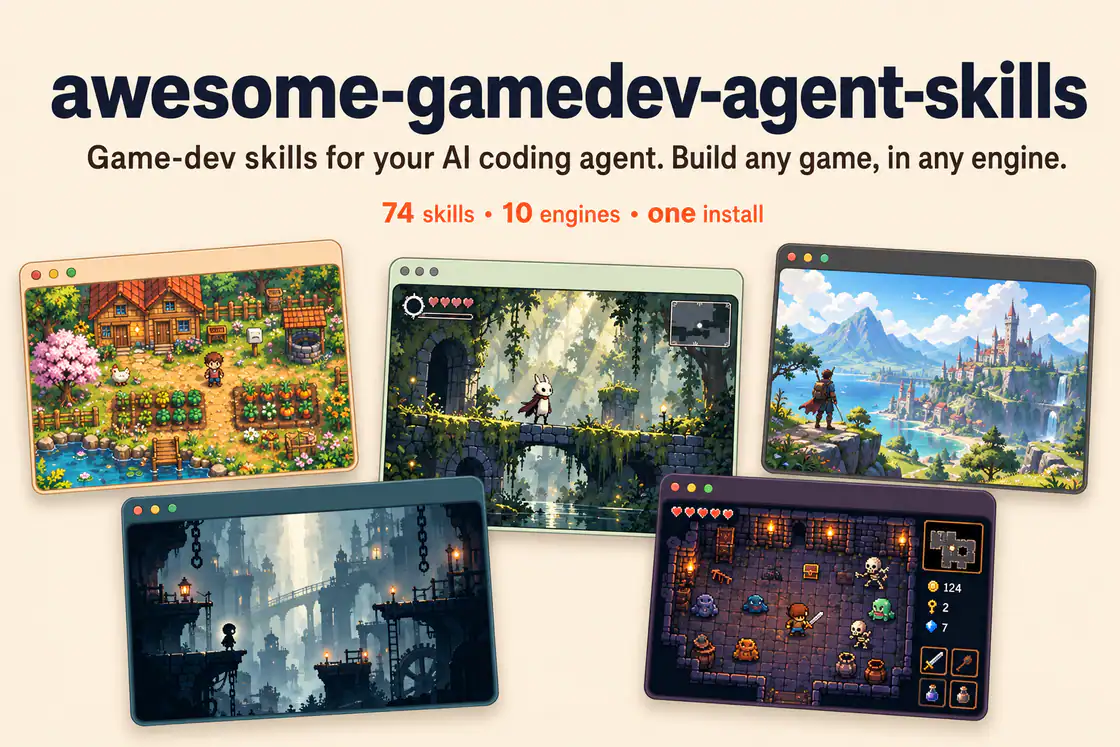
Author-provided banner showing five game scenes. Its 74-skill label reflects an earlier edition; the reviewed catalog contains 76 specialized skills plus a router.
Schermate del progettoInformazioni sullo Skill
Separate board state from rendering and implement move rules, match detection, cascades, scoring, and undo.
SKILL.md
Autore: Abhishek Barali · gamedev-skills/awesome-gamedev-agent-skills · Apache-2.0 · SKILL.md @ c6ca6c4
---
name: puzzle
description: >
  Designs grid and logic puzzle games in any engine: match-3 cascades, Sokoban pushing,
  unique-solution grids (nonogram, Sudoku), exact undo and solver-checked levels. Use for a Candy
  Crush-like, Sokoban or Picross, or broken cascades, drifting undo or unsolvable levels. Not for
  physics puzzlers (`platformer`, `physics-tuning`) or card games (`card-game`).
---

# Puzzle

Owns discrete board puzzles: the rules engine, resolution order, undo, solvability and level
difficulty. The board model is the only truth; the view replays the list of changes each move
produced.

## When to use

- The player changes a discrete board with moves and the board resolves by rules: matching,
  pushing, sliding, merging, or pure logic deduction.
- Writing a solver or generator, ordering levels by difficulty, fixing undo or soft-locks.

**When not to use:** physics-driven puzzles and puzzle platformers (`platformer`,
`physics-tuning`); turn-based dungeon runs (`roguelike`); card zones (`card-game`).

## Workflow

1. **Model the board as plain data** (grid of cell values plus counters and RNG state) with a
   pure `apply(state, move) -> (state, events)` function. The view animates `events`.
2. **Write the rule resolver** for the family (below) and loop until stable where rules cascade.
3. **Undo from day one:** push a snapshot (or invertible command) before every move, including
   score, move counters and RNG state. Add restart, which thinky puzzles need as much as undo.
4. **Write a solver early** (BFS or A* over states for push and slide puzzles, a line or
   constraint solver for logic grids, move-existence for match-3). It validates every level,
   measures difficulty and powers hints.
5. **Order levels by measured difficulty,** introducing one mechanic at a time: a level that
   teaches it alone, a level that tests it, then one that combines it with a known mechanic.
6. **Check it.** Run these in the project's test runner and report the numbers:
   - the solver solves every shipped level; print minimum moves and states explored per level
     and flag levels whose order disagrees with difficulty;
   - logic grids: the solver finds exactly one solution without guessing;
   - undo: hash the full state, make a random move, undo, and compare hashes (1,000 times);
   - match-3: 10,000 random boards after generation have no ready-made match and at least one
     valid move;
   - input during a resolving cascade is ignored or queued, never applied mid-resolution.

## Rule families and numbers

| Family | Rules that matter | Starting numbers |
|--------|------------------|------------------|
| Match-3 | 4 in a line makes a line-clear piece, an L or T of 5 makes an area bomb, 5 in a line makes a colour bomb (Candy Crush naming) | 8x8 or 9x9 board, 5-6 colours (fewer colours, more cascades), hint after about 5 s idle |
| Push (Sokoban) | push one box, never pull; dead squares (non-goal corners, wall edges with no goal) | difficulty from minimum pushes and states explored, not board size |
| Slide (15-puzzle) | half of random arrangements are unsolvable | check inversion parity (refs §7) |
| Merge (2048) | slide, merge equal neighbours once per move, then spawn | the original spawns a 2 with 90% chance and a 4 with 10% |
| Logic grids | exactly one solution, reachable by deduction alone | grade difficulty by the hardest deduction rule the solver needed |
| Rule-changing (Baba Is You style) | rules are board objects; re-derive the rule set after every move, before win checks | test every rule word against every object type |

No-guess generation is standard for logic puzzles: Simon Tatham's Mines, for example,
ensures by default that the whole grid can be deduced from the first opening.

## Pattern 1: resolve to stability (match-3)

```python
def resolve(board, rng):
    events, chain = [], 0
    while True:
        matches = find_matches(board)              # runs of 3+, rows and columns
        if not matches:
            break
        chain += 1
        specials = specials_from(matches)          # decide BEFORE clearing (shape and swap cell)
        events.append(("clear", matches, chain))
        clear(board, matches); place(board, specials)
        events.append(("fall", apply_gravity(board)))
        events.append(("spawn", refill(board, rng)))   # seeded RNG, saved in undo snapshots
    if not has_valid_move(board):
        events.append(("shuffle", reshuffle_until_playable(board, rng)))
    return events
```

## Gotchas

- **Cascades miss matches** → resolution ran once. Loop until no matches (Pattern 1).
- **Special piece appears in the wrong cell** → specials decided after clearing. Decide from
  the match shape and the swapped cell first.
- **Undo rerolls the refill** → RNG state not in the snapshot; players learn to undo for better
  pieces. Snapshot board, score, counters and RNG state together.
- **Visuals desync from the board** → animation code reads a half-updated board. Animate the
  event list; lock or queue input until it finishes.
- **Soft-lock with no moves** → no deadlock check. Detect and reshuffle (keep piece counts, no
  free matches) or end the level.
- **Unsolvable generated level** → random scramble with no check. Generate backwards from the
  solved state with inverse moves (pull for Sokoban), or generate and solve, with the seed kept.
- **Two valid answers in a logic grid** → generator never checked uniqueness. Run the solver
  for a second solution and reject or add a clue.
- **Difficulty jumps** → levels ordered by designer guess. Order by solver effort and teach one
  mechanic at a time.
- **Box pushed into a dead corner with no hint** → no dead-square detection. Precompute dead
  squares and offer restart or flag them.

## References

- `references/board-and-resolution.md`: read when writing match-3 gravity, refill and
  deadlock code, cascade scoring, Sokoban pushing, logic-grid validity checks, undo strategies,
  solvable generation and sliding-tile parity, or input locking during animation.

Related: `level-design` (teaching order), `procedural-gen` (seeded generators), `save-systems`
(progress, daily seeds), `game-feel` (match pops, chain feedback), `godot-tilemap` or
`unity-tilemap-2d` (board rendering).

## Version notes

Last verified: 2026-11-11.

- 2048 spawn odds: `Math.random() < 0.9 ? 2 : 4` in
  https://github.com/gabrielecirulli/2048/blob/master/js/game_manager.js.
- Simon Tatham's Mines "Ensure solubility" option, on by default:
  https://www.chiark.greenend.org.uk/~sgtatham/puzzles/doc/mines.html.
- Match-3 board size, colour count and hint delay are common practice, not measured.
Perché lo abbiamo scelto
Provides a focused workflow, implementation patterns, and common failure checks for grid & match-3 puzzle games. Pair it with the detected engine and any related systems required by the task.
A cosa serve
- Use when your game task needs grid & match-3 puzzle games.
What this skill helps you build
Separate board state from rendering and implement move rules, match detection, cascades, scoring, and undo.
Patterns in the upstream playbook
The entrypoint covers: Board model + match detection (logic separate from visuals); Resolve → collapse → refill → cascade (repeat to stability); Undo via state snapshot or command.
Use it in your project
Inspect the existing project
Describe the desired behavior and share the relevant project files, engine version, and current failure or target result.
Apply the focused playbook
Separate board state from rendering and implement move rules, match detection, cascades, scoring, and undo.
Verify in the matching runtime
Run the project or workflow with its actual dependencies and check the changed behavior before accepting the result.
Original puzzle instructionsEngine versions and upgrade policy
Shared collection installation
Install the complete upstream collection with its router and keep each skill’s bundled references, scripts, and assets. The dispatcher selects an engine and the smallest relevant task set; a member listing is a focused entry into that shared package.
| Comando | A cosa serve |
|---|---|
npx skills add gamedev-skills/awesome-gamedev-agent-skills | Keep the router and supporting skill folders available together. |
Prima di usarlo
- A chosen engine and its development environment. Genre playbooks compose engine and discipline skills from the same collection.
Agenti supportati
Fonti e riferimenti
Le fonti originali sono collegate qui sotto. Gli spunti pratici sono suggerimenti editoriali di SkillHey.