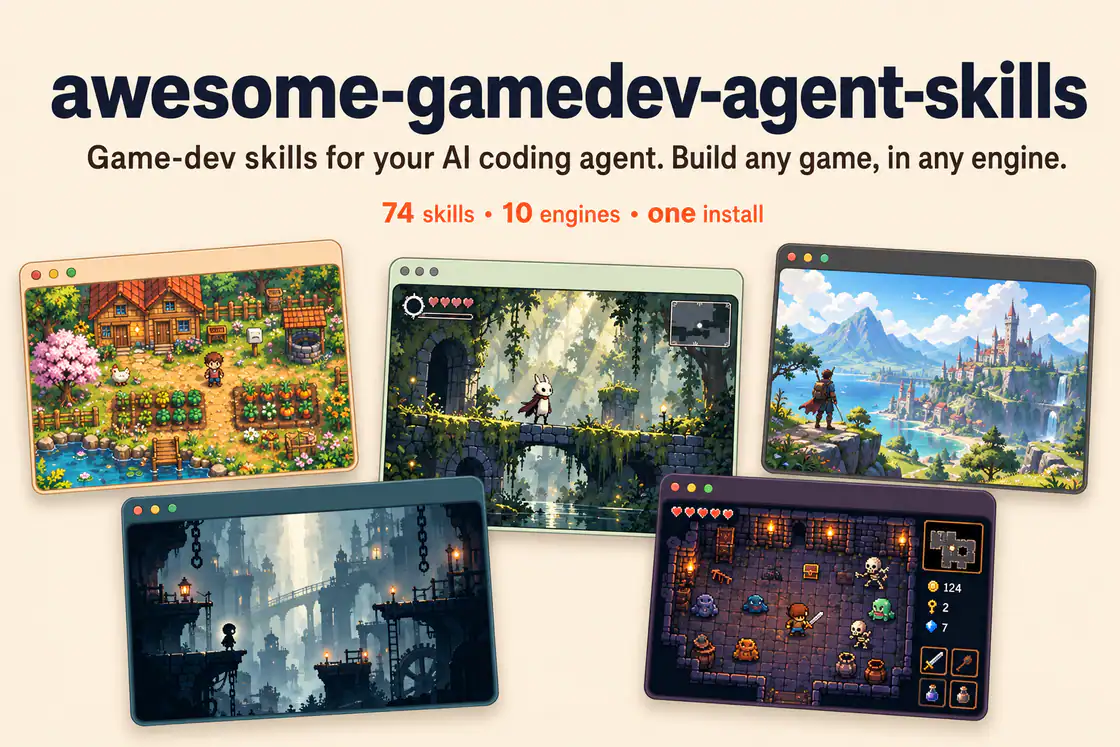
Author-provided banner showing five game scenes. Its 74-skill label reflects an earlier edition; the reviewed catalog contains 76 specialized skills plus a router.
Schermate del progettoInformazioni sullo Skill
Configure assemblies, constraints, collision policies, raycasts, overlap queries, forces, cleanup, and network ownership.
SKILL.md
Autore: Abhishek Barali · gamedev-skills/awesome-gamedev-agent-skills · Apache-2.0 · SKILL.md @ c6ca6c4
---
name: roblox-physics
description: >
  Roblox physics and spatial queries: assemblies, constraints, collision groups, Raycast and
  Shapecast, and network ownership. Use when parts fall through or jitter, Touched is unreliable,
  a ray hits the shooter, or BodyMovers need replacing. Not for hit legitimacy
  (`roblox-networking`), Humanoid movement (`roblox-characters`) or engine-neutral tuning
  (`physics-tuning`).
---

# Roblox physics

Simulation, character control, hit detection and visual-only motion are different jobs. Pick the
mechanism first, then the API. Whether a hit counts is a server validation decision owned by
`roblox-networking`; this skill supplies the queries it uses.

## Decide the mechanism

| Goal | Mechanism |
|---|---|
| sustained physical interaction | unanchored assembly plus modern constraints or forces |
| one-off physical change | `ApplyImpulse` / `ApplyAngularImpulse` |
| kinematic platform or path | scripted pivot or CFrame with an explicit passenger policy |
| character locomotion | Humanoid or Character Controller Library (`roblox-characters`) |
| hit test | server raycast, shapecast, or overlap with explicit filters |
| cosmetic trail or recoil | local visual motion; no gameplay authority |

## Workflow

1. **Inspect the mechanism.** In Studio, turn on the assembly, constraint and network-owner
   visualizations; or read `part.AssemblyRootPart`, `part.AssemblyMass`, `part.Anchored` and
   `part:GetNetworkOwner()` from code. Identify the assembly root and who should own it.
2. **Write the interaction policy.** A collision-group matrix, then `CanCollide`, `CanTouch` and
   `CanQuery` decided separately per role. Register groups once with
   `Workspace:RegisterCollisionGroup()` and `CollisionGroupSetCollidable()` (or the Collision
   Groups editor), from a single script so assignment never races registration.
3. **Choose simulation or query.** A ray for a line, a shapecast for a moving volume, an overlap for
   a static volume, and simulation contacts only when a physical response is wanted. `.Touched` is
   neither reliable nor secure as a hit detector.
4. **Apply motion at assembly level.** Forces on any part act on the whole assembly. Use
   `LinearVelocity`, `AngularVelocity`, `VectorForce`, `AlignPosition` and `AlignOrientation`;
   migrate BodyMovers when you touch that system.
5. **Set ownership deliberately.** Server-own gameplay-critical loose assemblies when needed;
   client ownership improves response but never authorizes results.
6. **Bound cost and lifetime.** Reuse query params, cap query frequency and result counts, and
   destroy temporary constraints, attachments and connections together.
7. **Check from code.** With the Studio MCP server connected, start play and use `execute_luau` on
   the `Server` datamodel to print the facts the change depends on: `AssemblyRootPart`,
   `AssemblyMass`, `GetNetworkOwner()`, `workspace:CollisionGroupsAreCollidable(a, b)`, and the
   result of one test query; then read `get_console_output`. Without MCP, ask the user to run the
   same snippet from the Command Bar during play and paste the Output. Fast movers, ownership
   hand-off and two-client interaction need a Server & Clients run.

## Pattern: filtered server raycast

```lua
local Workspace = game:GetService("Workspace")

local params = RaycastParams.new()
params.FilterType = Enum.RaycastFilterType.Exclude
params.FilterDescendantsInstances = {shooterCharacter}
params.IgnoreWater = true
params.CollisionGroup = "WeaponQuery"

local direction = aimDirection.Unit * MAX_RANGE   -- direction length is the range
local result = Workspace:Raycast(muzzlePosition, direction, params)
if result then
    local model = result.Instance:FindFirstAncestorOfClass("Model")
    local humanoid = model and model:FindFirstChildOfClass("Humanoid")
    if humanoid and serverCanDamage(shooter, model, result.Position) then
        humanoid:TakeDamage(serverWeaponDamage(shooter))
    end
end
```

`muzzlePosition` and `aimDirection` must come from server-known character and weapon state. A
raycast from a client-supplied origin is not validation (see `roblox-networking`).

## Pattern: overlap volume with explicit policy

```lua
local params = OverlapParams.new()
params.FilterType = Enum.RaycastFilterType.Exclude
params.FilterDescendantsInstances = {sourceCharacter}
params.CollisionGroup = "DamageQuery"
params.MaxParts = 64

local seen: {[Model]: boolean} = {}
for _, part in Workspace:GetPartBoundsInBox(hitboxCFrame, hitboxSize, params) do
    local model = part:FindFirstAncestorOfClass("Model")
    if model and not seen[model] then
        seen[model] = true
        validateAndApplyHit(model)
    end
end
```

Bounds queries test bounding boxes and return several parts per target, so deduplicate by model.
`WorldRoot:GetPartsInPart()` is exact but costs more. `OverlapParams.RespectCanCollide` switches
the query from `CanQuery` to `CanCollide`; set it on purpose or it silently overrides the flag
policy.

## Assemblies, force, and ownership

- Welded parts form one rigid assembly; force, impulse, velocity, mass and ownership act on the
  assembly. One anchored part anchors the whole assembly.
- Tune forces and impulses from intended acceleration times `AssemblyMass`, not by trial values.
- Automatic ownership moves nearby unanchored assemblies to clients. Call `SetNetworkOwner(nil)`
  for critical objects, then measure the server cost and responsiveness. Re-check ownership after
  anchoring changes; it is not always kept.
- A client owner can fake physical results and `.Touched` events. The server validates
  consequential hits, positions, timing and permissions independently.
- If `Workspace.AuthorityMode` is `Server`, the server owns simulation and clients predict nearby
  assemblies with rollback. Drive predicted forces and constraints from
  `RunService:BindToSimulation()` on both sides, not from `Heartbeat` or client-only scripts, and
  expect custom physics scripts to need changes when a place switches modes.

## Gotchas

| Symptom | Likely cause | Remedy |
|---|---|---|
| welded mechanism will not move | one part anchored | inspect the whole assembly; anchor only world roots |
| force too strong or too weak | assembly mass ignored | read `AssemblyMass`; size force for the intended acceleration |
| fast projectile misses | discrete contact sampling | swept query (`Blockcast`, `Spherecast`, `Shapecast`) per step; see `physics-tuning` |
| ray hits the shooter or effects | no filter or query group | reuse explicit params and a query collision group |
| one target damaged many times | overlap returned several body parts | deduplicate by model; attack ID or cooldown |
| exploit fires impossible touches | client owns the relevant part | server query plus context validation; deliberate ownership |
| invisible trigger blocks players or queries miss it | the three Can* flags conflated | set `CanCollide`, `CanTouch`, `CanQuery` independently |
| attachments pile up | temporary constraint lifecycle missing | create and destroy constraint, attachments and connections together |
| collision group "does not exist" at startup | groups registered from several scripts | register in one script before assigning |

## Resources

- Read `references/queries-and-ownership.md` when designing collision groups, query filters, a
  vehicle or other ownership-sensitive object, or a BodyMover migration; it has the flag roles,
  query choice, ownership debugging, and the physics test matrix.

## Related skills

- `physics-tuning`: timestep, jitter, tunnelling, mass ratios, and feel.
- `roblox-characters`: Humanoid and custom movement across respawns.
- `roblox-networking`: authoritative validation of client-requested physical actions.
- `roblox-studio-workflow`: visualization, Output, and multi-client verification.

## Version notes

Last verified: 2026-11-11.

- Collision groups are registered on `Workspace` or a `WorldModel` (`WorldRoot` methods); the
  `PhysicsService` collision-group methods are deprecated. A `WorldModel` keeps its own matrix
  unless `UseWorkspaceCollisionGroups` is on.
- BodyMovers (`BodyPosition`, `BodyVelocity`, `BodyGyro` and others) are deprecated in favour of
  the constraint-based movers.
- Server Authority reached full release in July 2026; see `roblox-networking` for its rules.
- To re-check an API: append `.md` to its Creator Hub URL, or start from
  `https://create.roblox.com/docs/llms.txt`.

Sources: `https://create.roblox.com/docs/physics/assemblies`,
`https://create.roblox.com/docs/physics/network-ownership`,
`https://create.roblox.com/docs/workspace/raycasting`,
`https://create.roblox.com/docs/workspace/collisions`,
`https://create.roblox.com/docs/projects/server-authority`.
Perché lo abbiamo scelto
Provides a focused workflow, implementation patterns, and common failure checks for roblox physics & hit detection. Pair it with the detected engine and any related systems required by the task.
A cosa serve
- Use when your game task needs roblox physics & hit detection.
What this skill helps you build
Configure assemblies, constraints, collision policies, raycasts, overlap queries, forces, cleanup, and network ownership.
Use it in your project
Inspect the existing project
Describe the desired behavior and share the relevant project files, engine version, and current failure or target result.
Apply the focused playbook
Configure assemblies, constraints, collision policies, raycasts, overlap queries, forces, cleanup, and network ownership.
Verify in the matching runtime
Run the project or workflow with its actual dependencies and check the changed behavior before accepting the result.
Original roblox-physics instructionsEngine versions and upgrade policy
Shared collection installation
Install the complete upstream collection with its router and keep each skill’s bundled references, scripts, and assets. The dispatcher selects an engine and the smallest relevant task set; a member listing is a focused entry into that shared package.
| Comando | A cosa serve |
|---|---|
npx skills add gamedev-skills/awesome-gamedev-agent-skills | Keep the router and supporting skill folders available together. |
Prima di usarlo
- A Roblox Studio place or Rojo project and access to the relevant server/client test modes. Persistent data and publishing use your own Roblox account.
Agenti supportati
Fonti e riferimenti
Le fonti originali sono collegate qui sotto. Gli spunti pratici sono suggerimenti editoriali di SkillHey.