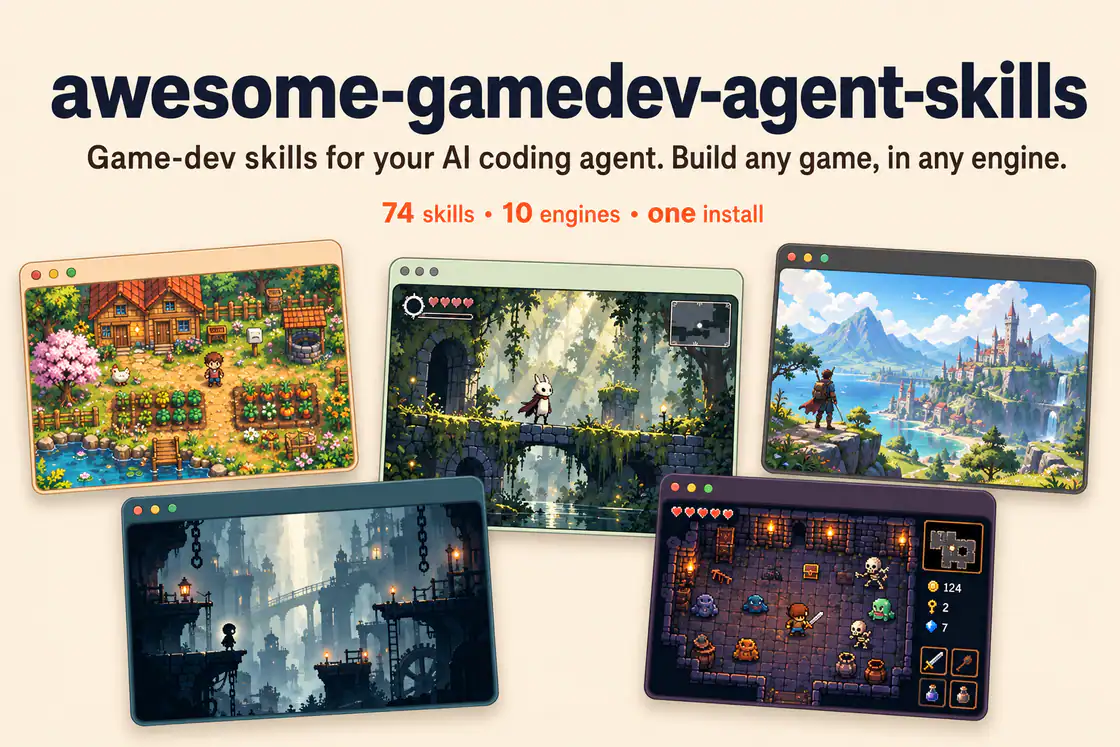
Author-provided banner showing five game scenes. Its 74-skill label reflects an earlier edition; the reviewed catalog contains 76 specialized skills plus a router.
Schermate del progettoInformazioni sullo Skill
Design resource gathering, needs, inventories, atomic crafting recipes, tool tiers, technology, and base building.
SKILL.md
Autore: Abhishek Barali · gamedev-skills/awesome-gamedev-agent-skills · Apache-2.0 · SKILL.md @ c6ca6c4
---
name: survival-crafting
description: >
  Designs survival-crafting loops in any engine: gathering, recipes and tech trees, carry weight,
  spoilage, hunger and temperature, and base building. Use for a Minecraft-, Valheim- or Don't
  Starve-like, or crafting that eats materials or needs that feel like chores. Not for RPG
  equipment stats (`rpg`), terrain generation (`procedural-gen`) or save files (`save-systems`).
---

# Survival crafting

Owns the gather, craft, build and survive loop and the pressure systems around it: needs,
scarcity, logistics and escalating threats. Each tier of tools must open the next tier of
resources; when that ladder breaks, the game turns into chores.

## When to use

- The player gathers resources, crafts tools and structures, manages needs and builds a base
  against rising threats: survival sandbox, crafting game, colony or base builder.
- Tuning needs, recipes, carry limits, spoilage, building rules or raid pacing.

**When not to use:** weapon and armour stat systems, rarity and affixes (`rpg`); world and
biome generation (`procedural-gen`); save file format and migration (`save-systems`).

## Workflow

1. **Choose the needs model with the user** (it sets the tone):
   - *Attrition:* an empty bar causes damage. Minecraft: 20 hunger points; at 0 the player loses
     1 HP every 4 s, stopping at 10 HP on Easy and 1 HP on Normal, and it can kill on Hard.
   - *Buff:* food raises maximums instead. Valheim: up to 3 different foods at once, each
     adding max health and stamina for about 10-50 minutes; nobody starves. Better for
     co-op and building-focused games.
2. **Set the clock.** Pick day length (Minecraft: 20 minutes, 10 of them full day) and size
   needs to it: a full hunger bar lasts about 1-2 days of normal activity, thirst drains about
   1.5-2x faster than hunger, warnings appear at 25-30%, and activity (sprint, cold, carrying
   weight) speeds the drain.
3. **Draw the progression ladder** as a graph: resource tier → tool → new node type → station
   → next resource tier. Each step needs one new trip outward from the base.
4. **Define recipes as data** with a station and tech requirement (Pattern 1), and choose how
   they are discovered: show a recipe once the player has picked up one of its ingredients, so
   the menu teaches the next goal without a wiki.
5. **Set logistics limits:** slots with stack sizes (Minecraft stacks most items to 64), or
   weight (Valheim starts at 300). Storage and crafting from nearby chests relieve them at base.
6. **Pace threats by progress** (bosses killed, tech tier, base size), not by wall-clock time
   alone, and telegraph big raids at least a day ahead.
7. **Check it.** Write and run these as tests and report the results:
   - every craftable item is reachable from the starting resources through the recipe and tech
     graph, and no recipe needs its own output (or a later tier) to be made;
   - crafting with a full inventory either fits the output or changes nothing;
   - simulated needs: minutes from full to warning and to empty at idle and at sprint, printed
     against the day length;
   - spoilage moves food through each freshness tier at the expected time;
   - save, change one chunk and a container, reload: the change and the contents survive.

## Spoilage

Track freshness per stack (`0..1`, merged as a count-weighted average) and apply tiers.
Don't Starve's tiers are a tested reference: fresh (50-100%) gives full value; stale
(20-50%) gives 2/3 of the hunger, 1/3 of the health and no sanity; spoiled (under 20%) gives
1/2 the hunger, no health and costs 10 sanity, then the item rots. Cooking halves the spoilage
so far. Cold storage slows the clock. Show the tier on the icon.

## Pattern 1: atomic crafting

```python
# Pseudocode. Validate everything, then consume and add as one step.
recipe = {"id": "stone_axe", "inputs": {"wood": 3, "stone": 2}, "output": ("stone_axe", 1),
          "station": "workbench", "tech": "basic_tools"}

def craft(recipe, inv, tech, station):
    if recipe["tech"] and recipe["tech"] not in tech: return "locked"
    if recipe["station"] and recipe["station"] != station: return "needs " + recipe["station"]
    if any(inv.count(i) < n for i, n in recipe["inputs"].items()): return "missing materials"
    if not inv.fits_after_removing(recipe["inputs"], *recipe["output"]):
        return "no room"                             # count slots the inputs free up
    for item, n in recipe["inputs"].items():
        inv.remove(item, n)
    inv.add(*recipe["output"])
    return "ok"
```

## Gotchas

- **Inputs consumed, nothing crafted** → output added after removal into a full bag, or an
  exception between the two steps. Check space including freed slots first (Pattern 1); if
  "drop on the ground" is the rule, do it inside the same step.
- **Needs feel like chores** → bars that drain fast with small refills. Fewer, larger meals,
  meal variety that rewards effort, or the buff model.
- **Instant deaths from needs** → binary failure. Warn, then attrition with time to recover.
- **Map stripped, players quit** → no regrowth. Respawn nodes on a timer or when the player is
  far away, and keep rare nodes scarce near base so exploration stays the answer.
- **Inventory always full** → weight or slots with no base-side relief. Add storage, crafting
  from nearby containers and a deposit-all action.
- **Mid-game stalls** → a tier needs a resource with no hint where to find it. Every tier's key
  resource must be visible or hinted before the player needs it.
- **Spoilage doubles or resets when stacks merge** → freshness kept per item but merged by
  taking the newest. Merge by count-weighted average.
- **Needs drain differently on fast machines** → per-frame decay without `dt`, or decay tied to
  render frames. Tick needs on the game clock.
- **Huge, slow saves or lost bases** → saving the whole world each time. Save changed chunks
  and structures incrementally, autosave on sleep or day rollover, never mid-combat
  (`save-systems`).

## References

- `references/needs-and-crafting.md`: read when writing the needs model and thresholds, the
  tech tree as a graph, multi-step recipe chains, gather and respawn rules, build placement
  and stability, threat escalation or incremental world saves.

Related: `rpg` (gear stats and loot rarity), `procedural-gen` (biomes, resource placement),
`save-systems`, `game-ai` (creatures and raiders), `game-ui-ux` with the engine UI skill
(inventory, crafting menu, needs HUD), `godot-tilemap` or `unity-tilemap-2d` (2D build grids).

## Version notes

Last verified: 2026-11-11.

- Minecraft hunger (20 points, starvation 1 HP per 4 s, difficulty floors 10/1/0 HP):
  https://minecraft.wiki/w/Food and https://minecraft.wiki/w/Damage. Day length 24,000
  ticks = 20 minutes: https://minecraft.wiki/w/Daylight_cycle.
- Don't Starve freshness tiers and cooking halving spoilage: https://dontstarve.wiki.gg/wiki/Food.
- Valheim: 3 food slots adding max health and stamina, base carry weight 300 (community
  guides, for example https://eip.gg/valheim/guides/carry-weight).
- Pacing ratios (bar length in days, thirst versus hunger, warning thresholds) are design
  starting points.
Perché lo abbiamo scelto
Provides a focused workflow, implementation patterns, and common failure checks for survival & crafting games. Pair it with the detected engine and any related systems required by the task.
A cosa serve
- Use when your game task needs survival & crafting games.
What this skill helps you build
Design resource gathering, needs, inventories, atomic crafting recipes, tool tiers, technology, and base building.
Patterns in the upstream playbook
The entrypoint covers: Needs decay with graded consequences; Crafting: validate, then atomically consume inputs; Gathering gated by tool tier.
Use it in your project
Inspect the existing project
Describe the desired behavior and share the relevant project files, engine version, and current failure or target result.
Apply the focused playbook
Design resource gathering, needs, inventories, atomic crafting recipes, tool tiers, technology, and base building.
Verify in the matching runtime
Run the project or workflow with its actual dependencies and check the changed behavior before accepting the result.
Original survival-crafting instructionsEngine versions and upgrade policy
Shared collection installation
Install the complete upstream collection with its router and keep each skill’s bundled references, scripts, and assets. The dispatcher selects an engine and the smallest relevant task set; a member listing is a focused entry into that shared package.
| Comando | A cosa serve |
|---|---|
npx skills add gamedev-skills/awesome-gamedev-agent-skills | Keep the router and supporting skill folders available together. |
Prima di usarlo
- A chosen engine and its development environment. Genre playbooks compose engine and discipline skills from the same collection.
Agenti supportati
Fonti e riferimenti
Le fonti originali sono collegate qui sotto. Gli spunti pratici sono suggerimenti editoriali di SkillHey.