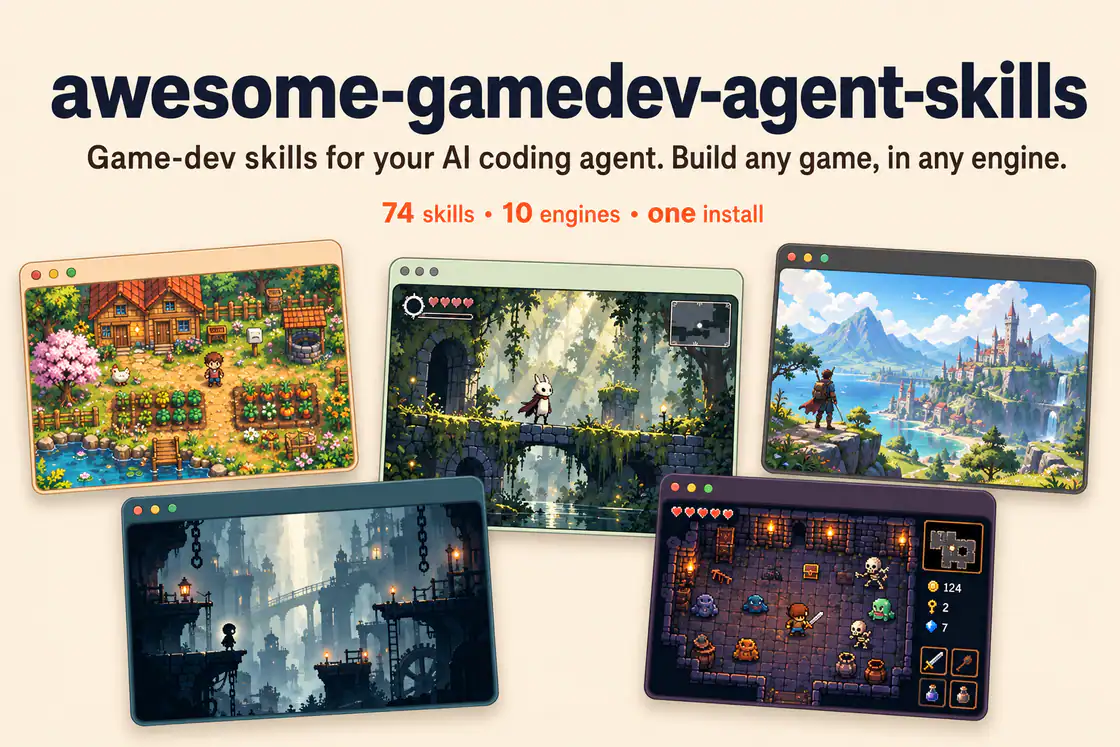
Author-provided banner showing five game scenes. Its 74-skill label reflects an earlier edition; the reviewed catalog contains 76 specialized skills plus a router.
Schermate del progettoInformazioni sullo Skill
Write reflected C++ Actors and components, configure the Gameplay Framework, and manage module dependencies.
SKILL.md
Autore: Abhishek Barali · gamedev-skills/awesome-gamedev-agent-skills · Apache-2.0 · SKILL.md @ c6ca6c4
---
name: unreal-cpp-gameplay
description: >
  Unreal Engine 5 (UE 5.8) C++ gameplay code: UCLASS and UPROPERTY reflection, the Gameplay
  Framework, GC-safe pointers, Build.cs and command-line builds. Use for GENERATED_BODY, Live
  Coding, "unresolved external symbol" or UHT errors. Not for Blueprints (`unreal-blueprints`),
  Enhanced Input (`unreal-enhanced-input`) or packaging (`unreal-packaging`); engine source builds
  are out of scope.
---

# Unreal C++ Gameplay

Write UE5 gameplay C++ that compiles the first time, survives garbage collection and is
testable from a terminal. Targets **UE 5.8**.

## When to use

- Creating or fixing C++ gameplay classes (`AActor`, `APawn`, `ACharacter`, `AGameModeBase`,
  `UActorComponent`), reflection macros, or a module's `*.Build.cs`.
- Diagnosing compile, UHT, linker or Live Coding problems, and crashes from freed `UObject`s.
- Writing C++ automation tests and running them headless.

**When *not* to use:** designer-facing visual logic → `unreal-blueprints`. Input assets and
bindings → `unreal-enhanced-input`. Behavior Trees and EQS → `unreal-behavior-trees`. Cooking
and packaging → `unreal-packaging`. Building Unreal Engine itself from source is not covered;
follow Epic's source-build instructions for the engine's GitHub repository.

## Workflow

1. **Read the project.** `EngineAssociation` in the `.uproject` gives the engine version; the
   `Modules` list and `Source/<Module>/<Module>.Build.cs` give module names and dependencies;
   existing base classes in `Source/` tell you what to extend. Match the existing API macro
   (`MYGAME_API`) and folder layout (`Public/`, `Private/`).
2. **Declare reflected types correctly.** The prefix matches the base (`A` actors, `U` other
   `UObject`s and components, `F` structs, `E` enums, `I` interfaces). `GENERATED_BODY()` is
   the first line in the body and `#include "Name.generated.h"` is the last include.
3. **Make every `UObject` pointer GC-visible.** Members that hold a `UObject` are
   `UPROPERTY()` with `TObjectPtr<T>`; non-owning references are `TWeakObjectPtr<T>`. This is
   the most common source of random crashes.
4. **Create default components in the constructor** with `CreateDefaultSubobject`, attach with
   `SetupAttachment`, and set `RootComponent`. Runtime components use `NewObject` plus
   `RegisterComponent`.
5. **Put logic where the framework expects it.** Rules and default classes in the GameMode
   (server only), per-player state in PlayerState, input and UI ownership in the
   PlayerController, the body in the Pawn or Character, reusable behavior in components.
6. **Add module dependencies** to `PublicDependencyModuleNames` (or `Private...` when only the
   `.cpp` files use them) whenever you include another module's headers, for example
   `EnhancedInput`, `AIModule`, `Niagara`, `UMG`.
7. **Build and test from the command line (see Verify).** Use Live Coding (Ctrl+Alt+F11) only
   for function-body edits while the editor is open.

## Patterns

### Reflected actor with a GC-safe component

```cpp
// Pickup.h
#pragma once
#include "CoreMinimal.h"
#include "GameFramework/Actor.h"
#include "Pickup.generated.h"            // last include

UCLASS()
class MYGAME_API APickup : public AActor
{
    GENERATED_BODY()
public:
    APickup();

    UPROPERTY(EditAnywhere, BlueprintReadWrite, Category = "Pickup")
    int32 ScoreValue = 10;

    UFUNCTION(BlueprintCallable, Category = "Pickup")
    void Collect();

protected:
    UPROPERTY(VisibleAnywhere)
    TObjectPtr<UStaticMeshComponent> Mesh;  // UPROPERTY keeps it alive and visible to the editor
};
```

### A C++ automation test

```cpp
// Source/MyGame/Private/Tests/ScoreTests.cpp
#include "Misc/AutomationTest.h"

#if WITH_DEV_AUTOMATION_TESTS
IMPLEMENT_SIMPLE_AUTOMATION_TEST(FScoreAddsTest, "MyGame.Score.Adds",
    EAutomationTestFlags::EditorContext | EAutomationTestFlags::ProductFilter)

bool FScoreAddsTest::RunTest(const FString& Parameters)
{
    FScoreBoard Board;                       // plain logic: no world needed
    Board.Add(10);
    TestEqual(TEXT("score after one add"), Board.Total(), 10);
    return true;                             // failed Test* calls still mark the test failed
}
#endif
```

Keep testable rules in plain structs or functions so most tests need no world; use functional
tests in a test map for behavior that needs actors.

## Verify

Say which of these you ran and paste the relevant result lines; "it should compile" is not a
check.

1. **Compile the editor target with the editor closed:**
   `Engine/Build/BatchFiles/Build.bat <Project>Editor Win64 Development -Project="<abs path>.uproject" -WaitMutex`
   (Linux: `Engine/Build/BatchFiles/Linux/Build.sh <Project>Editor Linux Development ...`;
   macOS: `Engine/Build/BatchFiles/Mac/Build.sh <Project>Editor Mac Development ...`). Fix
   every error and every warning in files you touched.
2. **Run the tests headless:**
   `UnrealEditor-Cmd <Project>.uproject -ExecCmds="Automation RunTest MyGame;Quit" -unattended -nullrhi -nosplash -ReportExportPath="<dir>"`.
   `RunTest` takes a full name, a dotted prefix, `Test1+Test2`, or `Group:<name>`. Read the
   JSON report or the `Test Completed` lines in the log, and confirm the expected tests ran: a
   wrong filter runs nothing and still looks clean.
3. **When behavior needs a person,** ask the user to open the editor, check that the new class
   and its properties appear, run PIE, and report the Output Log lines for your category.
4. **Optional:** with Epic's `unreal-mcp` skill connected to a running editor, its testing
   toolset can discover and run automation tests and return detailed results.

## Gotchas

- **"Cannot open include file ...generated.h" or UHT errors:** the generated include isn't
  last, `GENERATED_BODY()` is missing, or the file was added while the editor ran and project
  files weren't regenerated.
- **Unresolved external symbol:** the module that defines the symbol isn't in `Build.cs`.
  Find the header's path under `Engine/Source/` or `Engine/Plugins/` to get the module name.
- **Random crash on a pointer that "was valid":** a raw `UObject*` member without `UPROPERTY`,
  or a container of them, so GC freed the object. `IsValid()` on a dangling raw pointer does
  not save you.
- **Live Coding after header changes:** new `UPROPERTY`s or functions rely on Object
  Reinstancing, which is on by default but less reliable; pointers cached to reinstanced
  objects go stale. If the editor or Blueprints misbehave afterwards, close the editor and do a
  full build.
- **Building from the IDE or command line while the editor runs:** with Live Coding active the
  build is refused or fights the editor's loaded modules. Close the editor first, or compile
  through Live Coding.
- **`CreateDefaultSubobject` outside the constructor:** asserts. At runtime use `NewObject` and
  `RegisterComponent`, otherwise the component never ticks or renders.
- **Overrides that skip `Super::`** (`BeginPlay`, `Tick`, `EndPlay`,
  `GetLifetimeReplicatedProps`) silently skip engine setup.
- **GameMode logic on a client:** the GameMode exists only on the server. Use GameState or
  PlayerState for data clients must see.

## References

- Read `references/components-and-gc.md` when creating or attaching components at runtime,
  choosing between `TObjectPtr`, `TWeakObjectPtr`, `TStrongObjectPtr` and `FGCObject`, adding
  `USTRUCT`/`UENUM` data, or replicating a property with `OnRep_`.
- Epic docs: [Gameplay Framework](https://dev.epicgames.com/documentation/unreal-engine/gameplay-framework-in-unreal-engine),
  [Write C++ Tests](https://dev.epicgames.com/documentation/unreal-engine/write-cplusplus-tests-in-unreal-engine),
  [Run Automation Tests](https://dev.epicgames.com/documentation/unreal-engine/run-automation-tests-in-unreal-engine).

## Related skills

- `unreal-blueprints`: exposing C++ to designers.
- `unreal-enhanced-input`: binding input in a C++ Pawn or Character.
- `unreal-behavior-trees`: AIControllers and custom BT nodes.
- `unreal-packaging`: cooking and shipping the build.

## Version notes

Last verified: 2026-11-11.

- Current release: UE 5.8 (5.8.4 hotfix, October 2026); UE 5.9 is in Preview.
- 5.8 Windows toolchain: Visual Studio 2022 17.14 or newer (2026 recommended), MSVC 14.38
  minimum (14.50 recommended), Windows SDK 10.0.22621.0 minimum. 5.8.4 added Visual Studio
  2026 `.slnx` solution support.
- 5.8 macOS: Xcode 15.2 minimum (15.4 or newer recommended). Linux: clang 20.1.8.
- 5.9 Preview adds the Modular Test Framework for scoped plugin tests.
- Sources: [UE 5.8 release notes, Platform SDK Upgrades](https://dev.epicgames.com/documentation/unreal-engine/unreal-engine-5-8-release-notes),
  [5.8.4 hotfix announcement](https://forums.unrealengine.com/t/5-8-4-hotfix-released/2842775)
  and [5.8.4 summary](https://www.digitaldeveloper.io/releases/unreal-engine/5-8-4),
  [UE 5.9 Preview release notes](https://dev.epicgames.com/documentation/unreal-engine/unreal-engine-5-9-release-notes),
  [Write C++ Tests](https://dev.epicgames.com/documentation/unreal-engine/write-cplusplus-tests-in-unreal-engine).
Perché lo abbiamo scelto
Provides a focused workflow, implementation patterns, and common failure checks for unreal c++ gameplay framework. Pair it with the detected engine and any related systems required by the task.
A cosa serve
- Use when your game task needs unreal c++ gameplay framework.
What this skill helps you build
Write reflected C++ Actors and components, configure the Gameplay Framework, and manage module dependencies.
Patterns in the upstream playbook
The entrypoint covers: Minimal Actor class (header + source); GameMode wiring its default classes; Module dependency in Build.cs.
Use it in your project
Inspect the existing project
Describe the desired behavior and share the relevant project files, engine version, and current failure or target result.
Apply the focused playbook
Write reflected C++ Actors and components, configure the Gameplay Framework, and manage module dependencies.
Verify in the matching runtime
Run the project or workflow with its actual dependencies and check the changed behavior before accepting the result.
Original unreal-cpp-gameplay instructionsEngine versions and upgrade policy
Shared collection installation
Install the complete upstream collection with its router and keep each skill’s bundled references, scripts, and assets. The dispatcher selects an engine and the smallest relevant task set; a member listing is a focused entry into that shared package.
| Comando | A cosa serve |
|---|---|
npx skills add gamedev-skills/awesome-gamedev-agent-skills | Keep the router and supporting skill folders available together. |
Prima di usarlo
- An Unreal Engine project and matching editor; C++ tasks need a configured native toolchain, and packaging needs the target-platform SDK.
Agenti supportati
Fonti e riferimenti
Le fonti originali sono collegate qui sotto. Gli spunti pratici sono suggerimenti editoriali di SkillHey.