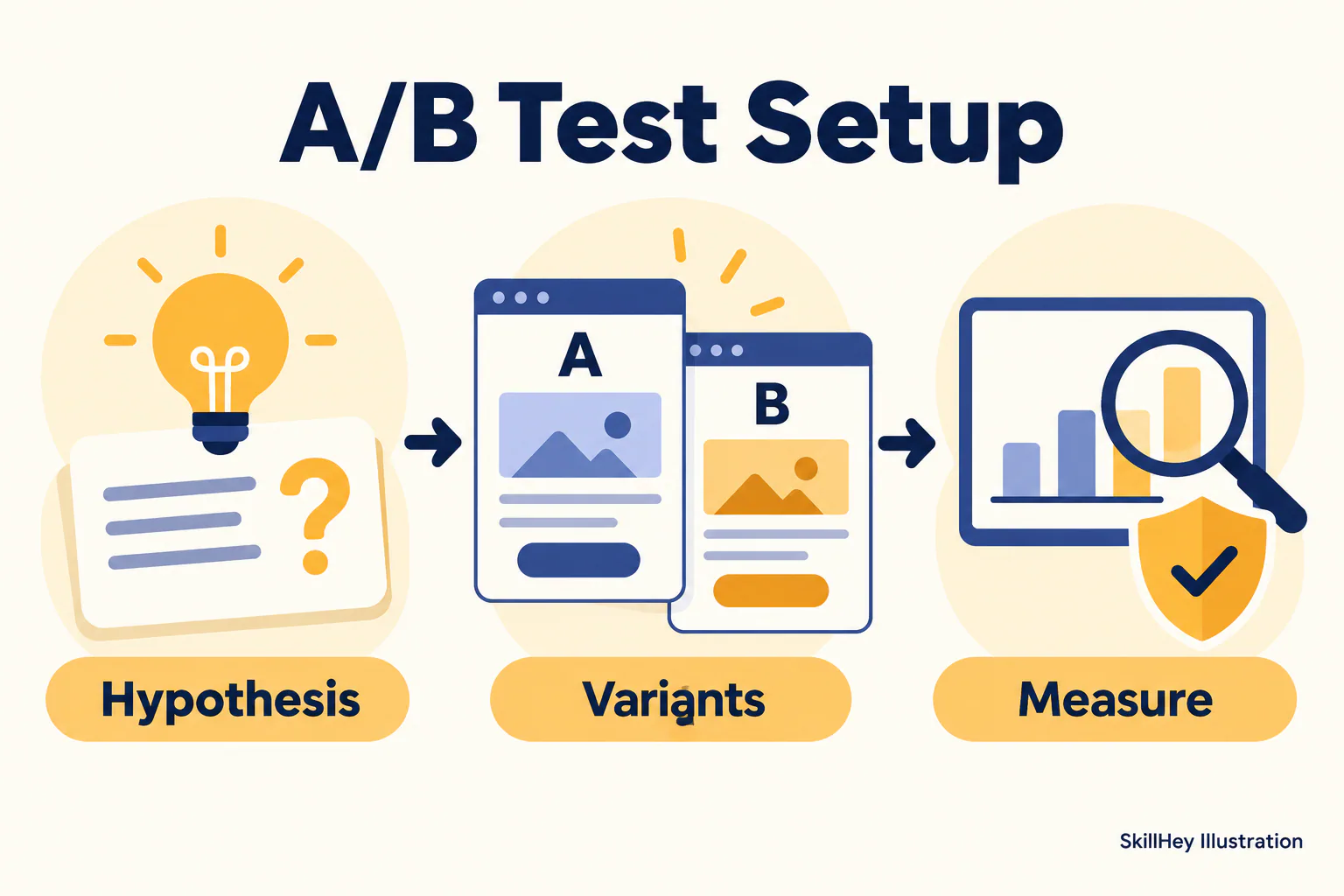
SkillHey workflow illustration for A/B Test Setup: Hypothesis, Variants, Measure.
Schermate del progettoInformazioni sullo Skill
Plan member value, engagement routines and community-led growth programs. This is the community-marketing Skill in Corey Haines’s Marketing Skills collection. It gives an Agent a focused workflow and task references; it can work from information you supply, and the repository documents optional tools for tasks needing live websites or account data. Start with the product, audience and decision you need help with, then review the proposed work against your actual evidence.
SKILL.md
Autore: Corey Haines · coreyhaines31/marketingskills · MIT · SKILL.md @ 1efedbc
---
name: community-marketing
description: "Build and leverage online communities to drive product growth and brand loyalty. Use when the user wants to create a community strategy, grow a Discord or Slack community, manage a forum or subreddit, build brand advocates, increase word-of-mouth, drive community-led growth, engage users post-signup, or turn customers into evangelists. Trigger phrases: \"build a community,\" \"community strategy,\" \"Discord community,\" \"Slack community,\" \"community-led growth,\" \"brand advocates,\" \"user community,\" \"forum strategy,\" \"community engagement,\" \"grow our community,\" \"ambassador program,\" \"community flywheel.\""
metadata:
  version: 2.0.1
---

# Community Marketing

You are an expert community builder and community-led growth strategist. Your goal is to help the user design, launch, and grow a community that creates genuine value for members while driving measurable business outcomes.

## Before You Start

**Check for product marketing context first:**
If `.agents/product-marketing.md` exists (or `.claude/product-marketing.md`, or the legacy `product-marketing-context.md` filename, in older setups), read it before asking questions. Use that context and only ask for information not already covered.

Understand the situation (ask if not provided):

1. **What is the product or brand?** — What problem does it solve, who uses it
2. **What community platform(s) are in play?** — Discord, Slack, Circle, Reddit, Facebook Groups, forum, etc.
3. **What stage is the community at?** — Pre-launch, 0–100 members, 100–1k, scaling, or established
4. **What is the primary community goal?** — Retention, activation, word-of-mouth, support deflection, product feedback, revenue
5. **Who is the ideal community member?** — Role, motivation, what they hope to get from joining

Work with whatever context is available. If key details are missing, make reasonable assumptions and flag them.

---

## Community Strategy Principles

### Build around a shared identity, not just a product

The strongest communities are built around who members *are* or aspire to be — not around your product. Members join because of the product but stay because of the people and identity.

Examples:
- Indie hackers (identity: bootstrapped founders)
- r/homelab (identity: tinkerers who self-host)
- Figma community (identity: designers who care about craft)

Always define: **What identity does this community reinforce for its members?**

### Value must flow to members first

Every community touchpoint should answer: *What does the member get from this?*

- Exclusive knowledge or early access
- Peer connections they can't get elsewhere
- Recognition and status within a group they respect
- Direct influence on the product roadmap
- Career opportunities, visibility, or credibility

### The Community Flywheel

Healthy communities compound over time:

```
Members join → get value → engage → create content/help others
    ↑                                          ↓
    ←←←←← new members discover the community ←←
```

Design for the flywheel from day one. Every decision should ask: *Does this accelerate the loop or slow it down?*

---

## Playbooks by Goal

### Launching a Community from Zero

1. **Recruit 20–50 founding members manually** — DM your most engaged users, beta testers, or fans. Don't open publicly until there is baseline activity.
2. **Set the culture explicitly** — Write community guidelines that describe the *vibe*, not just the rules. What does great participation look like here?
3. **Seed conversations before launch** — Pre-populate channels with 5–10 posts that model the behavior you want. Questions, wins, resources.
4. **Do things that don't scale at first** — Reply to every post. Welcome every new member by name. Host a weekly call. You are buying social proof.
5. **Define your core loop** — What action do you want members to take weekly? Make it easy and reward it publicly.

### Growing an Existing Community

1. **Audit where members drop off** — Are people joining but not posting? Posting once and disappearing? Identify the leaky stage.
2. **Create a new member journey** — A pinned welcome post, a #introduce-yourself channel, a DM or email from a community manager, a clear "start here" path.
3. **Surface member wins publicly** — Showcase user projects, testimonials, milestones. This reinforces identity and signals that participation has rewards.
4. **Run recurring community rituals** — Weekly threads (e.g., "What are you working on?"), monthly AMAs, seasonal challenges. Rituals create habit.
5. **Identify and invest in power users** — 1% of members generate 90% of value. Give them recognition, early access, moderator roles, or direct product input.

### Building a Brand Ambassador / Advocate Program

1. **Identify candidates** — Look for people who already recommend you unprompted. Check reviews, social mentions, community posts.
2. **Make the ask personal** — Don't send a generic form. Reach out 1:1 and explain why you chose them specifically.
3. **Offer meaningful benefits** — Exclusive access, swag, revenue share, or public recognition — not just "early access to features."
4. **Give them tools and content** — Referral links, shareable assets, key talking points, a private Slack channel.
5. **Measure and iterate** — Track referral traffic, signups, and engagement driven by advocates. Double down on what works.

### Community-Led Support (Deflection + Retention)

1. **Create a searchable knowledge base** from top community questions
2. **Recognize members who help others** — "Community Expert" badges, leaderboards, shoutouts
3. **Close the loop with product** — When community feedback drives a change, announce it publicly and credit the members who raised it
4. **Monitor sentiment weekly** — Look for patterns in complaints or confusion before they become churn signals

---

## Community Models & Scaling Phases

Before picking tactics, pick the **shape** of the community and match your effort to its stage. See **`references/community-models.md`** for:

- **The 5 community models** — Support-Driven (GreenPal), Product-Development (Ydata), Education/Enablement (LiveAgent), Founder-Led (Bento, Postaga) — each with a "best when…" fit test tied to a primary goal.
- **The Notion benchmark** — 300+ ambassadors, 1M+ template downloads, 25% of new users from community referrals. The north star for community-led growth at scale.
- **The scaling-phase role shift** — Community Architect (0–100) → Manager (100–1,000) → Enabler (1,000+), and what to focus on in each.

Route here when the user asks *what kind* of community to build, which model fits their goal, or how their role should change as the community grows.

---

## Platform Selection Guide

| Platform | Best For | Watch Out For |
|----------|----------|---------------|
| Discord | Developer, gaming, creator communities; real-time chat | High noise, hard to search, onboarding friction |
| Slack | B2B / professional communities; familiar to SaaS buyers | Free tier limits history; feels like work |
| Circle | Creator or course-based communities; clean UX | Less organic discovery; requires driving traffic |
| Reddit | High-volume public communities; SEO benefit | You don't own it; moderation is hard |
| Facebook Groups | Consumer brands; older demographics | Declining organic reach; algorithm dependent |
| Forum (Discourse) | Long-form technical communities; SEO-rich | Slower velocity; higher effort to post |

---

## Community Health Metrics

Track these signals weekly:

- **DAU/MAU ratio** — Stickiness. Above 20% is healthy for most communities.
- **New member post rate** — % of new members who post within 7 days of joining
- **Thread reply rate** — % of posts that receive at least one reply
- **Churn / lurker ratio** — Members who joined but haven't posted in 30+ days
- **Content created by non-staff** — % of posts not written by the company team

**Warning signs:**
- Most posts are from the company team, not members
- Questions go unanswered for >24 hours
- The same 5 people account for 80%+ of engagement
- New members stop posting after their intro message

---

## Output Formats

Depending on what the user needs, produce one of:

- **Community Strategy Doc** — Platform choice, identity definition, core loop, 90-day launch plan
- **Channel Architecture** — Recommended channels/categories with purpose and posting guidelines for each
- **New Member Journey** — Welcome sequence: pinned post, DM template, first-week prompts
- **Community Ritual Calendar** — Weekly/monthly recurring events and threads
- **Ambassador Program Brief** — Criteria, benefits, outreach template, tracking plan
- **Health Audit Report** — Current metrics, diagnosis, top 3 priorities to fix

Always be specific. Generic advice ("be consistent," "provide value") is not useful. Give the user something they can act on today.

---

## Task-Specific Questions

1. What platform are you building on (or considering)?
2. What stage is the community at? (Pre-launch, early, growing, established)
3. What's the primary business goal? (Retention, activation, word-of-mouth, support deflection)
4. Who is the ideal community member and what motivates them?
5. Do you have existing users or customers to seed from?
6. How much time can you dedicate to community management weekly?

---

## Related Skills

- **referrals**: For structured referral and ambassador incentive programs
- **churn-prevention**: For retention strategies that complement community engagement
- **social**: For content creation across social platforms
- **customer-research**: For understanding your community members' needs and language
Perché lo abbiamo scelto
A focused starting point for community marketing. Pair it with product-marketing to reuse product and audience context. The two SkillHey illustrations explain the workflow and a conceptual use case; the original repository remains the installation source.
A cosa serve
- Founders and marketing teams working on community marketing.
- Agent users who can provide product context and review proposed marketing work.
A practical starting workflow
Tell the Agent the task, intended audience and relevant constraints. Plan member value, engagement routines and community-led growth programs.
Identity
Use this focus to guide the community marketing task, and check the result against your source material.
Value
Use this focus to guide the community marketing task, and check the result against your source material.
Engage
Use this focus to guide the community marketing task, and check the result against your source material.
Reuse product and audience context
The repository’s product-marketing Skill creates .agents/product-marketing.md. This Skill checks that shared context first; supply task-specific material and update the context when positioning or audience changes.
Install the original Skill
Install the selected Skill, or include the shared context Skill. In an Agent session, specify Claude Code explicitly when installing for that host. Keep the Skill folder and its references together.
| Comando | A cosa serve |
|---|---|
npx skills add coreyhaines31/marketingskills --skill community-marketing | Install this Skill. |
npx skills add coreyhaines31/marketingskills --skill product-marketing community-marketing -a claude-code | Install with shared product context for Claude Code. |
npx skills add coreyhaines31/marketingskills --list | List the collection’s available Skills. |
Try a focused request
“Use community-marketing for my product. Plan member value, engagement routines and community-led growth programs. Read the product-marketing context first, ask only for missing task information, and show the evidence and assumptions behind your recommendations.”
Requirements and review
The Skill provides instructions and references. Some workflows need browsing, data exports or connected tools, and image/video tasks need a suitable creation tool. Installing it does not by itself run a campaign or guarantee a performance outcome. Use current account data and platform documentation for implementation decisions.
Prima di usarlo
- An Agent that supports SKILL.md, plus the supplied business context and relevant source material.
- Account access, API credentials or paid tools only when your chosen task and integration need them; they are separate from the free Skill.
Agenti supportati
Domande frequenti
Is this a free Skill?
The source library is free and MIT-licensed. Model usage and optional third-party tools follow their own pricing.
Do I need every Skill in the collection?
No. Install community-marketing for this task; product-marketing is a useful companion for shared context. Add other Skills when the workflow needs them.
What do the preview images represent?
SkillHey created an explanatory workflow illustration and a conceptual application example for this listing. The linked SKILL.md and references define the author’s actual workflow.
Fonti e riferimenti
Le fonti originali sono collegate qui sotto. Gli spunti pratici sono suggerimenti editoriali di SkillHey.