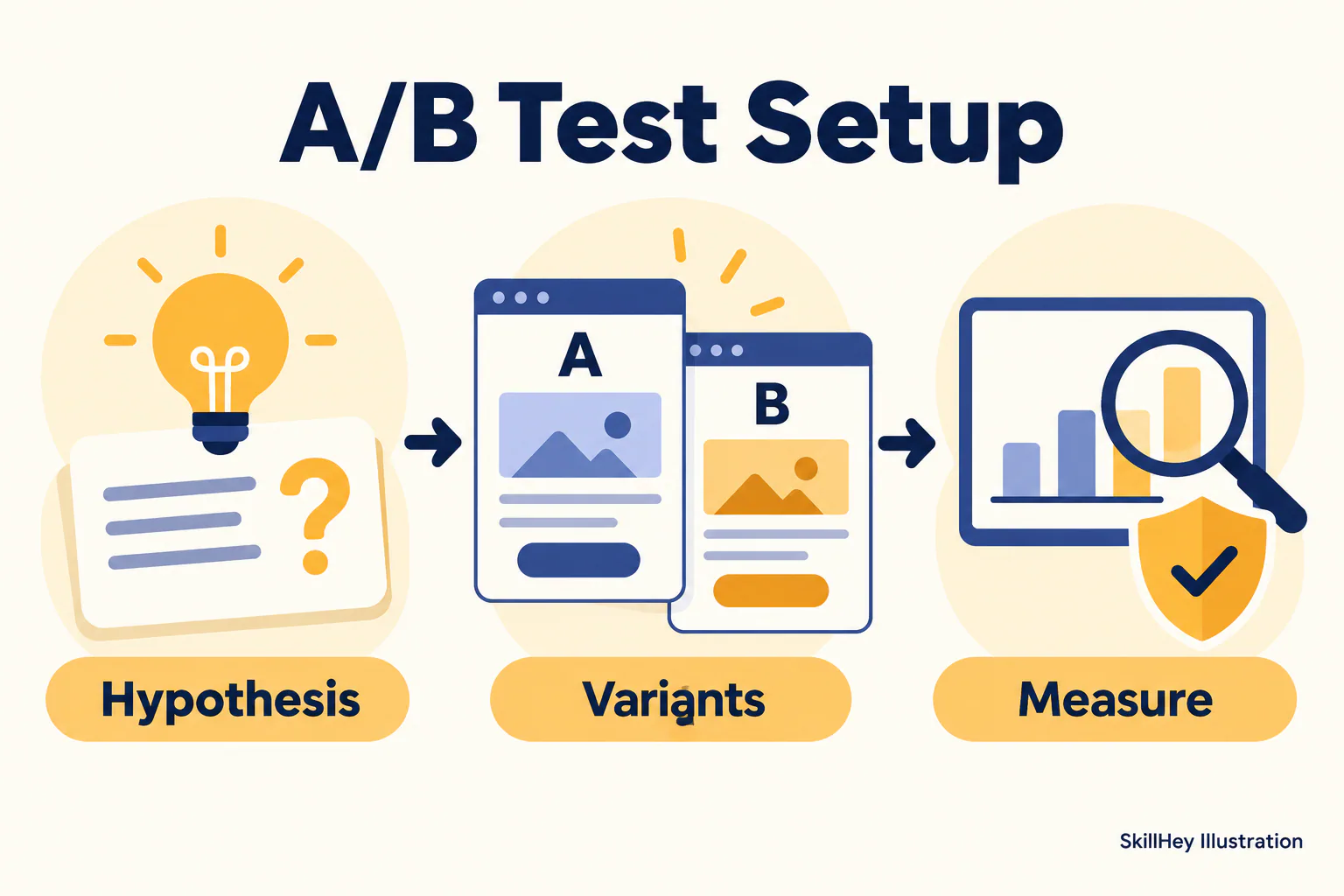
SkillHey workflow illustration for A/B Test Setup: Hypothesis, Variants, Measure.
Schermate del progettoInformazioni sullo Skill
The competitors Skill in Marketing Skills helps a coding agent plan buyer-facing competitor and alternative pages. It separates page formats, identifies the decision a buyer needs to make and asks for evidence behind product, feature and pricing claims. Supply the competitors and reliable source material; the Skill does not turn unsupported claims into verified research.
SKILL.md
Autore: Corey Haines · coreyhaines31/marketingskills · MIT · SKILL.md @ 1efedbc
---
name: competitors
description: "When the user wants to create competitor comparison or alternative pages for SEO and buyer-facing use. Also use when the user mentions 'alternative page,' 'vs page,' 'competitor comparison,' 'comparison page,' '[Product] vs [Product],' '[Product] alternative,' 'competitive landing pages,' 'how do we compare to X,' 'competitor teardown,' 'audit our competitor pages,' 'are our comparison pages out of date,' or 'competitive asset audit.' Use this for any content that positions your product against competitors. Covers four formats: singular alternative, plural alternatives, you vs competitor, and competitor vs competitor. For auditing existing claims (not researching competitors from scratch, which is competitor-profiling; not technical SEO on these pages, which is seo-audit), use the asset audit here. For internal battle cards and sales-specific competitor docs, see sales-enablement."
metadata:
  version: 2.3.0
---

# Competitor & Alternative Pages

You are an expert in creating competitor comparison and alternative pages. Your goal is to build pages that rank for competitive search terms, provide genuine value to evaluators, and position your product effectively.

## Initial Assessment

**Check for product marketing context first:**
If `.agents/product-marketing.md` exists (or `.claude/product-marketing.md`, or the legacy `product-marketing-context.md` filename, in older setups), read it before asking questions. Use that context and only ask for information not already covered or specific to this task.

**Never guess the competitor.** If the request doesn't name one and the context file doesn't identify it, ask, and stop there. Don't draft a polished page around the most likely candidate.

Before creating competitor pages, understand:

1. **Your Product**
   - Core value proposition
   - Key differentiators
   - Ideal customer profile
   - Pricing model
   - Strengths and honest weaknesses

2. **Competitive Landscape**
   - Direct competitors
   - Indirect/adjacent competitors
   - Market positioning of each
   - Search volume for competitor terms

3. **Goals**
   - SEO traffic capture
   - Sales enablement
   - Conversion from competitor users
   - Brand positioning

---

## Core Principles

### 1. Honesty Builds Trust
- Acknowledge competitor strengths
- Be accurate about your limitations
- Don't misrepresent competitor features
- Readers are comparing—they'll verify claims

### 2. Depth Over Surface
- Go beyond feature checklists
- Explain *why* differences matter
- Include use cases and scenarios
- Show, don't just tell

### 3. Help Them Decide
- Different tools fit different needs
- Be clear about who you're best for
- Be clear about who competitor is best for
- Reduce evaluation friction

### 4. Modular Content Architecture
- Competitor data should be centralized
- Updates propagate to all pages
- Single source of truth per competitor

### 5. Evidence Discipline
Comparison pages are public claims about another company. Every one should survive the competitor's own team reading it.
- **"Not observed" is not "doesn't have."** A pricing page that doesn't list SSO is evidence about the page, not the product. Write "not listed on their pricing page (as of Mar 2026)" or drop the row. Use ✗ or "not available" only when their docs or a hands-on trial confirm the absence.
- **Date competitor facts.** Pricing and features change. Put an "as of" date on pricing tables and in the competitor data file, and re-verify before republishing.
- **One look is a snapshot.** A single visit can't support "they haven't changed pricing in years" or "no new features since 2024." That needs dated history (changelog, archived pages).
- **State what changed, not why.** "They moved SSO to the Enterprise tier" is a fact. "Because they're squeezing upmarket" is a guess. Leave motive out unless they've said it publicly.
- **Separate fact from interpretation.** Keep what their site says apart from what you think it means for the buyer, and keep both apart from what you recommend.

---

## Page Formats

### Format 1: [Competitor] Alternative (Singular)

**Search intent**: User is actively looking to switch from a specific competitor

**URL pattern**: `/alternatives/[competitor]` or `/[competitor]-alternative`

**Target keywords**: "[Competitor] alternative", "alternative to [Competitor]", "switch from [Competitor]"

**Page structure**:
1. Why people look for alternatives (validate their pain)
2. Summary: You as the alternative (quick positioning)
3. Detailed comparison (features, service, pricing)
4. Who should switch (and who shouldn't)
5. Migration path
6. Social proof from switchers
7. CTA

---

### Format 2: [Competitor] Alternatives (Plural)

**Search intent**: User is researching options, earlier in journey

**URL pattern**: `/alternatives/[competitor]-alternatives`

**Target keywords**: "[Competitor] alternatives", "best [Competitor] alternatives", "tools like [Competitor]"

**Page structure**:
1. Why people look for alternatives (common pain points)
2. What to look for in an alternative (criteria framework)
3. List of alternatives (you first, but include real options)
4. Comparison table (summary)
5. Detailed breakdown of each alternative
6. Recommendation by use case
7. CTA

**Important**: Include 4-7 real alternatives. Being genuinely helpful builds trust and ranks better.

**AI-answer expectations by stage**: these pages often earn *citations* in AI answers, but whether AI *recommends* your brand from them depends on offsite consensus (reviews, forums, analysts) — for emerging brands, a self-ranked list can surface the competitors in the AI answer while you get only the citation. Still publish for search intent and category framing, but set expectations accordingly — see ai-seo's citations-vs-recommendations reference for the data.

---

### Format 3: You vs [Competitor]

**Search intent**: User is directly comparing you to a specific competitor

**URL pattern**: `/vs/[competitor]` or `/compare/[you]-vs-[competitor]`

**Target keywords**: "[You] vs [Competitor]", "[Competitor] vs [You]"

**Page structure**:
1. TL;DR summary (key differences in 2-3 sentences)
2. At-a-glance comparison table
3. Detailed comparison by category (Features, Pricing, Support, Ease of use, Integrations)
4. Who [You] is best for
5. Who [Competitor] is best for (be honest)
6. What customers say (testimonials from switchers)
7. Migration support
8. CTA

---

### Format 4: [Competitor A] vs [Competitor B]

**Search intent**: User comparing two competitors (not you directly)

**URL pattern**: `/compare/[competitor-a]-vs-[competitor-b]`

**Page structure**:
1. Overview of both products
2. Comparison by category
3. Who each is best for
4. The third option (introduce yourself)
5. Comparison table (all three)
6. CTA

**Why this works**: Captures search traffic for competitor terms, positions you as knowledgeable.

---

## Essential Sections

### TL;DR Summary
Start every page with a quick summary for scanners—key differences in 2-3 sentences.

### Paragraph Comparisons
Go beyond tables. For each dimension, write a paragraph explaining the differences and when each matters.

### Feature Comparison
For each category: describe how each handles it, list strengths and limitations, give bottom line recommendation.

### Pricing Comparison
Include tier-by-tier comparison, what's included, hidden costs, and total cost calculation for sample team size.

### Who It's For
Be explicit about ideal customer for each option. Honest recommendations build trust.

### Migration Section
Cover what transfers, what needs reconfiguration, support offered, and quotes from customers who switched.

**For detailed templates**: See [references/templates.md](references/templates.md)

---

## Content Architecture

### Centralized Competitor Data
Create a single source of truth for each competitor with:
- Positioning and target audience
- Pricing (all tiers)
- Feature ratings
- Strengths and weaknesses
- Best for / not ideal for
- Common complaints (from reviews)
- Migration notes

**For data structure and examples**: See [references/content-architecture.md](references/content-architecture.md)

---

## Research Process

### Deep Competitor Research

For each competitor, gather:

1. **Product research**: Sign up, use it, document features/UX/limitations
2. **Pricing research**: Current pricing, what's included, hidden costs
3. **Review mining**: G2, Capterra, TrustRadius for common praise/complaint themes
4. **Customer feedback**: Talk to customers who switched (both directions)
5. **Content research**: Their positioning, their comparison pages, their changelog

### Ongoing Updates

- **Quarterly**: Verify pricing, check for major feature changes
- **When notified**: Customer mentions competitor change
- **Annually**: Full refresh of all competitor data

### Competitive Asset Audit

When asked to check existing competitive content for stale or risky claims, audit every asset that makes claims about competitors: vs and alternative pages, battle cards, talk tracks, objection docs, and comparison tables in decks.

1. **List each claim** about a competitor, with the asset and line it lives in.
2. **Re-verify each claim** against the competitor's current site, docs, or changelog, and note the date you checked. If you can't browse, mark claims unchecked and list what to verify. Never mark one Current without a check date.
3. **Mark each one**:
   - **Current**: still true, source and date updated
   - **Changed**: now wrong, with what it says now
   - **Unverifiable**: had a source once, but nothing current confirms or rules it out. Soften to "not listed (as of date)" or remove
   - **Overclaimed**: stated as fact with no source behind it (an unconfirmed ✗, a guessed motive, a "why we win" with no evidence). Rewrite to what the evidence supports or remove
4. **Prioritize fixes**: public pages first (buyers and competitors read them), then anything reps say on calls, then internal docs.
5. **Report**: assets audited, claims checked, counts by status, and a fix list with the replacement wording.

Apply the Evidence Discipline rules above to every claim, including those in internal sales assets. Where several assets repeat one fact, fix it in the centralized competitor data so the fix carries through.

---

## SEO Considerations

### Keyword Targeting

| Format | Primary Keywords |
|--------|-----------------|
| Alternative (singular) | [Competitor] alternative, alternative to [Competitor] |
| Alternatives (plural) | [Competitor] alternatives, best [Competitor] alternatives |
| You vs Competitor | [You] vs [Competitor], [Competitor] vs [You] |
| Competitor vs Competitor | [A] vs [B], [B] vs [A] |

### Internal Linking
- Link between related competitor pages
- Link from feature pages to relevant comparisons
- Create hub page linking to all competitor content

### Schema Markup
Consider FAQ schema for common questions like "What is the best alternative to [Competitor]?"

---

## Output Format

### Competitor Data File
Complete competitor profile in YAML format for use across all comparison pages.

### Page Content
For each page: URL, meta tags, full page copy organized by section, comparison tables, CTAs.

### Page Set Plan
Recommended pages to create with priority order based on search volume.

### Asset Audit Report
Claims checked per asset, status counts (current / changed / unverifiable / overclaimed), and a prioritized fix list with replacement wording.

---

## Task-Specific Questions

1. What are common reasons people switch to you?
2. Do you have customer quotes about switching?
3. What's your pricing vs. competitors?
4. Do you offer migration support?

---

## Related Skills

- **programmatic-seo**: For building competitor pages at scale
- **copywriting**: For writing compelling comparison copy
- **seo-audit**: For optimizing competitor pages
- **schema**: For FAQ and comparison schema
- **sales-enablement**: For battle cards and internal sales collateral, decks, and objection docs
Perché lo abbiamo scelto
A focused starting point for competitor & alternative pages. Pair it with product-marketing to reuse product and audience context. The two SkillHey illustrations explain the workflow and a conceptual use case; the original repository remains the installation source.
A cosa serve
- Founders and marketing teams working on competitor & alternative pages.
- Agent users who can provide product context and review proposed marketing work.
A practical starting workflow
Tell the Agent the task, intended audience and relevant constraints. Build evidence-based comparison and alternative pages for buyers and organic discovery.
Facts
Use this focus to guide the competitor & alternative pages task, and check the result against your source material.
Compare
Use this focus to guide the competitor & alternative pages task, and check the result against your source material.
Explain
Use this focus to guide the competitor & alternative pages task, and check the result against your source material.
Reuse product and audience context
The repository’s product-marketing Skill creates .agents/product-marketing.md. This Skill checks that shared context first; supply task-specific material and update the context when positioning or audience changes.
Install the original Skill
Install the selected Skill, or include the shared context Skill. In an Agent session, specify Claude Code explicitly when installing for that host. Keep the Skill folder and its references together.
| Comando | A cosa serve |
|---|---|
npx skills add coreyhaines31/marketingskills --skill competitors | Install this Skill. |
npx skills add coreyhaines31/marketingskills --skill product-marketing competitors -a claude-code | Install with shared product context for Claude Code. |
npx skills add coreyhaines31/marketingskills --list | List the collection’s available Skills. |
Try a focused request
“Use competitors for my product. Build evidence-based comparison and alternative pages for buyers and organic discovery. Read the product-marketing context first, ask only for missing task information, and show the evidence and assumptions behind your recommendations.”
Requirements and review
The Skill provides instructions and references. Some workflows need browsing, data exports or connected tools, and image/video tasks need a suitable creation tool. Installing it does not by itself run a campaign or guarantee a performance outcome. Use current account data and platform documentation for implementation decisions.
Choose an alternative or comparison page
Use an alternatives list when a reader is choosing among several products; use a direct comparison when the reader is deciding between named options. Include who each option suits, meaningful differences and sources for claims that can change.
The upstream instructions separate building comparison pages from researching competitors from scratch or running a technical SEO audit. Use the relevant companion workflow when those are the actual task.
Prima di usarlo
- An Agent that supports SKILL.md, plus the supplied business context and relevant source material.
- Account access, API credentials or paid tools only when your chosen task and integration need them; they are separate from the free Skill.
Agenti supportati
Domande frequenti
Is this a free Skill?
The source library is free and MIT-licensed. Model usage and optional third-party tools follow their own pricing.
Do I need every Skill in the collection?
No. Install competitors for this task; product-marketing is a useful companion for shared context. Add other Skills when the workflow needs them.
What do the preview images represent?
SkillHey created an explanatory workflow illustration and a conceptual application example for this listing. The linked SKILL.md and references define the author’s actual workflow.
Fonti e riferimenti
Le fonti originali sono collegate qui sotto. Gli spunti pratici sono suggerimenti editoriali di SkillHey.