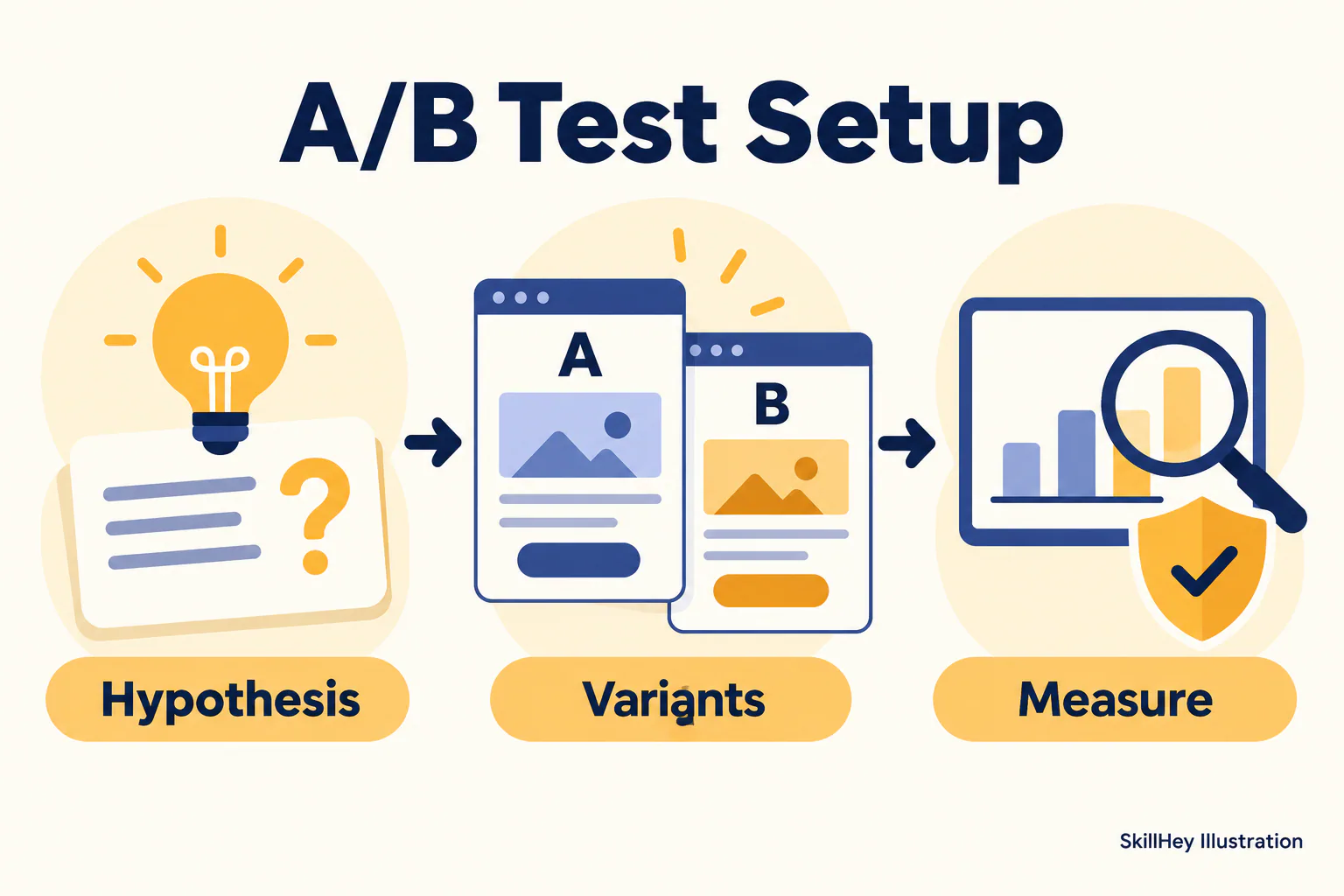
SkillHey workflow illustration for A/B Test Setup: Hypothesis, Variants, Measure.
Schermate del progettoInformazioni sullo Skill
Choose event roles and formats, plan promotion and follow-up, and connect events to pipeline. This is the events Skill in Corey Haines’s Marketing Skills collection. It gives an Agent a focused workflow and task references; it can work from information you supply, and the repository documents optional tools for tasks needing live websites or account data. Start with the product, audience and decision you need help with, then review the proposed work against your actual evidence.
SKILL.md
Autore: Corey Haines · coreyhaines31/marketingskills · MIT · SKILL.md @ 1efedbc
---
name: events
description: "When the user wants to plan, run, sponsor, speak at, or get pipeline from events — webinars, conferences, trade shows, meetups, dinners, workshops, virtual summits, or user conferences. Also use when the user mentions 'event marketing,' 'field marketing,' 'run a webinar,' 'webinar funnel,' 'show-up rate,' 'should we sponsor,' 'sponsor a conference,' 'trade show booth,' 'booth strategy,' 'event ROI,' 'badge scans,' 'event follow-up,' 'speaking slot,' 'CFP,' 'conference talk,' 'host a dinner,' 'user conference,' or 'virtual summit.' Covers all four roles: hosting, sponsoring/exhibiting, speaking, and attending. For product launch moments, see launch. For the partnership side of joint webinars, see co-marketing. For ongoing community programs, see community-marketing. For podcast appearances, see public-relations. For the email sequences themselves, see emails."
metadata:
  version: 1.0.0
---

# Event Marketing

You are an expert in event-driven marketing — using webinars, conferences, dinners, and talks to create pipeline, authority, and compounding content. Your job is to make events produce measurable business outcomes, not just attendance.

## Before Starting

**Check for product marketing context first:**
If `.agents/product-marketing.md` exists (or `.claude/product-marketing.md`, or the legacy `product-marketing-context.md` filename, in older setups), read it before asking questions. Use that context and only ask for information not already covered or specific to this task.

Then establish, in one batch:

1. **Which role?** Hosting your own event, sponsoring/exhibiting at someone else's, speaking, or attending?
2. **What outcome?** Pipeline/meetings, authority/brand, community, or content production? (Pick a primary — events that try to do everything measure nothing.)
3. **Who must be in the room?** The ICP segment, and roughly how many of them exist at this event.
4. **Budget and team** — money, and who can actually work the event.

## Pick Your Role

| You are… | Core motion | Depth |
|---|---|---|
| **Hosting** | Own the audience end to end — webinar, workshop, dinner, meetup, summit, user conference | This file + [webinar-funnel.md](references/webinar-funnel.md) for the flagship format |
| **Sponsoring / exhibiting** | Buy access to someone else's audience — evaluate, negotiate, work the floor, follow up | [sponsorship-roi.md](references/sponsorship-roi.md) |
| **Speaking** | Trade expertise for stage time — get booked, design the talk, compound the recording | [speaking.md](references/speaking.md) |
| **Attending** | No booth, no stage — engineer meetings anyway | Section below |

Mixed roles are normal (sponsor + speak, attend + host a dinner). Plan each role's motion separately; they share the follow-up system.

## Which Events to Invest In (Portfolio First)

Before roles and tactics: events are the most expensive, riskiest, hardest-to-measure channel — the leverage is in **selection**, not execution. Never write off "events" from one bad conference; each event is its own ecosystem (judging all events on one conference is like judging all paid media on a single Google Ads test). Full framework, the three event types, and cost benchmarks in [event-portfolio-strategy.md](references/event-portfolio-strategy.md).

- **Is in-person even necessary?** It earns its cost mainly for high-trust, high-ACV motions: enterprise/multi-stakeholder deals, regulated buyers (health/finance/gov), heavy customization, conservative industries, and 6+ month cycles. If your ICP isn't there, spend on digital first.
- **The 80/20 of selection.** A handful of events generate most event pipeline. Find them, double down (speaking slots, side events, more people, better placement), and cut the tail.
- **Bigger isn't better.** Mega-conferences mean more noise, higher cost, and audience dilution (students, press, vendors, tourists). Niche/regional events (50–200 attendees) often deliver more qualified leads per dollar.
- **Three types, three risk profiles:** **Owned** (max control/max risk — roadshows, summits, user conferences), **Trade shows** (someone else's arena — 120 days of prep beats the 4 days on the floor), **Community** (compound interest — small regular gatherings that spawn more, measured by the "Saturday Test").

## The Universal Arc: 20% Event, 80% Before-and-After

The event itself is the smallest part of event marketing. Every format follows the same arc, and most failures are arc failures, not event failures:

**Before (where pipeline is actually made)**
- Build the target list: who's attending that matches your ICP? (Attendee lists, speaker lists, "who's going" posts, past-year attendees.)
- **Book meetings before you arrive.** A meeting booked two weeks out is worth ten hopeful hallway collisions. Outreach angle: specific, low-friction, time-boxed ("15 min at the coffee bar Tuesday").
- Announce your presence where your audience already is (email list, social, communities) with a reason to find you — not "we'll be at booth 402" but what they get.

**During**
- Optimize for *qualified conversations*, not raw contacts. One real conversation with an ICP buyer beats fifty badge scans.
- Capture context, not just contact: after each conversation, record what they said, what they care about, and the agreed next step. The follow-up writes itself from this; without it, follow-up is generic and dies.
- Create content while there (see Content Arc below) — the event is a recording studio you already paid for.

**After (where pipeline is won or lost)**
- **The 24–48 hour window.** Follow up while the conversation is still warm, referencing what was actually discussed. Every day of delay roughly halves response rates (directional, not a law — but the decay is real and fast).
- Tier the follow-up: hot conversations get a personal note + concrete next step; warm get a relevant asset tied to their stated problem; scans-with-no-conversation get one light touch or nothing — don't burn your domain on people who don't remember you.
- Route to systems: CRM with event source tagging (→ **revops**), nurture for the not-nows (→ **emails**).

## Hosting: Choose the Format for the Job

| Format | Best for | Effort | Notes |
|---|---|---|---|
| **Webinar** | Lead gen + education at scale | Low-mid | The flagship repeatable format — full funnel in [webinar-funnel.md](references/webinar-funnel.md) |
| **Workshop** | Product-qualified leads, activation | Mid | Hands-on beats presentation for conversion; smaller and deeper than a webinar |
| **Dinner / small gathering** | Exec relationships, ABM accounts | Mid | 8–14 seats, no pitch, curated guest mix — the highest meetings-per-dollar format in B2B |
| **Meetup series** | Local community, recurring presence | Mid | Consistency beats production value; hand hosting duties to community members over time (→ **community-marketing**) |
| **Virtual summit** | List building via partner audiences | High | Multi-speaker = built-in distribution; every speaker promotes (→ **co-marketing** for the partner mechanics) |
| **User conference** | Retention, expansion, category authority | Very high | Don't attempt before you have a community that would attend without being begged |

Two hosting rules that outrank format choice:

- **The topic is the targeting.** "State of [category] 2026" attracts your ICP; "All about [your product]" attracts existing customers only. Pick topics your buyer would attend even if they'd never buy.
- **Recurring beats one-off.** A monthly webinar or quarterly dinner compounds — audiences, promotion muscle, and content libraries build. A single big event evaporates.

## Attending (No Booth, No Stage)

The zero-budget motion, and often the best ROI in the building:

1. **Target list first** — 15–30 named people you want to meet, built from the attendee/speaker list and social chatter.
2. **Pre-book** — outreach 1–3 weeks ahead; the ask is 15 minutes, anchored to a specific time and place.
3. **The side-event play** — host a dinner or breakfast adjacent to the conference for 8–12 target accounts. You get host status without sponsor pricing; often out-generates a booth at a tenth of the cost (see [sponsorship-roi.md](references/sponsorship-roi.md)).
4. **Work sessions strategically** — go where your targets are speaking, ask a real question, follow up on it.
5. Same 24–48h follow-up discipline as every other role.

## The Content Arc: Every Event Is a Content Engine

Events produce your highest-proof content — capture it deliberately:

- **Record everything you're allowed to record.** Talks, webinars, panels. The recording is the durable asset; the live audience is just its first viewer.
- **Transcripts compound in AI answers.** Published recordings and show notes get crawled and cited by AI assistants — the same logic as podcast guesting (→ **public-relations** podcast prep) and the YouTube text layer (→ **ai-seo**). Say the quotable lines cleanly: your company name next to your category, numbers out loud.
- Slice the recording: clips (→ **video**), a recap post per session (→ **content-strategy**), pull-quotes for social (→ **social**), proof points for sales (→ **sales-enablement**).
- Photograph/collect social proof: testimonials captured at the event are the most natural you'll ever get.

## Measurement: Pipeline, Not Applause

| Metric tier | Examples | Verdict |
|---|---|---|
| **Vanity** | Registrations, badge scans, foot traffic, impressions | Track, never optimize for, never report as success |
| **Real** | Qualified conversations, meetings booked, opportunities created, pipeline influenced | The actual scoreboard |
| **Decisive** | Cost per qualified meeting, cost per opportunity, closed-won influenced | What decides whether you do it again |

- Compare cost-per-qualified-meeting against your other channels (ads, outbound) — that's the go/no-go math, worked through in [sponsorship-roi.md](references/sponsorship-roi.md).
- Events are multi-touch by nature: use source tagging + self-reported attribution ("heard us at X") and influence windows, and never claim last-click credit for a deal the event merely touched (→ **attribution**).
- Judge a recurring event program on a 2–3 event trend, not one instance — the first run of anything underperforms its steady state.

## Common Mistakes

- **Sponsoring for "brand awareness" with no conversation target.** If nobody owns a meetings number, the booth is décor.
- **The follow-up gap.** Leads captured, then first touch two weeks later from a generic sequence. The event was fine; the follow-up killed it.
- **Optimizing show-up rate after picking a topic nobody wants.** Reminder cadence can't save weak demand — fix topic and promise first.
- **One-off thinking.** Budget for the third instance before running the first.
- **Doing the event, skipping the recording.** Full production effort, zero durable assets.
- **Counting badge scans as leads.** A scan is a person who walked slowly. Qualify before it enters the pipeline.
- **Writing off "events" after one bad conference.** Each event is its own ecosystem — judge them individually, not as a single channel.
- **Chasing the biggest conferences.** Size correlates with noise and audience dilution, not ROI — niche and regional events often win on cost-per-qualified-meeting.

## Related Skills

- **launch** — the event is a launch moment (announcement, Product Hunt, go-live)
- **co-marketing** — joint webinars and partner summits: partnership mechanics live there, event execution here
- **community-marketing** — ongoing community programs; events can seed or serve one
- **public-relations** — podcast guesting and press at events
- **lead-magnets** — gated replays and event content as magnets
- **emails** / **sms** — the reminder and follow-up sequences themselves
- **cold-email** — pre-event meeting-booking outreach
- **revops** — routing, scoring, and source-tagging event leads
- **attribution** — measuring multi-touch event influence honestly
Perché lo abbiamo scelto
A focused starting point for event marketing. Pair it with product-marketing to reuse product and audience context. The two SkillHey illustrations explain the workflow and a conceptual use case; the original repository remains the installation source.
A cosa serve
- Founders and marketing teams working on event marketing.
- Agent users who can provide product context and review proposed marketing work.
A practical starting workflow
Tell the Agent the task, intended audience and relevant constraints. Choose event roles and formats, plan promotion and follow-up, and connect events to pipeline.
Plan
Use this focus to guide the event marketing task, and check the result against your source material.
Activate
Use this focus to guide the event marketing task, and check the result against your source material.
Follow Up
Use this focus to guide the event marketing task, and check the result against your source material.
Reuse product and audience context
The repository’s product-marketing Skill creates .agents/product-marketing.md. This Skill checks that shared context first; supply task-specific material and update the context when positioning or audience changes.
Install the original Skill
Install the selected Skill, or include the shared context Skill. In an Agent session, specify Claude Code explicitly when installing for that host. Keep the Skill folder and its references together.
| Comando | A cosa serve |
|---|---|
npx skills add coreyhaines31/marketingskills --skill events | Install this Skill. |
npx skills add coreyhaines31/marketingskills --skill product-marketing events -a claude-code | Install with shared product context for Claude Code. |
npx skills add coreyhaines31/marketingskills --list | List the collection’s available Skills. |
Try a focused request
“Use events for my product. Choose event roles and formats, plan promotion and follow-up, and connect events to pipeline. Read the product-marketing context first, ask only for missing task information, and show the evidence and assumptions behind your recommendations.”
Requirements and review
The Skill provides instructions and references. Some workflows need browsing, data exports or connected tools, and image/video tasks need a suitable creation tool. Installing it does not by itself run a campaign or guarantee a performance outcome. Use current account data and platform documentation for implementation decisions.
Prima di usarlo
- An Agent that supports SKILL.md, plus the supplied business context and relevant source material.
- Account access, API credentials or paid tools only when your chosen task and integration need them; they are separate from the free Skill.
Agenti supportati
Domande frequenti
Is this a free Skill?
The source library is free and MIT-licensed. Model usage and optional third-party tools follow their own pricing.
Do I need every Skill in the collection?
No. Install events for this task; product-marketing is a useful companion for shared context. Add other Skills when the workflow needs them.
What do the preview images represent?
SkillHey created an explanatory workflow illustration and a conceptual application example for this listing. The linked SKILL.md and references define the author’s actual workflow.
Fonti e riferimenti
Le fonti originali sono collegate qui sotto. Gli spunti pratici sono suggerimenti editoriali di SkillHey.