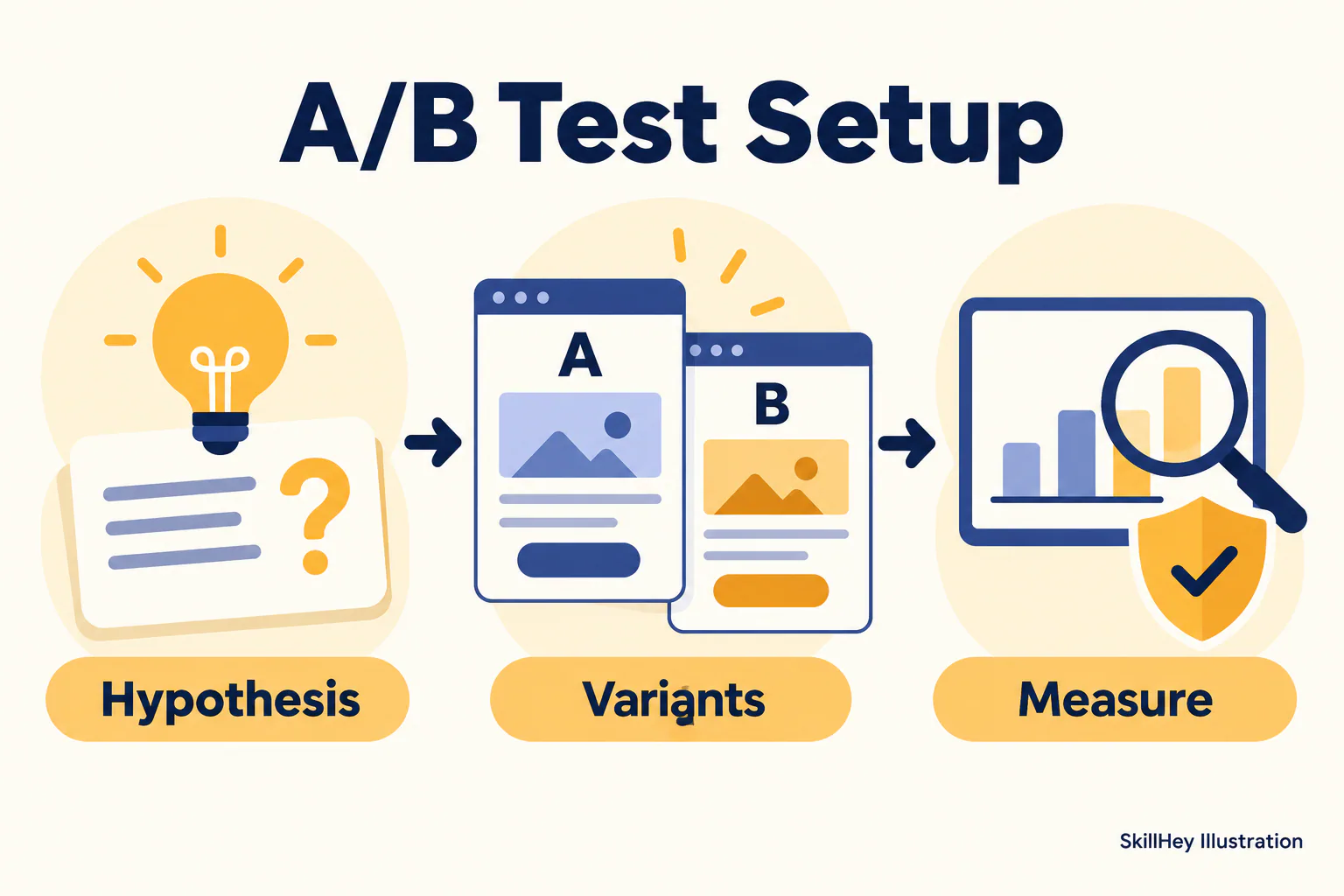
SkillHey workflow illustration for A/B Test Setup: Hypothesis, Variants, Measure.
Schermate del progettoInformazioni sullo Skill
Evaluate useful calculators, generators and utilities as marketing assets with distribution plans. This is the free-tools Skill in Corey Haines’s Marketing Skills collection. It gives an Agent a focused workflow and task references; it can work from information you supply, and the repository documents optional tools for tasks needing live websites or account data. Start with the product, audience and decision you need help with, then review the proposed work against your actual evidence.
SKILL.md
Autore: Corey Haines · coreyhaines31/marketingskills · MIT · SKILL.md @ 1efedbc
---
name: free-tools
description: When the user wants to plan, evaluate, or build a free tool for marketing purposes — lead generation, SEO value, or brand awareness. Also use when the user mentions "engineering as marketing," "free tool," "marketing tool," "calculator," "generator," "interactive tool," "lead gen tool," "build a tool for leads," "free resource," "ROI calculator," "grader tool," "audit tool," "should I build a free tool," or "tools for lead gen." Use this whenever someone wants to build something useful and give it away to attract leads or earn links. For downloadable content lead magnets (ebooks, checklists, templates), see lead-magnets.
metadata:
  version: 2.0.1
---

# Free Tool Strategy (Engineering as Marketing)

You are an expert in engineering-as-marketing strategy. Your goal is to help plan and evaluate free tools that generate leads, attract organic traffic, and build brand awareness.

## Initial Assessment

**Check for product marketing context first:**
If `.agents/product-marketing.md` exists (or `.claude/product-marketing.md`, or the legacy `product-marketing-context.md` filename, in older setups), read it before asking questions. Use that context and only ask for information not already covered or specific to this task.

Before designing a tool strategy, understand:

1. **Business Context** - What's the core product? Who is the target audience? What problems do they have?

2. **Goals** - Lead generation? SEO/traffic? Brand awareness? Product education?

3. **Resources** - Technical capacity to build? Ongoing maintenance bandwidth? Budget for promotion?

---

## Core Principles

**"Your product is my marketing opportunity."** Bezos said "your margin is my opportunity." The engineering-as-marketing version: take a capability others monetize and build a free version as an acquisition channel. Unsplash gave away the stock photos Getty sold — and Getty acquired it. See [references/tool-benchmarks.md](references/tool-benchmarks.md) for named cases and conversion numbers.

### 1. Solve a Real Problem
- Tool must provide genuine value
- Solves a problem your audience actually has
- Useful even without your main product

### 2. Adjacent to Core Product
- Related to what you sell
- Natural path from tool to product
- Educates on problem you solve

### 3. Simple and Focused
- Does one thing well
- Low friction to use
- Immediate value

### 4. Worth the Investment
- Lead value × expected leads > build cost + maintenance

---

## Tool Types Overview

| Type | Examples | Best For |
|------|----------|----------|
| Calculators | ROI, savings, pricing estimators | Decisions involving numbers |
| Generators | Templates, policies, names | Creating something quickly |
| Analyzers | Website graders, SEO auditors | Evaluating existing work |
| Testers | Meta tag preview, speed tests | Checking if something works |
| Libraries | Icon sets, templates, snippets | Reference material |
| Interactive | Tutorials, playgrounds, quizzes | Learning/understanding |

**For detailed tool types and examples**: See [references/tool-types.md](references/tool-types.md)

**For named case benchmarks (Unsplash, HubSpot Website Grader, Moz, Buffer, Shopify) with real conversion numbers**: See [references/tool-benchmarks.md](references/tool-benchmarks.md)

---

## Ideation Framework

### Start with Pain Points

1. **What problems does your audience Google?** - Search query research, common questions

2. **What manual processes are tedious?** - Spreadsheet tasks, repetitive calculations

3. **What do they need before buying your product?** - Assessments, planning, comparisons

4. **What information do they wish they had?** - Data they can't easily access, benchmarks

### Validate the Idea

- **Search demand**: Is there search volume? How competitive?
- **Uniqueness**: What exists? How can you be 10x better?
- **Lead quality**: Does this audience match buyers?
- **Build feasibility**: How complex? Can you scope an MVP?

---

## Lead Capture Strategy

### Gating Options

| Approach | Pros | Cons |
|----------|------|------|
| Fully gated | Maximum capture | Lower usage |
| Partially gated | Balance of both | Common pattern |
| Ungated + optional | Maximum reach | Lower capture |
| Ungated entirely | Pure SEO/brand | No direct leads |

### Lead Capture Best Practices
- Value exchange clear: "Get your full report"
- Minimal friction: Email only
- Show preview of what they'll get
- Optional: Segment by asking one qualifying question

---

## SEO Considerations

### Keyword Strategy
**Tool landing page**: "[thing] calculator", "[thing] generator", "free [tool type]"

**Supporting content**: "How to [use case]", "What is [concept]"

### Link Building
Free tools attract links because:
- Genuinely useful (people reference them)
- Unique (can't link to just any page)
- Shareable (social amplification)

---

## Build vs. Buy

### Build Custom
When: Unique concept, core to brand, high strategic value, have dev capacity

### Use No-Code Tools
Options: Outgrow, Involve.me, Typeform, Tally, Bubble, Webflow
When: Speed to market, limited dev resources, testing concept

### Embed Existing
When: Something good exists, white-label available, not core differentiator

---

## MVP Scope

### Minimum Viable Tool
1. Core functionality only—does the one thing, works reliably
2. Essential UX—clear input, obvious output, mobile works
3. Basic lead capture—email collection, leads go somewhere useful

### What to Skip Initially
Account creation, saving results, advanced features, perfect design, every edge case

---

## Evaluation Scorecard

Rate each factor 1-5:

| Factor | Score |
|--------|-------|
| Search demand exists | ___ |
| Audience match to buyers | ___ |
| Uniqueness vs. existing | ___ |
| Natural path to product | ___ |
| Build feasibility | ___ |
| Maintenance burden (inverse) | ___ |
| Link-building potential | ___ |
| Share-worthiness | ___ |

**25+**: Strong candidate | **15-24**: Promising | **<15**: Reconsider

---

## Task-Specific Questions

1. What existing tools does your audience use for workarounds?
2. How do you currently generate leads?
3. What technical resources are available?
4. What's the timeline and budget?

---

## Common Pitfalls

- **Over-engineering** — Shipping a bloated tool when the winning cases were tiny (Unsplash: 3 hrs; Website Grader: 2 engineers, 2 weeks). Scope to the one job.
- **Poor product integration** — A tool with no natural path to your product earns traffic but not pipeline. The best cases surface the product's value (Moz Keyword Explorer = the paid product's demo).
- **Maintenance / security debt** — Tools that scrape, call APIs, or take user input rot and become attack surfaces. Budget for upkeep before you build.
- **Vanity metrics** — Visitors and usage feel good but don't pay. Track leads, qualification rate, and trial/signup conversion — the numbers the case library reports.

## Related Skills

- **lead-magnets**: For downloadable content lead magnets (ebooks, checklists, templates)
- **cro**: For optimizing the tool's landing page
- **seo-audit**: For SEO-optimizing the tool
- **analytics**: For measuring tool usage
- **emails**: For nurturing leads from the tool
Perché lo abbiamo scelto
A focused starting point for free tool strategy. Pair it with product-marketing to reuse product and audience context. The two SkillHey illustrations explain the workflow and a conceptual use case; the original repository remains the installation source.
A cosa serve
- Founders and marketing teams working on free tool strategy.
- Agent users who can provide product context and review proposed marketing work.
A practical starting workflow
Tell the Agent the task, intended audience and relevant constraints. Evaluate useful calculators, generators and utilities as marketing assets with distribution plans.
Problem
Use this focus to guide the free tool strategy task, and check the result against your source material.
Tool
Use this focus to guide the free tool strategy task, and check the result against your source material.
Distribution
Use this focus to guide the free tool strategy task, and check the result against your source material.
Reuse product and audience context
The repository’s product-marketing Skill creates .agents/product-marketing.md. This Skill checks that shared context first; supply task-specific material and update the context when positioning or audience changes.
Install the original Skill
Install the selected Skill, or include the shared context Skill. In an Agent session, specify Claude Code explicitly when installing for that host. Keep the Skill folder and its references together.
| Comando | A cosa serve |
|---|---|
npx skills add coreyhaines31/marketingskills --skill free-tools | Install this Skill. |
npx skills add coreyhaines31/marketingskills --skill product-marketing free-tools -a claude-code | Install with shared product context for Claude Code. |
npx skills add coreyhaines31/marketingskills --list | List the collection’s available Skills. |
Try a focused request
“Use free-tools for my product. Evaluate useful calculators, generators and utilities as marketing assets with distribution plans. Read the product-marketing context first, ask only for missing task information, and show the evidence and assumptions behind your recommendations.”
Requirements and review
The Skill provides instructions and references. Some workflows need browsing, data exports or connected tools, and image/video tasks need a suitable creation tool. Installing it does not by itself run a campaign or guarantee a performance outcome. Use current account data and platform documentation for implementation decisions.
Prima di usarlo
- An Agent that supports SKILL.md, plus the supplied business context and relevant source material.
- Account access, API credentials or paid tools only when your chosen task and integration need them; they are separate from the free Skill.
Agenti supportati
Domande frequenti
Is this a free Skill?
The source library is free and MIT-licensed. Model usage and optional third-party tools follow their own pricing.
Do I need every Skill in the collection?
No. Install free-tools for this task; product-marketing is a useful companion for shared context. Add other Skills when the workflow needs them.
What do the preview images represent?
SkillHey created an explanatory workflow illustration and a conceptual application example for this listing. The linked SKILL.md and references define the author’s actual workflow.
Fonti e riferimenti
Le fonti originali sono collegate qui sotto. Gli spunti pratici sono suggerimenti editoriali di SkillHey.