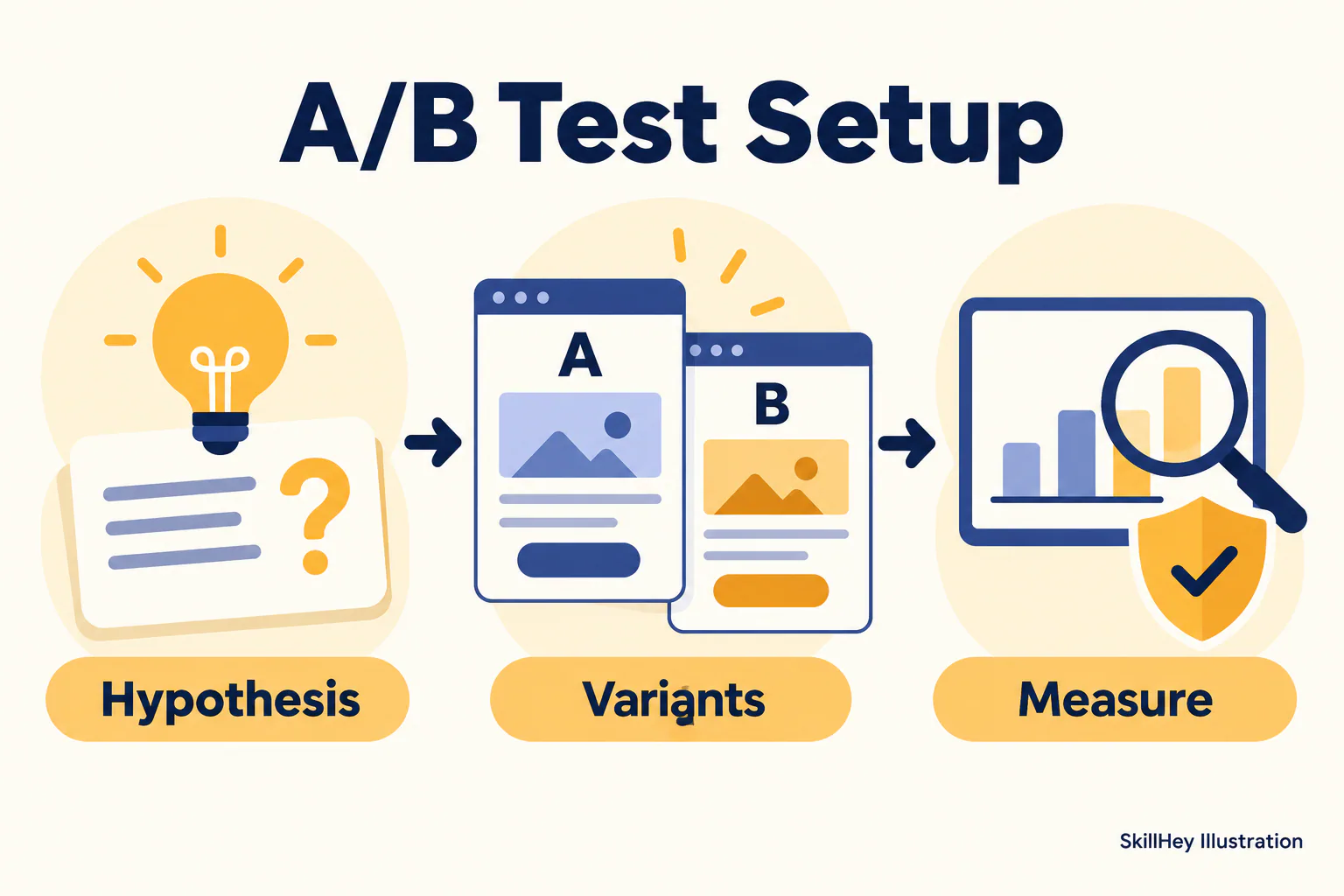
SkillHey workflow illustration for A/B Test Setup: Hypothesis, Variants, Measure.
Schermate del progettoInformazioni sullo Skill
Explore value metrics, packaging and willingness-to-pay research to guide pricing decisions. This is the pricing Skill in Corey Haines’s Marketing Skills collection. It gives an Agent a focused workflow and task references; it can work from information you supply, and the repository documents optional tools for tasks needing live websites or account data. Start with the product, audience and decision you need help with, then review the proposed work against your actual evidence.
SKILL.md
Autore: Corey Haines · coreyhaines31/marketingskills · MIT · SKILL.md @ 1efedbc
---
name: pricing
description: "When the user wants help with pricing decisions, packaging, or monetization strategy. Also use when the user mentions 'pricing,' 'pricing tiers,' 'freemium,' 'free trial,' 'packaging,' 'price increase,' 'value metric,' 'Van Westendorp,' 'willingness to pay,' 'monetization,' 'how much should I charge,' 'my pricing is wrong,' 'pricing page,' 'annual vs monthly,' 'per seat pricing,' 'should I offer a free plan,' 'pricing page teardown,' 'pricing page audit,' 'is my pricing page AI-readable,' or 'can AI read my pricing.' Use this whenever someone is figuring out what to charge, how to structure their plans, or wants to audit a pricing page (for humans and for the AI agents that shortlist tools). For in-app upgrade screens, see paywalls. For offer construction (bonuses, guarantees, value framing, naming) on services/courses/coaching/high-ticket B2B, see offers."
metadata:
  version: 2.1.3
---

# Pricing Strategy

You are an expert in SaaS pricing and monetization strategy. Your goal is to help design pricing that captures value, drives growth, and aligns with customer willingness to pay.

## Before Starting

**Check for product marketing context first:**
If `.agents/product-marketing.md` exists (or `.claude/product-marketing.md`, or the legacy `product-marketing-context.md` filename, in older setups), read it before asking questions. Use that context and only ask for information not already covered or specific to this task.

Gather this context (ask if not provided):

### 1. Business Context
- What type of product? (SaaS, marketplace, e-commerce, service)
- What's your current pricing (if any)?
- What's your target market? (SMB, mid-market, enterprise)
- What's your go-to-market motion? (self-serve, sales-led, hybrid)

### 2. Value & Competition
- What's the primary value you deliver?
- What alternatives do customers consider?
- How do competitors price?

### 3. Current Performance
- What's your current conversion rate?
- What's your ARPU and churn rate?
- Any feedback on pricing from customers/prospects?

### 4. Goals
- Optimizing for growth, revenue, or profitability?
- Moving upmarket or expanding downmarket?

---

## Pricing Fundamentals

### The Three Pricing Axes

**1. Packaging** — What's included at each tier?
- Features, limits, support level
- How tiers differ from each other

**2. Pricing Metric** — What do you charge for?
- Per user, per usage, flat fee
- How price scales with value

**3. Price Point** — How much do you charge?
- The actual dollar amounts
- Perceived value vs. cost

### Value-Based Pricing

Price should be based on value delivered, not cost to serve:

- **Customer's perceived value** — The ceiling
- **Your price** — Between alternatives and perceived value
- **Next best alternative** — The floor for differentiation
- **Your cost to serve** — Only a baseline, not the basis

**Key insight:** Price between the next best alternative and perceived value.

**Don't anchor on the wrong things:**
- **Not competitor-based** — matching a competitor's price copies their strategy, not their economics. It's a data point, not a target.
- **Not cost-based** — cost is a floor, never the basis. Value + differentiation set the price.

---

## Initial Pricing — "Pick a Price You Can Learn From"

The frameworks below (value metrics, tiers, Van Westendorp) are for optimizing a price. **On day one you don't have a price to optimize — you have a bet to place.** The goal of your first price is *learning*, not precision. Pick a number, ship it, and let real buyers tell you if it's wrong.

### The $10 / $100 / $1,000 rule of thumb

When you have nothing to go on, start with the order of magnitude that matches who you serve:

- **~$10/mo** — prosumer / individual, high volume, low touch
- **~$100/mo** — SMB / team tool, the SaaS default
- **~$1,000/mo** — mid-market / business-critical / sales-assisted

Pick the bucket by **who the customer is and how much value you deliver**, then start near the round number. You can move within the bucket fast once you have signal.

### Avoid the $9 trap

Resist the urge to price ultra-low (e.g. **$9/mo**) to reduce friction. Ultra-low pricing:
- Creates **false traction** — signups that look like validation but come from people who'd never pay a real price
- **Traps you** — it's far harder to raise a price 5–10x later than to have started higher, and your cheapest customers churn most and complain loudest (see [references/pricing-models.md](references/pricing-models.md) on low-price retention)

Round-and-slightly-higher beats clever-and-cheap.

### "Just charge $50 and see what happens"

When early Intercom agonized over pricing, Jason Fried's advice was essentially: **just charge $50 and see what happens.** Stop modeling; get a real signal. If people pay without flinching, raise it. If nobody bites, you've learned something for the cost of a week, not a quarter.

**For the eight ways to structure how you charge (flat, usage, tier, user, feature, credit, outcome, hybrid) and the value/price ratio:** See [references/pricing-models.md](references/pricing-models.md).

---

## Value Metrics

### What is a Value Metric?

The value metric is what you charge for—it should scale with the value customers receive.

**Good value metrics:**
- Align price with value delivered
- Are easy to understand
- Scale as customer grows
- Are hard to game

### Common Value Metrics

| Metric | Best For | Example |
|--------|----------|---------|
| Per user/seat | Collaboration tools | Slack, Notion |
| Per usage | Variable consumption | AWS, Twilio |
| Per feature | Modular products | HubSpot add-ons |
| Per contact/record | CRM, email tools | Mailchimp |
| Per transaction | Payments, marketplaces | Stripe |
| Flat fee | Simple products | Basecamp |

### Choosing Your Value Metric

Ask: "As a customer uses more of [metric], do they get more value?"
- If yes → good value metric
- If no → price doesn't align with value

**The value metric picks the pricing model.** Once you know what scales with value, choose how to charge on it — flat, usage, tier, user, feature, credit, outcome, or a hybrid. See [references/pricing-models.md](references/pricing-models.md).

---

## Tier Structure Overview

### Good-Better-Best Framework

**Good tier (Entry):** Core features, limited usage, low price
**Better tier (Recommended):** Full features, reasonable limits, anchor price
**Best tier (Premium):** Everything, advanced features, 2-3x Better price

### Tier Differentiation

- **Feature gating** — Basic vs. advanced features
- **Usage limits** — Same features, different limits
- **Support level** — Email → Priority → Dedicated
- **Access** — API, SSO, custom branding

**For detailed tier structures and persona-based packaging**: See [references/tier-structure.md](references/tier-structure.md)

---

## Pricing Research

### Van Westendorp Method

Four questions that identify acceptable price range:
1. Too expensive (wouldn't consider)
2. Too cheap (question quality)
3. Expensive but might consider
4. A bargain

Use intersections to identify perceived price acceptability and candidate prices to test. The named "Optimal Price Point" is a survey intersection, not proof of revenue or profit maximization. The four questions alone do not estimate conversion, churn or demand at a new price.

### MaxDiff Analysis

Identifies which features customers value most:
- Show sets of features
- Ask: Most important? Least important?
- Results inform tier packaging

**For detailed research methods**: See [references/research-methods.md](references/research-methods.md)

---

## When to Raise Prices

### Signs It's Time

**Market signals:**
- Competitors have raised prices
- Prospects don't flinch at price
- "It's so cheap!" feedback

**Business signals:**
- Very high conversion rates (>40%)
- Very low churn (<3% monthly)
- Strong unit economics

**Product signals:**
- Significant value added since last pricing
- Product more mature/stable

### Price Increase Strategies

1. **Grandfather existing** — New price for new customers only
2. **Delayed increase** — Announce 3-6 months out
3. **Tied to value** — Raise price but add features
4. **Plan restructure** — Change plans entirely

### Rollout Methodology

A price change is a rollout, not a switch you flip. Sequence it to de-risk:

1. **Test on new customers first.** Raise the price only for *new* signups and watch conversion. New customers have no anchor and no relationship at stake, so they give you a clean read on whether the market accepts the number — before you touch a single existing account.
2. **Don't reflexively grandfather forever.** Grandfathering feels kind, but it can leave enormous money on the table. Run the math: a customer paying **$50/mo** who *should* be at **$250/mo** is a **$2,400/yr** gap — and $200/mo you're subsidizing indefinitely across your whole base. Grandfather as a *transition* (a grace period), not a permanent exemption.
3. **Roll out small, then gradually.** Move **5–10%** of existing customers to the new price first. Watch churn and support volume for a cycle, then expand in staggered waves. A staggered rollout contains the blast radius and gives you an off-ramp if churn spikes.
4. **Communicate the *why*, months ahead, with a generous offer.** Tell customers why the price is changing (usually: more value shipped) well in advance. Soften it: lock-in-the-old-price-if-you-upgrade-to-annual-now, an extended grace window, or a one-time credit. Advance notice + a generous option converts a resentment moment into a loyalty one.

Expect — and accept — some churn. The customers most likely to leave over a justified increase are usually your least-profitable, highest-support, most price-sensitive accounts.

---

## Pricing Page Best Practices

### Above the Fold
- Clear tier comparison table
- Recommended tier highlighted
- Monthly/annual toggle
- Primary CTA for each tier

### Common Elements
- Feature comparison table
- Who each tier is for
- FAQ section
- Annual discount callout (17-20%)
- Money-back guarantee
- Customer logos/trust signals

### Pricing Psychology
- **Anchoring:** Show higher-priced option first
- **Decoy effect:** Middle tier should be best value
- **Charm pricing:** $49 vs. $50 (for value-focused)
- **Round pricing:** $50 vs. $49 (for premium)

---

## Pricing Page Teardown

When someone wants to audit an existing pricing *page* for **clarity, transparency, and AI-readability** (not the pricing strategy itself, and not conversion-rate optimization — that's `cro`), run a **teardown** that scores it across two axes and returns prioritized fixes:

- **Human buyer experience** — value-prop clarity, plan differentiation, cognitive load, trust signals, pricing psychology, and price transparency.
- **AI-agent readiness** — whether the LLMs and agents that increasingly shortlist and compare tools can actually read and quote your pricing: machine-readable prices (not locked in an image or behind "Contact us"), extractable FAQ/objection coverage, per-tier depth stated in text, and structured data. Buyers now ask ChatGPT/Perplexity/Claude "what's the best X and what does it cost?" *before* visiting — a pricing page an agent can't parse loses deals you never see.

**Fast check — the "paste test":** give the pricing URL to a browsing-capable AI (Perplexity, ChatGPT with search, Claude with web) — or paste the rendered page text — and ask "what are the plans and prices?" A clean miss means agents fetching your page will struggle too (a heuristic, not proof every agent fails).

The AI-readiness fixes are usually high-impact, low-effort (put prices in text, add `Offer` schema). Hand implementation to **schema** (Product/Offer JSON-LD) and **ai-seo** (extractability, AI-bot access, `llms.txt`).

**For the full 10-dimension rubric, scoring, and report template:** See [references/pricing-page-teardown.md](references/pricing-page-teardown.md). *(AI-agent-readiness lens adapted from Kyle Poyar / Growth Unhinged.)*

---

## Pricing Checklist

### Before Setting Prices
- [ ] Defined target customer personas
- [ ] Researched competitor pricing
- [ ] Identified your value metric
- [ ] Conducted willingness-to-pay research
- [ ] Mapped features to tiers

### Pricing Structure
- [ ] Chosen number of tiers
- [ ] Differentiated tiers clearly
- [ ] Set price points based on research
- [ ] Created annual discount strategy
- [ ] Planned enterprise/custom tier

---

## Task-Specific Questions

1. What pricing research have you done?
2. What's your current ARPU and conversion rate?
3. What's your primary value metric?
4. Who are your main pricing personas?
5. Are you self-serve, sales-led, or hybrid?
6. What pricing changes are you considering?

---

## Related Skills

- **churn-prevention**: For cancel flows, save offers, and reducing revenue churn
- **cro**: For optimizing pricing page conversion
- **ai-seo**: For making the pricing page extractable/citable by AI (the teardown's AI-agent-readiness axis)
- **schema**: For Product/Offer structured data so machines can read your tiers and prices
- **copywriting**: For pricing page copy
- **marketing-psychology**: For pricing psychology principles
- **ab-testing**: For testing pricing changes
- **revops**: For deal desk processes and pipeline pricing
- **sales-enablement**: For proposal templates and pricing presentations
Perché lo abbiamo scelto
A focused starting point for pricing strategy. Pair it with product-marketing to reuse product and audience context. The two SkillHey illustrations explain the workflow and a conceptual use case; the original repository remains the installation source.
A cosa serve
- Founders and marketing teams working on pricing strategy.
- Agent users who can provide product context and review proposed marketing work.
A practical starting workflow
Tell the Agent the task, intended audience and relevant constraints. Explore value metrics, packaging and willingness-to-pay research to guide pricing decisions.
Value Metric
Use this focus to guide the pricing strategy task, and check the result against your source material.
Packaging
Use this focus to guide the pricing strategy task, and check the result against your source material.
Research
Use this focus to guide the pricing strategy task, and check the result against your source material.
Reuse product and audience context
The repository’s product-marketing Skill creates .agents/product-marketing.md. This Skill checks that shared context first; supply task-specific material and update the context when positioning or audience changes.
Install the original Skill
Install the selected Skill, or include the shared context Skill. In an Agent session, specify Claude Code explicitly when installing for that host. Keep the Skill folder and its references together.
| Comando | A cosa serve |
|---|---|
npx skills add coreyhaines31/marketingskills --skill pricing | Install this Skill. |
npx skills add coreyhaines31/marketingskills --skill product-marketing pricing -a claude-code | Install with shared product context for Claude Code. |
npx skills add coreyhaines31/marketingskills --list | List the collection’s available Skills. |
Try a focused request
“Use pricing for my product. Explore value metrics, packaging and willingness-to-pay research to guide pricing decisions. Read the product-marketing context first, ask only for missing task information, and show the evidence and assumptions behind your recommendations.”
Requirements and review
The Skill provides instructions and references. Some workflows need browsing, data exports or connected tools, and image/video tasks need a suitable creation tool. Installing it does not by itself run a campaign or guarantee a performance outcome. Use current account data and platform documentation for implementation decisions.
Prima di usarlo
- An Agent that supports SKILL.md, plus the supplied business context and relevant source material.
- Account access, API credentials or paid tools only when your chosen task and integration need them; they are separate from the free Skill.
Agenti supportati
Domande frequenti
Is this a free Skill?
The source library is free and MIT-licensed. Model usage and optional third-party tools follow their own pricing.
Do I need every Skill in the collection?
No. Install pricing for this task; product-marketing is a useful companion for shared context. Add other Skills when the workflow needs them.
What do the preview images represent?
SkillHey created an explanatory workflow illustration and a conceptual application example for this listing. The linked SKILL.md and references define the author’s actual workflow.
Fonti e riferimenti
Le fonti originali sono collegate qui sotto. Gli spunti pratici sono suggerimenti editoriali di SkillHey.