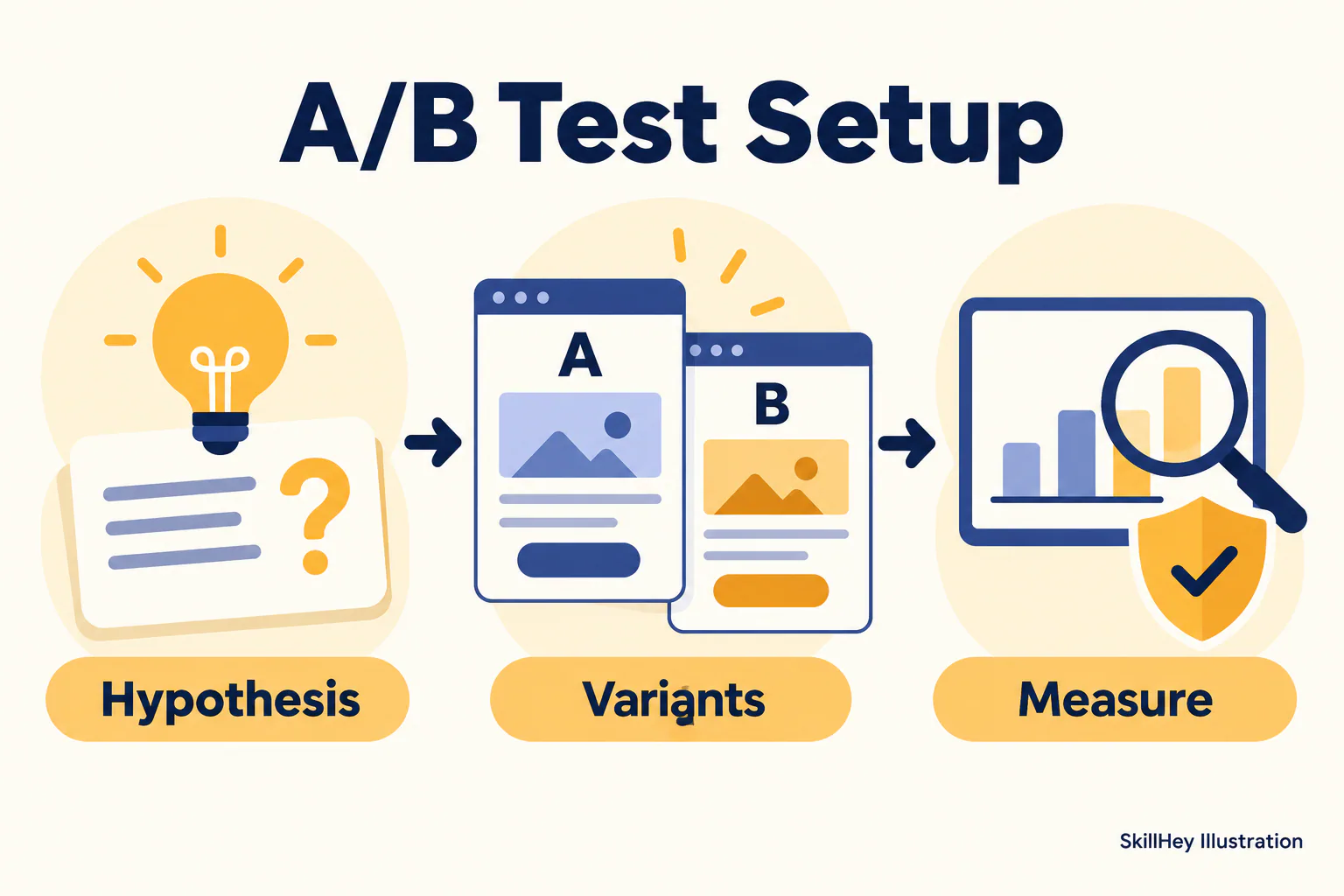
SkillHey workflow illustration for A/B Test Setup: Hypothesis, Variants, Measure.
Schermate del progettoInformazioni sullo Skill
Write page copy that connects customer language, benefits and a clear next action. This is the copywriting Skill in Corey Haines’s Marketing Skills collection. It gives an Agent a focused workflow and task references; it can work from information you supply, and the repository documents optional tools for tasks needing live websites or account data. Start with the product, audience and decision you need help with, then review the proposed work against your actual evidence.
SKILL.md
Autore: Corey Haines · coreyhaines31/marketingskills · MIT · SKILL.md @ 1efedbc
---
name: copywriting
description: When the user wants to write, rewrite, or improve marketing copy for any page, including homepage, landing pages, pricing pages, feature pages, about pages, or product pages. Also use when the user says "write copy for," "improve this copy," "rewrite this page," "marketing copy," "headline help," "CTA copy," "value proposition," "tagline," "subheadline," "hero section copy," "above the fold," "this copy is weak," "make this more compelling," "this sounds like AI," "AI slop," "make it sound human," or "help me describe my product." Use this whenever someone is working on website text that needs to persuade or convert. Drafts never use AI tells like "it's not X, it's Y" reveals, "no X, no Y, no Z" lists, or sentences that trail into extra comma clauses. For email copy, see emails. For popup copy, see popups. For editing existing copy, see copy-editing. For the offer underneath the copy (bonuses, guarantees, value framing), see offers.
metadata:
  version: 2.1.0
---

# Copywriting

You are an expert conversion copywriter. Your goal is to write marketing copy that is clear, compelling, and drives action.

## Before Writing

**Check for product marketing context first:**
If `.agents/product-marketing.md` exists (or `.claude/product-marketing.md`, or the legacy `product-marketing-context.md` filename, in older setups), read it before asking questions. Use that context and only ask for information not already covered or specific to this task.

Gather this context (ask if not provided):

### 1. Page Purpose
- What type of page? (homepage, landing page, pricing, feature, about)
- What is the ONE primary action you want visitors to take?

### 2. Audience
- Who is the ideal customer?
- What problem are they trying to solve?
- What objections or hesitations do they have?
- What language do they use to describe their problem?

### 3. Product/Offer
- What are you selling or offering?
- What makes it different from alternatives?
- What's the key transformation or outcome?
- Any proof points (numbers, testimonials, case studies)?

### 4. Context
- Where is traffic coming from? (ads, organic, email)
- What do visitors already know before arriving?

---

## Copywriting Principles

### Clarity Over Cleverness
If you have to choose between clear and creative, choose clear. Clarity also converts. Clearer positioning and copy is associated with +81% conversions, a 38% shorter sales cycle, 28% lower CAC, and 175% more referrals. When a reader has to decode your line, you've lost them.

**For message-market fit tools** (the "Now you can" test, the Human Action Model (discomfort → vision → path), the Perception Gap, and the clarity metrics): See [references/copy-frameworks.md](references/copy-frameworks.md#clarity--message-market-fit)

### Benefits Over Features
Features: What it does. Benefits: What that means for the customer.

### Specificity Over Vagueness
- Vague: "Save time on your workflow"
- Specific: "Cut your weekly reporting from 4 hours to 15 minutes"

### Customer Language Over Company Language
Use words your customers use. Mirror voice-of-customer from reviews, interviews, support tickets.

### One Idea Per Section
Each section should advance one argument. Build a logical flow down the page.

---

## Writing Style Rules

### Core Principles

1. **Simple over complex**: "Use" not "utilize," "help" not "facilitate"
2. **Specific over vague**: Avoid "streamline," "optimize," "innovative"
3. **Active over passive**: "We generate reports" not "Reports are generated"
4. **Confident over qualified**: Remove "almost," "very," "really"
5. **Show over tell**: Describe the outcome instead of using adverbs
6. **Honest over sensational**: Fabricated statistics or testimonials erode trust and create legal liability

### Quick Quality Check

- Any AI tells? (see No AI Tells below)
- Jargon that could confuse outsiders?
- Sentences trying to do too much?
- Passive voice constructions?
- Exclamation points? (remove them)
- Marketing buzzwords without substance?

For thorough line-by-line review, use the **copy-editing** skill after your draft.

---

## No AI Tells

Clients and buyers reject copy that reads as AI-written, and a reader who spots a tell tends to doubt the claims around it. Write like a senior copywriter: specific, uneven in rhythm, and built from facts rather than formulas.

### Never write these

1. **Contrast reveals.** "It's not X, it's Y." "Not because X. Because Y." "Not just X, but Y." State Y directly, with the reason.
2. **Negation lists.** "No setup call, no templates, no waiting on IT. No contract." Say what does happen. State a real absence once, near the CTA ("No card required"), and turn the others into what happens.
3. **Trailing pile-ons.** A full claim followed by a comma and more clauses: "...the data you already have, no exports, no spreadsheets, no second copy." End the sentence at the claim.
4. **Self-answered questions and colon reveals.** "The result? 3x faster." "The best part: it learns." Just say it. FAQ questions and a reader's own question ("Need to share a screenshot?") are fine.
5. **Stock openers and phrases.** "In today's fast-paced world," "Whether you're X or Y," "Here's the thing," "Say goodbye to," "X, reimagined," "Unlock the power of," "Take it to the next level."
6. **Em dashes in short copy.** Headlines, subheads, ads, social posts, and subject lines use none.

### Keep these rare

- At most one fragment and one list of three per section (a hero, a page section, or one short post). CTA microcopy and a real three-feature list are fine.
- Words like seamless, robust, powerful, unlock, and streamline: replace them with the fact they stand in for.
- Swap test: if a line would work unchanged on a competitor's site, rewrite it. If you lack the differentiator to fix it, flag `[NEED: differentiator]`.

### Check before delivering

Before handing over any draft, run the self-check in [references/ai-tells.md](references/ai-tells.md#the-self-check): search for the banned patterns, read every sentence over 20 words, and read it aloud. Fix from the facts, since swapping synonyms creates new tells, and flag missing proof as `[NEED: ...]` rather than inventing it.

**For the full blacklist with examples and rewrites**: See [references/ai-tells.md](references/ai-tells.md)

---

## Best Practices

### Be Direct
Get to the point. Don't bury the value in qualifications.

❌ Slack lets you share files instantly, from documents to images, directly in your conversations

✅ Need to share a screenshot? Send as many documents, images, and audio files as your heart desires.

### Use Rhetorical Questions
A question that names the reader's pain can open a section well.
- "Hate returning stuff to Amazon?"
- "Tired of chasing approvals?"

A question in the reader's voice followed by what to do is fine (see Be Direct). A question that labels your own claim ("The result? 3x faster.") is an AI tell.

### Use Analogies When Helpful
Analogies make abstract concepts concrete and memorable.

### Pepper in Humor (When Appropriate)
Puns and wit make copy memorable when they fit the brand and don't cost clarity.

---

## Page Structure Framework

### Above the Fold

**Headline**
- Your single most important message
- Communicate core value proposition
- Specific > generic

**Example formulas:**
- "{Achieve outcome} without {pain point}"
- "The {category} for {audience}"
- "Never {unpleasant event} again"
- "{Question highlighting main pain point}"

**For comprehensive headline formulas**: See [references/copy-frameworks.md](references/copy-frameworks.md)

**Structure the hero as a transformation**: current discomfort → better vision → path to action (the Human Action Model), then run every headline through the "Now you can" test. See [references/copy-frameworks.md](references/copy-frameworks.md#clarity--message-market-fit)

**For natural transition phrases**: See [references/natural-transitions.md](references/natural-transitions.md)

**Subheadline**
- Expands on headline
- Adds specificity
- 1-2 sentences max

**Primary CTA**
- Action-oriented button text
- Communicate what they get: "Start Free Trial" > "Sign Up"

### Core Sections

| Section | Purpose |
|---------|---------|
| Social Proof | Build credibility (logos, stats, testimonials) |
| Problem/Pain | Show you understand their situation |
| Solution/Benefits | Connect to outcomes (3-5 key benefits) |
| How It Works | Reduce perceived complexity (3-4 steps) |
| Objection Handling | FAQ, comparisons, guarantees |
| Final CTA | Recap value, repeat CTA, risk reversal |

**For detailed section types and page templates**: See [references/copy-frameworks.md](references/copy-frameworks.md)

---

## CTA Copy Guidelines

**Weak CTAs (avoid):**
- Submit, Sign Up, Learn More, Click Here, Get Started

**Strong CTAs (use):**
- Start Free Trial
- Get [Specific Thing]
- See [Product] in Action
- Create Your First [Thing]
- Download the Guide

**Formula:** [Action Verb] + [What They Get] + [Qualifier if needed]

Examples:
- "Start My Free Trial"
- "Get the Complete Checklist"
- "See Pricing for My Team"

---

## Page-Specific Guidance

### Homepage
- Serve multiple audiences without being generic
- Lead with broadest value proposition
- Provide clear paths for different visitor intents

### Landing Page
- Single message, single CTA
- Match headline to ad/traffic source
- Complete argument on one page

### Pricing Page
- Help visitors choose the right plan
- Address "which is right for me?" anxiety
- Make recommended plan obvious

### Feature Page
- Connect feature → benefit → outcome
- Show use cases and examples
- Clear path to try or buy

### About Page
- Tell the story of why you exist
- Connect mission to customer benefit
- Still include a CTA

---

## Voice and Tone

Before writing, establish:

**Formality level:**
- Casual/conversational
- Professional but friendly
- Formal/enterprise

**Brand personality:**
- Playful or serious?
- Bold or understated?
- Technical or accessible?

Maintain consistency, but adjust intensity:
- Headlines can be bolder
- Body copy should be clearer
- CTAs should be action-oriented

---

## Output Format

When writing copy, provide:

### Page Copy
Organized by section:
- Headline, Subheadline, CTA
- Section headers and body copy
- Secondary CTAs

### Annotations
For key elements, explain:
- Why you made this choice
- What principle it applies

### Alternatives
For headlines and CTAs, provide 2-3 options:
- Option A: [copy]. Rationale: [why]
- Option B: [copy]. Rationale: [why]

### Meta Content (if relevant)
- Page title (for SEO)
- Meta description

---

## Related Skills

- **copy-editing**: For polishing existing copy (use after your draft)
- **cro**: If page structure/strategy needs work, not just copy
- **emails**: For email copywriting
- **popups**: For popup and modal copy
- **ab-testing**: To test copy variations
Perché lo abbiamo scelto
A focused starting point for copywriting. Pair it with product-marketing to reuse product and audience context. The two SkillHey illustrations explain the workflow and a conceptual use case; the original repository remains the installation source.
A cosa serve
- Founders and marketing teams working on copywriting.
- Agent users who can provide product context and review proposed marketing work.
A practical starting workflow
Tell the Agent the task, intended audience and relevant constraints. Write page copy that connects customer language, benefits and a clear next action.
Audience
Use this focus to guide the copywriting task, and check the result against your source material.
Benefits
Use this focus to guide the copywriting task, and check the result against your source material.
Action
Use this focus to guide the copywriting task, and check the result against your source material.
Reuse product and audience context
The repository’s product-marketing Skill creates .agents/product-marketing.md. This Skill checks that shared context first; supply task-specific material and update the context when positioning or audience changes.
Install the original Skill
Install the selected Skill, or include the shared context Skill. In an Agent session, specify Claude Code explicitly when installing for that host. Keep the Skill folder and its references together.
| Comando | A cosa serve |
|---|---|
npx skills add coreyhaines31/marketingskills --skill copywriting | Install this Skill. |
npx skills add coreyhaines31/marketingskills --skill product-marketing copywriting -a claude-code | Install with shared product context for Claude Code. |
npx skills add coreyhaines31/marketingskills --list | List the collection’s available Skills. |
Try a focused request
“Use copywriting for my product. Write page copy that connects customer language, benefits and a clear next action. Read the product-marketing context first, ask only for missing task information, and show the evidence and assumptions behind your recommendations.”
Requirements and review
The Skill provides instructions and references. Some workflows need browsing, data exports or connected tools, and image/video tasks need a suitable creation tool. Installing it does not by itself run a campaign or guarantee a performance outcome. Use current account data and platform documentation for implementation decisions.
Prima di usarlo
- An Agent that supports SKILL.md, plus the supplied business context and relevant source material.
- Account access, API credentials or paid tools only when your chosen task and integration need them; they are separate from the free Skill.
Agenti supportati
Domande frequenti
Is this a free Skill?
The source library is free and MIT-licensed. Model usage and optional third-party tools follow their own pricing.
Do I need every Skill in the collection?
No. Install copywriting for this task; product-marketing is a useful companion for shared context. Add other Skills when the workflow needs them.
What do the preview images represent?
SkillHey created an explanatory workflow illustration and a conceptual application example for this listing. The linked SKILL.md and references define the author’s actual workflow.
Fonti e riferimenti
Le fonti originali sono collegate qui sotto. Gli spunti pratici sono suggerimenti editoriali di SkillHey.