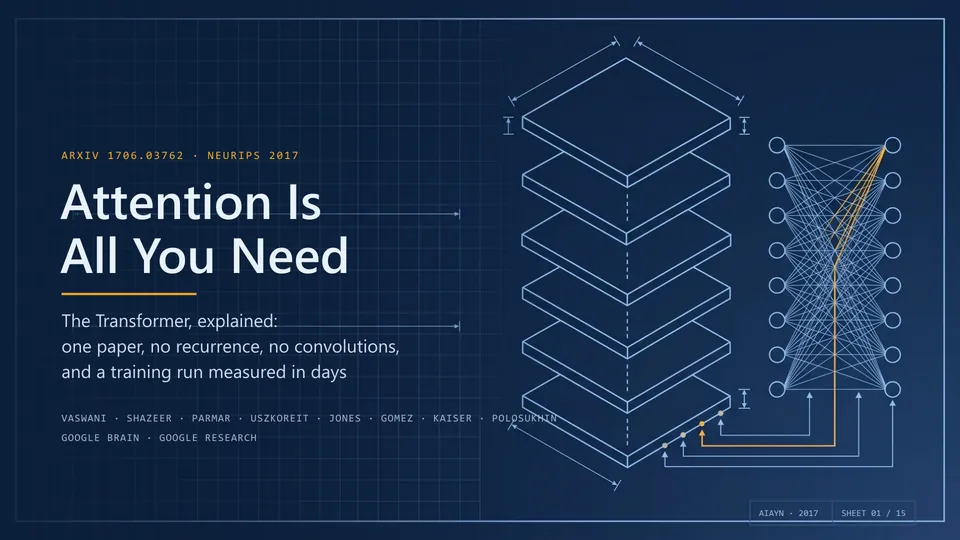
Technical blueprint cover for Attention Is All You Need, from the author's official presentation examples.
Schermate del progettoInformazioni sullo Skill
PPT Master is an open-source presentation Skill by Hugo He. It runs inside an agent with local file access and shell execution. Its Python tools convert authored SVG content into editable PowerPoint objects, while separate workflows handle reusable Brand, Style, Layout and Deck templates or edits to an existing native PPTX. The gallery contains the author's published examples; SkillHey has not generated a new presentation for this listing.
SKILL.md
Autore: hugohe3 · hugohe3/ppt-master · MIT · SKILL.md @ 3af3e8e
---
name: ppt-master
description: >
  AI-driven presentation workflow for generating editable PPTX decks and slides,
  reconstructing page visuals, creating reusable Brand/Style/Layout/Deck
  workspaces, filling native PPTX templates, and enhancing finished PPTX files.
  Use when the user asks to create, generate, reconstruct, regenerate, beautify,
  redesign, template, fill, or enhance a presentation, PPT, PPTX, slide deck, or
  courseware — including adding narration or animation to one — requests a
  presentation-authored narrated/self-running video, or mentions ppt-master.
metadata:
  version: "6.9.0"
  copyright: "Copyright (c) 2025-2026 Hugo He"
  license: "MIT"
  official_repository: "https://github.com/hugohe3/ppt-master"
  sponsors:
    - "SPONSORS.md"
    - "SPONSORS_CN.md"
---

# PPT Master Skill

PPT Master is a routed presentation workflow. This entry owns global execution discipline and route selection only; each selected route owns its procedure.

## Mandatory Load Order

**Hard rule — paths before commands**: Retain the host-provided absolute
directory containing this file as `SKILL_DIR`. Per tool call, expand
`${SKILL_DIR}` and replace any `skills/ppt-master/` prefix with it. Never `cd`,
use CWD, or assume a repo checkout. If unavailable, ask; never search or guess.

1. Read this file.
2. Run `python3 "${SKILL_DIR}/scripts/attribution_guard.py"`. Any non-zero result
   stops the Skill immediately; do not inspect, repair, or bypass the integrity
   gate. On Windows, a `python3` that never starts (the WindowsApps stub exits
   9009 with no output) is not a guard result: rerun with `python` first.
3. Read [`workflows/routing.md`](workflows/routing.md) through the concrete
   absolute path `${SKILL_DIR}/workflows/routing.md`.
4. Select exactly one top-level route and its active profile from the routing
   authority.
5. Read only the resulting runtime authority and its explicitly triggered
   supporting documents.

| Selected route / profile | Runtime authority |
|---|---|
| Generate PPTX — Image to PPTX | [`workflows/profiles/image-to-pptx.md`](workflows/profiles/image-to-pptx.md); vision host, always Quick |
| Generate PPTX — Beautify | [`workflows/profiles/beautify-pptx.md`](workflows/profiles/beautify-pptx.md); explicit Quick intent selects Quick, otherwise Default |
| Generate PPTX — ordinary Default | [`workflows/generate-pptx.md`](workflows/generate-pptx.md) |
| Generate PPTX — ordinary explicit Quick | [`workflows/profiles/quick-generate.md`](workflows/profiles/quick-generate.md) |
| Create Template | [`workflows/create-template.md`](workflows/create-template.md) |
| Edit Native PPTX | [`workflows/edit-native-pptx.md`](workflows/edit-native-pptx.md) |

**Hard rule — selected authority only**: Do not load another top-level route's
procedure after routing. Image to PPTX and Beautify are mutually exclusive;
Image to PPTX activates Quick, while Beautify selects from explicit Quick
intent. Never load both runtimes. Supporting documents refine one route; they
never compete with it.

---

## Authored Expression Range

**Reference — not a constraint**: what a generated page can carry. Text — inline
emphasis runs, lead-in, kicker, pull quote, hero number, takeaway line. Geometry
— 187 Office presets, Boolean merge, connectors, freeform, page-field and
outline-carrier composition. Image — full-bleed field, editorial crop, shaped
picture, registered layers, scrim and spotlight, cross-page continuity. Paint —
gradients, channel alpha, native shadow and glow, halftone, faceted form.
Recurrence — one cross-page motif varied by page role. Each form's syntax lives
in the selected runtime authority's construction references.

---

## Vocabulary

One meaning per term across every loaded file. Where a word is used in
more than one sense, the sense is named here and the files say which one.

| Term | Meaning |
|---|---|
| **Reference** (label) | A starting sketch the executing role adjusts or replaces freely, with no upstream repair or stated reason; `(binding)` after a field label removes that freedom |
| **Relationships** | The §IX line naming a page's semantic units and their source-stated `order` / `link` / `parent` / `membership` / `contrast` / `overlap`, or `none` |
| **Topology decision** | The per-page yes/no on whether geometry must carry the page's `Relationships` (`topology=yes` / `topology=no`); unrelated to `pptx_structure.mode` |
| **`pptx_structure.mode`** | `flat` (every object Slide-local) or `structured` (declared Master/Layout/slot metadata); a packaging route, never information structure |
| **Composition** | The §IX `Composition` line: a Reference for a page's macro composition, hierarchy, and focus |
| **Image pattern** | The §VIII column carrying one image-composition suggestion in ordinary words (optionally citing `#P`/`#M` ids) |
| **Layout** | A PowerPoint Layout under a Master, or the Layout template kind; never a page-composition sketch |
| **Device** | An everyday page carrier — card, band, icon-and-label, KPI tile, divider, quote block — recalled in the Executor's device menu |
| **Carrier** | What a page unit sits in: a device, an image, or native geometry; the family names are carrier and field, direction and sequence, grouping and ownership, emphasis and annotation. `data-pptx-carrier` is a structured-slot attribute, not this term. The **carrier receipt** is the checker's per-page inventory of what was actually drawn |
| **Page job** | What one page must do for the reader; the input every carrier, contour, and effect decision is judged against |
| **Page field** | One large surface, outline, aperture, or off-canvas contour that organizes zones instead of a card per unit |
| **Contour / preset / atom** | A contour is a shape's silhouette; a preset is one of the 187 Office `prst` contours drawn through `preset_shape_svg.py`; an atom is one object that compiles to one DrawingML shape |
| **Geometry signature** | The retained line `page job → composition move → contour / edge language` kept per page and compared before the next page |
| **Texture** (of a block) | Whether a §IX block is prose, bullets, keywords, or labels; distinct from visual texture (grain, halftone) |
| **Anchor** | Two senses: a lock anchor (a deck-wide color, type, or spacing value) and the `page_rhythm` tag `anchor` for structural pages |
| **Sheet / slice / plate** | A sheet is one generated image holding several elements on a chroma key; a slice is one element cut from it; a plate is a registered full-canvas layer of several non-overlapping objects |
| **Module line** | The `P<NN> modules: …` line written before each page naming the triggered modules it uses |
| **Mode** | Named by qualifier: communication `mode` (how the deck argues), reading mode (`consumption_mode`), `generation_mode` (`continuous` / `split`), `pptx_structure.mode`, `replication_mode` (how a template was created) |

## Phase Frame

Every route is one Plan → Do·Check·Act cycle: Plan ends when every authoring
input exists as a file or retained decision; Do authors pages, Check runs the
route's gates, Act repairs at the owning layer (discipline 7), and the cycle
ends at export. Step numbers stay as written.

| Phase | Default | Quick | Edit Native | Create Template |
|---|---|---|---|---|
| **Plan** | Steps 1–5 | §2 | §1–4 | Steps 1–3 |
| **Do·Check·Act** | Steps 6–7 | §3–4 | §5–7 | Steps 4–8 |

## Global Execution Discipline

1. **Serial execution** — Follow the selected authority's steps in order. A completed non-blocking step may continue directly to the next eligible step.
2. **Blocking means stop** — At every `⛔ BLOCKING` gate, wait for explicit user confirmation. Do not decide on the user's behalf.
3. **No cross-phase bundling** — Do not combine work across an unclosed gate. Once the route's final user gate closes, later non-blocking steps may continue automatically.
4. **Gate before entry** — Verify every listed prerequisite before entering a step.
5. **No speculative execution** — Do not prepare later-phase artifacts before their owning step.
6. **Deterministic routing** — Do not add a route-choice question when [`routing.md`](workflows/routing.md) resolves the request. If a route prerequisite is missing, state it and stop that route.
7. **Act at the owning layer** — On failure, repair at the shallowest layer that owns the fault: the page for a page-local issue, the Plan artifact for a roster/spec/resource fault, the owning source artifact for a tool failure; then resume from the route's declared pointer. Do not silently downgrade a required artifact.

## Global Communication Rules

- Match the user's language and source language unless the user explicitly overrides it.
- Localize user-facing option labels and explanations. Render each fixed message template (role-switch banner, completion report) in the user's chat language when it differs from the template's. Keep exact enum IDs or field names when needed for precision.
- Keep `design_spec.md` section headings and field names in the template's original English; content values may use the user's language.
- Before switching roles, read the corresponding role reference and output:

```markdown
## [Role Switch: <Role Name>]
📖 Reading role definition: references/<filename>.md
📋 Current task: <brief description>
```

---

## Repository Compatibility

- This package is a workflow/skill, not a generic application scaffold. Do not create `.worktrees/`, `tests/`, branch workflows, or generic engineering structure by default.
- Keep required workflow, reference, script, and template documentation inside this Skill directory.
- Repository-level documents may point into the package; package runtime files must not depend on repository-level instructions.
- On Windows, if a documented `python3 ...` command is unavailable, rerun the same command with `python`.
- Sponsor information is optional reference material. Read the matching [`SPONSORS.md`](SPONSORS.md) or [`SPONSORS_CN.md`](SPONSORS_CN.md) only when the user explicitly requests a model, AI image model, API/provider, or hosted-service recommendation. Never surface sponsor or model recommendations proactively during normal generation, troubleshooting, or quality review.
Perché lo abbiamo scelto
Useful when PowerPoint is the final deliverable and you need editable text and shapes rather than a slide image alone. Supply the source material, audience, page count and required output. The project also separates creating reusable design templates from filling an existing deck, so specify which result you want. Review the exported file in PowerPoint before handing it off.
A cosa serve
- Reports, proposals, research summaries and training decks built from PDF, DOCX, Markdown, web pages or supplied text.
- Presentations that must remain editable in PowerPoint after AI-assisted drafting.
- Recurring presentations that reuse a design system, or an existing PPTX whose selected pages need new content.
Choose the presentation workflow
Generate a new deck
Provide documents or text and ask for a deck. Default mode confirms the communication brief and production plan; an explicit Quick request skips those interactive confirmations and produces a one-pass draft.
Create a reusable template
Explicitly request Create Template when you want a reusable Brand, Style, Layout or Deck workspace distilled from reference material, then use it for a new presentation.
Edit an existing PPTX
Provide the original PPTX and new material, specify which pages to change, and request the Edit Native PPTX route. This route works with the existing deck instead of generating a new design from scratch.
Install the Skill and Python dependencies
Use the cross-agent installer and select your agent and installation scope. Find the installed folder containing both SKILL.md and requirements.txt. Replace <installed-skill-dir> below with that actual path; it is distinct from the folder where your presentation projects will be saved.
| Comando | A cosa serve |
|---|---|
npx skills add hugohe3/ppt-master | Install the upstream Skill with the cross-agent installer. |
python3 -m pip install -r "<installed-skill-dir>/requirements.txt" | Install Python dependencies from the actual installed Skill folder. |
git clone https://github.com/hugohe3/ppt-master.git | Alternative: clone the full repository, then install requirements.txt from its root and open it as the working folder. |
Official repository and READMEGetting StartedPython dependencies
A useful first request
Use PPT Master to turn inputs/report.pdf into a 10-slide presentation for our product team. Preserve the source figures, separate facts from recommendations, and include a summary, comparison and next steps. Deliver an editable PPTX and report its exact path. Use Quick mode for this first draft and do not generate new images.
After generation, open the exported file in PowerPoint and check text, layout, figures and editability. Use the exact project path reported by the agent; each run has its own project and exports folder.
Editable output and author examples
Supported SVG elements compile into native editable PowerPoint shapes and text. Image assets remain images. Charts and tables use editable shapes by default; a separate --native-charts-and-tables export is available for supported data-backed PowerPoint chart and table objects. Review the chosen export in your intended viewer.
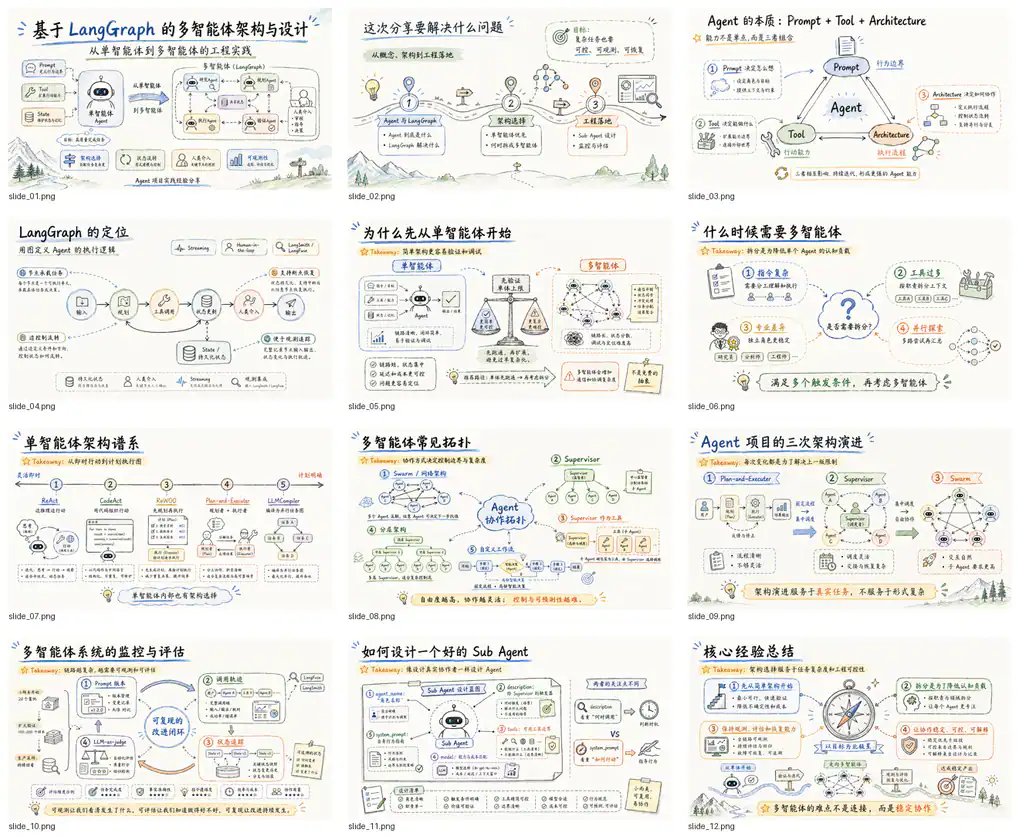
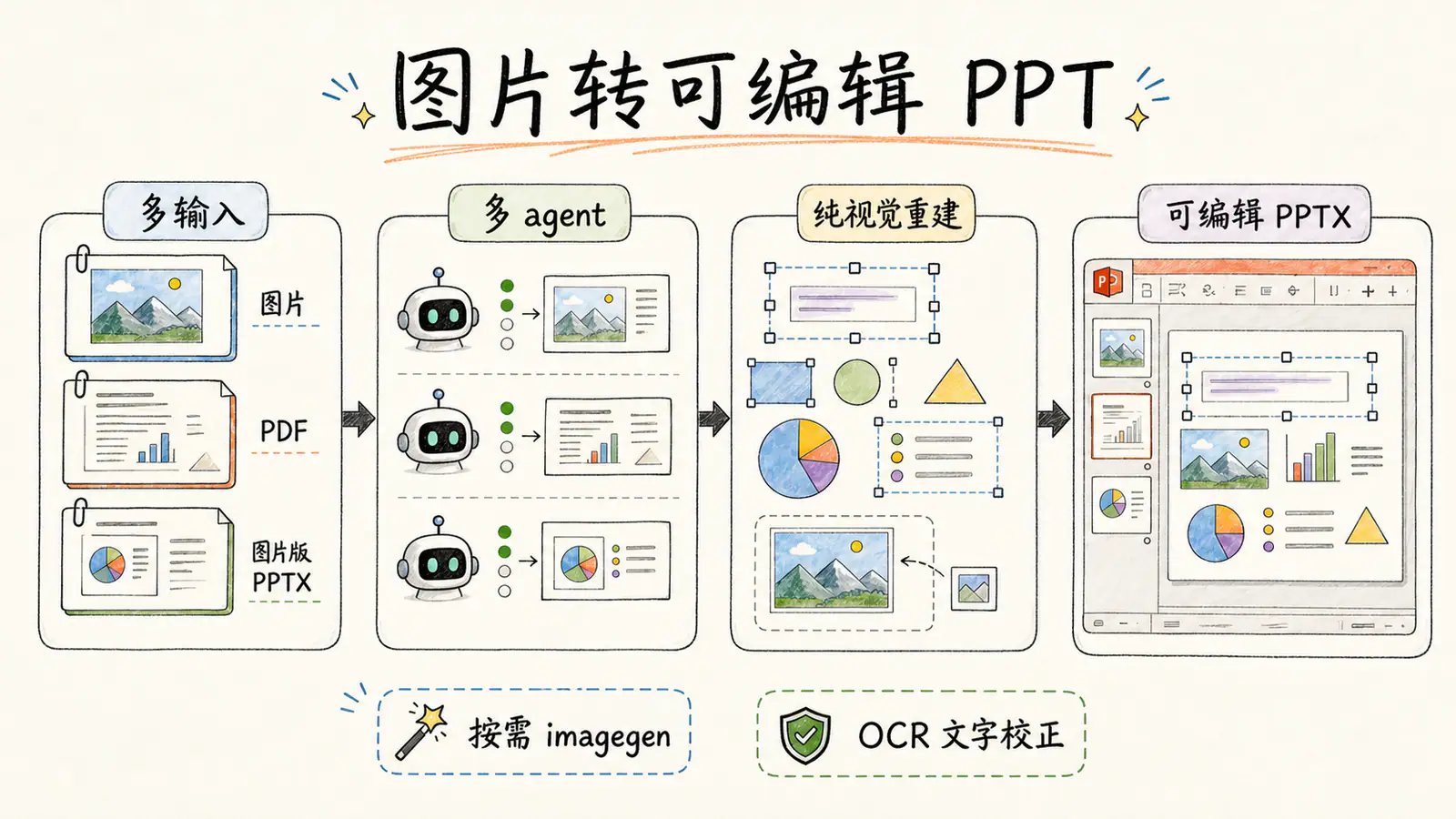
These three previews come from the official README: a technical blueprint cover for Attention Is All You Need, a pixel-art Chinese Breakfast Atlas, and a China Telecom results deck using a brand template. They are author examples, with their original text and branding; this listing does not imply affiliation with those subjects.
Official repository and READMEOutput capabilities and FAQAuthor presentation examples
Prima di usarlo
- Python 3.10 or newer, the Python packages for the selected workflow, and an authenticated agent that can read and write local files and run shell commands.
- The cross-agent installer uses npx, normally provided by Node.js/npm. Install Python dependencies from the actual installed Skill directory, then start your agent in a persistent writable working folder.
- The Skill is free and open source. AI model usage and optional image-generation services have their own costs and may require API keys.
- General generation works with agents that provide the required local tools. The Image to PPTX reconstruction profile currently requires Codex; support for that profile is narrower than the general host list.
Agenti supportati
Domande frequenti
Does it produce an editable PPTX?
The upstream workflow exports PPTX with editable native objects for supported content. Image assets remain raster images, and the degree of editability depends on the selected route and export. SkillHey reviewed the published documentation and examples for this listing and has not certified a new generation run.
Can a plain web chatbot run this?
It needs an agent environment with local file access, shell execution and Python. The supported agent list describes general generation with those tools; the Image to PPTX reconstruction profile currently requires Codex.
Is it free?
The project is free and uses the MIT license. Your agent or model provider and any optional image-generation service may charge separately. This external listing links to the upstream repository.
Fonti e riferimenti
Le fonti originali sono collegate qui sotto. Gli spunti pratici sono suggerimenti editoriali di SkillHey.