Person Distillation Skills: Turn Experience Into Agent Instructions
Last updated: November 3, 2026
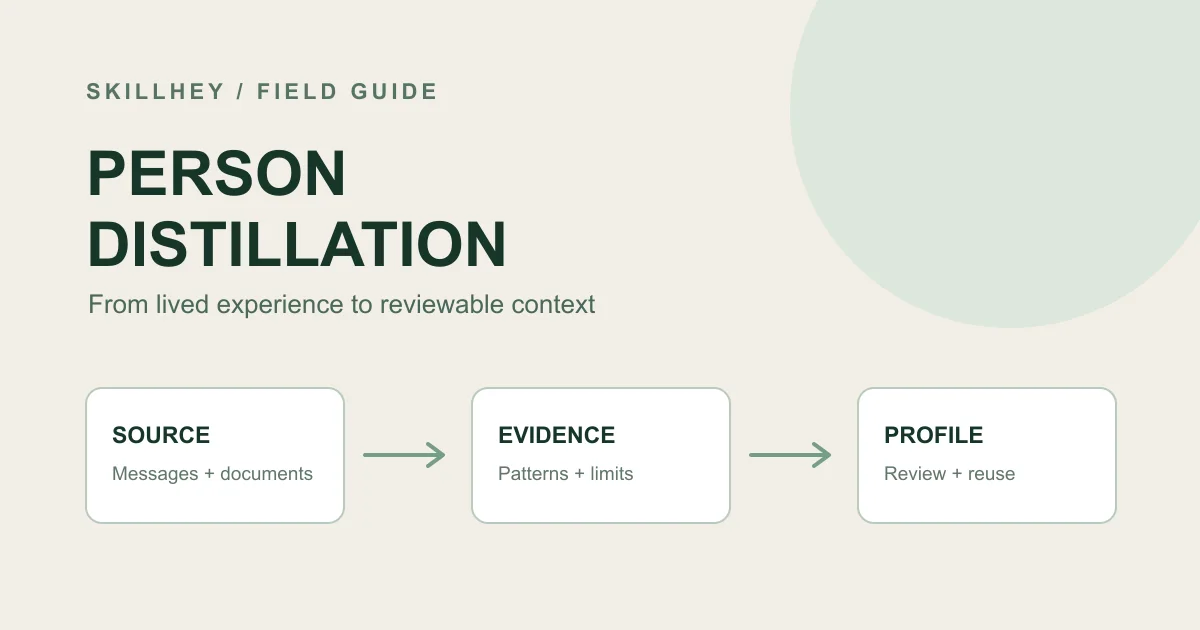
A colleague leaves and takes years of context with them. You repeatedly tell your coding agent what “done” means. You have read an author's work and want to apply a particular idea to a new problem. Each situation can lead to a similar question: can the relevant material be organized so an agent can use it again?
Person distillation Skills offer one approach. They use messages, documents, interviews or session history to produce instructions describing a person's working practices, decisions or expression. The result is an interpretation of available evidence, not the person. Here we compare five projects using their published instructions; we have not run a controlled head-to-head test or measured how faithfully their profiles reproduce anyone.

Nuwa Skill
Research a person or topic and turn mental models, decision heuristics and expression patterns into an Agent Skill. Includes ready-made perspective Skills.
38.118Sternenpx skills add alchaincyf/nuwa-skillInstallation options
git clone https://github.com/alchaincyf/nuwa-skill.gitImmortal Skill
Create a source-based personal profile from messages and documents, with separate workflows for usage terms and handover protection.
1145Sternegit clone https://github.com/agenmod/immortal-skill.gitEmulo
Mine a personal working profile from AI coding sessions and use focused workflows for profile setup, repeated instructions and video work.
305Sternenpx skills add ohad6k/emuloAnyone to Skill
Create a person-perspective Skill from supplied documents, chat logs, audio or video; includes preset persona prompts.
134Sternenpx skills add OpenDemon/anyone-to-skillAgent support
Declared by the skill author
| Skill | Agent support |
|---|---|
| Distilly Person Profiles | Not specified |
| Nuwa Skill | Claude Code, Codex CLI, Cursor, GitHub Copilot, DeepSeek Harness, Gemini CLI, Grok Build, Hermes Agent, OpenCode, Pi, Kiro, Rovo Dev, Qoder, Mistral Vibe, Google Antigravity |
| Immortal Skill | Not specified |
| Emulo | Not specified |
| Anyone to Skill | Not specified |
A full list is a declaration, not a test.
| Project | Start with | What it produces | Best suited to |
|---|---|---|---|
| Distilly | Messages, documents, interviews or public sources | A source-grounded Person Profile packaged as an Agent Skill | Organizing a colleague's experience or a person's documented perspective |
| Nuwa Skill | A person or topic, public research and optional source material | A perspective Skill built from mental models, decision heuristics and expression | Exploring a documented person's thinking or finding a perspective for a problem |
| Immortal Skill | Authorized messages, documents and other records | A profile separated into work, interaction, memory and values, with source records | Multi-source profiles and explicit handling of conflicting evidence |
| Emulo | Your own AI coding sessions | A personal working profile and domain-specific context | Preferences and corrections repeated across agent sessions |
| Anyone to Skill | Documents, chat, audio or video | A generated perspective Skill and pipeline artifacts | Experimenting with custom persona Skills from different formats |
The names sound alike, but the inputs and review needs differ. Choose the material and task first; then choose the project.
What “distillation” means here
These projects organize information into files and instructions an agent can read. They do not necessarily train a smaller model or change model weights. A profile might say that a person asks for a reproduction before accepting a bug fix, cite the messages supporting that observation, and explain when it should be applied. The agent then receives that instruction as context for future tasks.
A useful profile separates an observation from an inference. “Asked for a live check in three releases” is observable if the records support it; “never trusts anyone” is a much broader interpretation. A fluent answer in a familiar voice is not evidence that the underlying rule is accurate.
Distilly: preserve documented experience and judgment
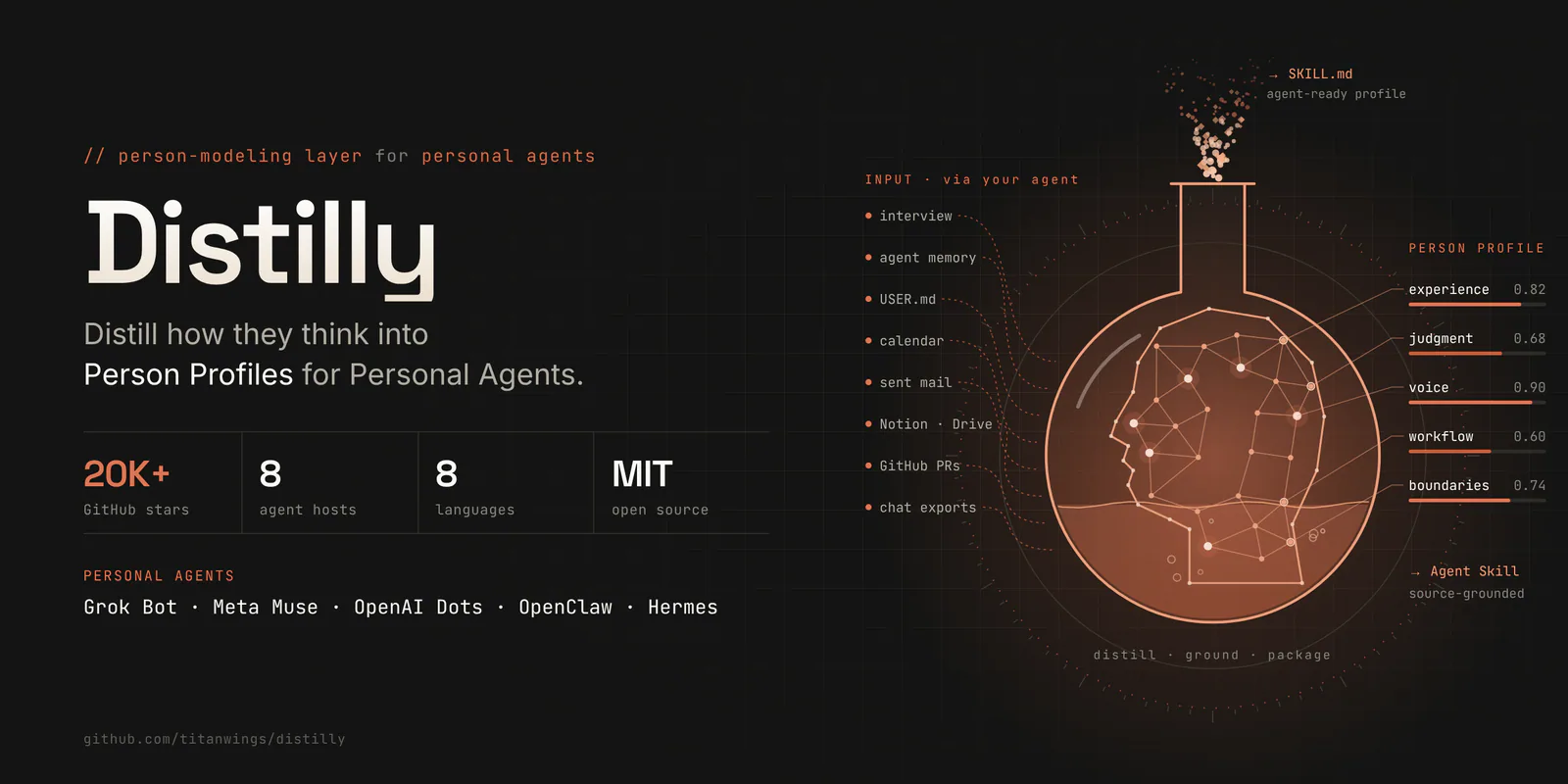
Distilly, formerly Colleague Skill, creates a reusable Person Profile from material supplied by the user. Its current repository describes profiles for colleagues, relationships and public figures, among others, and packages the result as an Agent Skill. It is a useful starting point for an authorized handover when the goal is to retain how a person approaches recurring work.
Give the agent a defined task, such as documenting how an engineer triages production incidents, along with approved incident reviews and decisions. Ask for evidence, dates, gaps and disagreements. A profile built from a few messages cannot establish how that engineer behaves in every situation, and old decisions may no longer fit a changed system.
Nuwa Skill: research a person's thinking
Nuwa Skill develops a perspective Skill from a named person or topic. Its instructions describe research, extracting mental models and decision heuristics, and assembling a runnable Skill. If you have a problem but no person in mind, it can also suggest perspectives to research. You can supply your own source material, and the repository includes ready-made examples.
Choose a research scope and budget before starting: its instructions describe quick, standard and deeper research paths, with costs depending on the model and work involved. Review sources and generated claims before use. A generated perspective is an interpretation of available material, not the person's endorsement or an authentic statement. We reviewed the published instructions but did not run a full distillation.
Immortal Skill: separate dimensions and record conflicts
Immortal Skill organizes a profile into procedural knowledge, interaction, memory and personality or values. Its root workflow describes role templates, source collection, evidence grading, conflict handling and a generated Skill directory. Its collectors support several sources, though availability and credentials depend on the chosen integration.
The repository also contains Distill Protocol, which produces usage terms and a manifest, and Distill Shield, which offers canary markers and optional handover protections. A template is not a substitute for legal advice, and a marker cannot guarantee that material will not be reused. For a practical first run, start with a small, authorized set of documents rather than collecting every available message.
Emulo: learn from your own agent sessions
Emulo addresses a narrower question: what do you keep asking your coding agents to do? It reads user-authored messages from supported local session histories and can build a working profile with dated evidence. The session coach offers a local, model-free report of repeated messages before you decide whether a full profile is worthwhile.
The project's mining workflow shows a preflight plan and requires approval before model work. Extraction and storage may be local, but selected evidence goes to the chosen model provider when a hosted model is used. Profiles can also contain quotations: check the destination before writing one into a shared repository file.
Emulo's published testing notes distinguish a profile changing output from improving quality. Its author reports mixed results against an invented profile and does not claim that the tests prove better work. Loading also varies by host; follow the current host-specific instructions and verify the profile is actually read.
Anyone to Skill: turn varied materials into a perspective
Anyone to Skill has two described modes: preset persona conversations and a pipeline for a new person using supplied materials. The Skill instructions describe ingestion, extraction, synthesis, Skill assembly and a QA report. Audio transcription and other input formats need their respective dependencies; the Python pipeline also needs its model configuration.
Preset personas are brief instructions, not verified records of what a public figure would say. Treat their outputs as prompts for exploration, not quotations or investment, career or medical advice. When creating a new profile, inspect the resulting corpus, claims and generated files before sharing them. We reviewed the entrypoint; the local CLI help did not start without the openai Python dependency, and we did not run a full distillation.
A small first experiment
Start with one job and a handful of records that you are allowed to use. For example:
Create a draft profile for how I review product specifications.
Use only the three documents I provide. For each proposed rule, cite its source
and distinguish direct evidence from inference. Preserve disagreements and gaps.
Do not invent quotations, private opinions or commitments. List what needs my review.
Then use a separate, previously unseen example. Ask the profile to explain which rule applies and why; compare its answer with the source and, when appropriate, the person's own judgment. A single matching answer is a useful check, not a fidelity score. Revise or remove rules that are unsupported or too broad.
Before using other people's messages, establish permission and the intended audience. Remove unrelated personal information, check where processing occurs, and inspect every generated file before sharing. Automatic redaction and prompt instructions are helpful controls, not guarantees of secrecy.
Frequently asked questions
Is a person Skill the same as model training?
Not necessarily. These projects primarily create files and instructions used as context. The underlying model and any provider processing remain separate.
Can a Skill predict what someone would say?
It can generate a response based on its instructions and the model's behavior. That response is a hypothesis or creative simulation, not the person's actual statement or decision.
Which one should I try first?
For your own coding-session habits, start with Emulo's report. For a colleague's documented practices, consider Distilly or Immortal Skill. For a researched person's perspective, consider Nuwa Skill; for an experiment with mixed media, inspect Anyone to Skill's requirements first.
Does local collection mean the whole process is private?
No. Check the model provider, scripts, generated files and destinations individually. Local collection can still be followed by a hosted model call or by writing quotes into a shared project.