Writing Skills for AI Agents: Drafts, Editing and Voice
Last updated: 2026-10-26
“Improve this text” can authorize more change than the writer intended. An agent might shorten a qualification, replace a precise term, introduce a stronger promise or make every paragraph sound alike. The result can be smoother while becoming less accurate or less recognizable as the author's work.
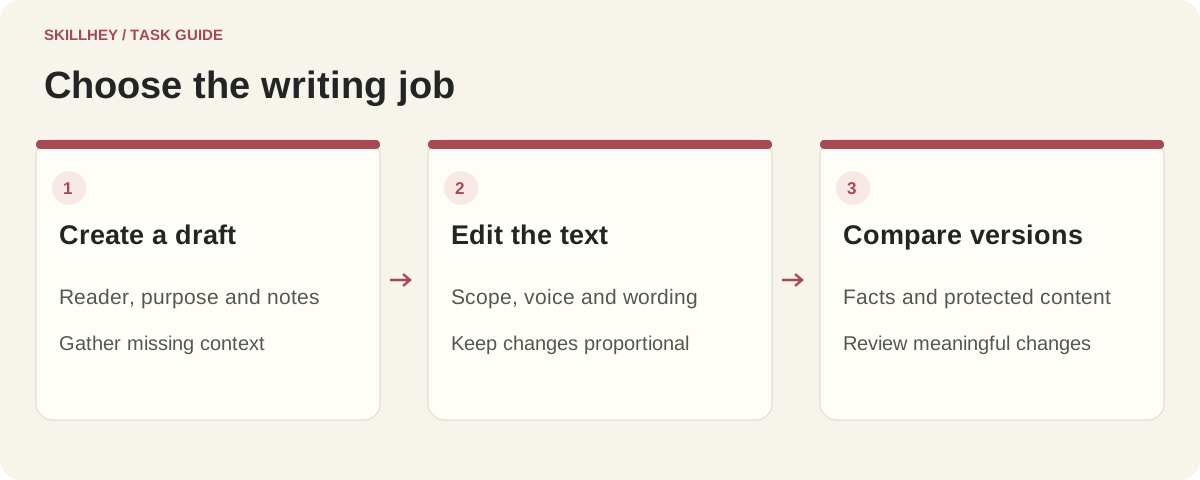
A writing Skill is useful when it makes the editing job explicit: gather missing context, build a document, revise a draft, improve a call to action, or compare the revision with its source. This guide uses five child Skill entrypoints. Each card leads to that task's detail page, rather than the collection containing it.
The recommendations follow the authors' published instructions. They are a guide to choosing a workflow, not a detector of authorship or a ranking from a shared writing experiment. In particular, a rule that identifies a weak sentence cannot establish whether a person or a model wrote it.
Writing task entrypoints
Document Co-authoring
Co-author proposals, specifications and decision documents through context gathering, refinement and reader testing.
183.4KStars
Waza Write
Draft, rewrite, and polish Chinese or English prose, technical instructions, and product copy.
7.3KStarsAvoid AI Writing — Audit and Rewrite English
Audit and revise formulaic English writing while preserving facts, structure and the author voice.
5KStarsAvoid AI Writing — Verify a Rewrite
Compare original and rewritten text to check facts, formatting, numbers, quotes, code and structure.
5KStars
Anti Slop — Clear Copywriting
Improve headlines, prose, tone and calls to action with the core antislop writing rules.
6.2KStars| Your current need | Child Skill | The important handoff |
|---|---|---|
| Build a substantial document from incomplete context | Document Co-authoring | An organized draft that works for its intended reader |
| Draft or revise prose in Chinese or English | Waza Write | A scoped edit aligned with the task and existing voice |
| Audit and revise formulaic English | Avoid AI Writing | A revised text and an honest account of remaining issues |
| Check what a rewrite changed | Preservation Verifier | Findings about meaning, facts and protected structure |
| Improve headlines, copy and calls to action | Anti Slop Clear Copywriting | Clearer copy supported by the actual offer and evidence |
Choose the stage of writing
First decide whether you are creating material or changing existing material. A new proposal may need research, interviews and a clearer decision. A finished customer email may need only a shorter opening. Both are writing tasks, but they should not share the same default permission to add or restructure content.
For an existing draft, name what must remain stable: facts, numbers, dates, links, direct quotes, technical terms, paragraph order or the writer's level of certainty. Then name the allowed change. “Make the opening easier to understand for a first-time customer” is a more useful instruction than “make it professional.”
For a new document, supply source notes and identify gaps. An agent can ask about missing context, but it should not invent customer examples, operating results or commitments to make a document feel complete. Keep placeholders visible until the owner supplies the information.
The reader's next action is a useful organizing principle. A decision memo should help someone choose. An explanation should help someone understand. A product page should explain the offer and the next step. The writing method should serve that action rather than apply one voice to every format.
Document Co-authoring: build the document with context
Document Co-authoring is a structured workflow for proposals, specifications, decision documents and similar substantial writing. Its official instructions organize the work around gathering context, refining structure and checking whether the document makes sense to a reader.
Choose it when the main difficulty is transferring what the author knows into something another person can use. Provide the document's purpose, audience, source notes and any existing format. The workflow can help identify assumptions that are obvious inside a project but missing from the draft.
For example, a memo proposing offline reading should explain the user problem, constraints, options, consequences and decision needed. Stronger adjectives do not compensate for a missing tradeoff. A fresh-reader pass is valuable because it asks whether someone without the conversation can follow the reasoning.
The reader-checking stage depends on available tools and the working arrangement. Describe what was actually reviewed rather than treating a suggested stage as completed automatically. If the document later becomes a presentation, use the presentation Skills guide to choose the handoff format.
Waza Write: give an existing draft a defined edit
Waza Write covers drafting, rewriting and editing Chinese or English prose, including technical and product writing. Its published instructions emphasize the requested outcome, existing context and a suitable mode of work.
Use it with a concrete brief. Include the text, intended reader, destination and the part that feels wrong. If a paragraph is difficult to follow, describe the missing connection. If it sounds unlike the author, provide a short writing sample you own and identify the features you want preserved.
A useful edit can be small. Replacing an abstract opening with the actual event may be enough. Moving a qualification beside the claim it limits may be more valuable than rewriting the whole page. Ask for changes proportional to the problem so that review remains manageable.
The final draft should remain accountable to the original material. When an edit needs an additional fact, mark that requirement instead of quietly inserting a plausible statement. Clear prose and adequate evidence are related tasks, but one cannot substitute for the other.
Avoid AI Writing: inspect patterns in their context
Avoid AI Writing provides an English-focused audit and revision workflow. The upstream task distinguishes writing-quality patterns from claims about authorship and places boundaries around editing passes and preservation.
This is useful when a draft repeats stock structures, inflates significance, uses vague attributions or obscures a simple claim. A flagged pattern still needs a judgment in context. A phrase inside a quotation, a technical term or a deliberate stylistic choice may deserve to stay.
Specify the desired mode: inspect the draft, return a rewrite, or edit a named file. State whether direct quotes, code, links and formatting are protected. Its local detector and preservation tooling require the documented runtime. If those tools are unavailable, a model's review should not be described as an executed deterministic check.
Treat a score or pattern count as an editing aid. Reducing the count is not the same as making a text better. The useful outcome is a clear, faithful draft whose remaining tradeoffs the writer can understand.
Preservation Verifier: compare the revision with the source
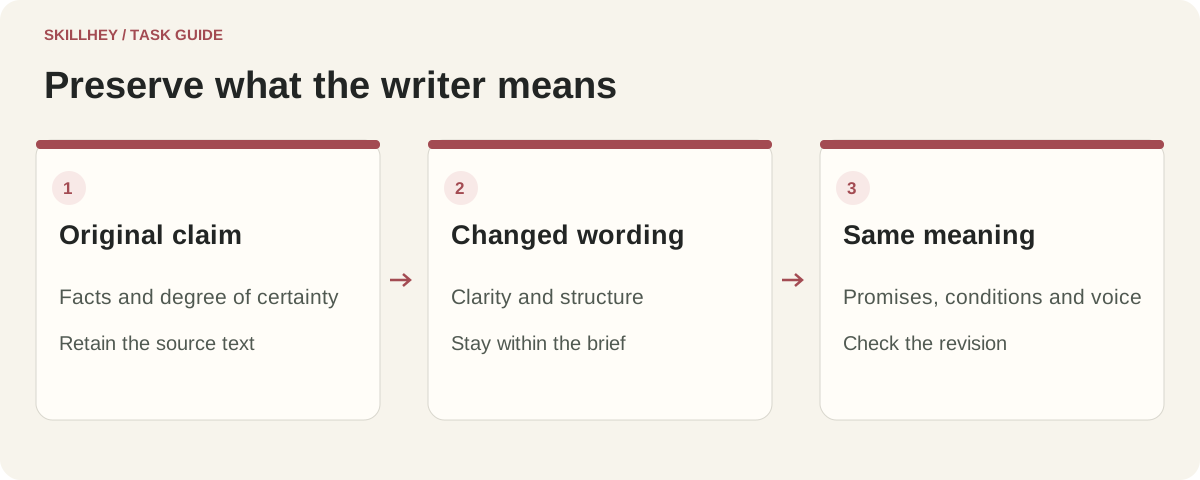
Preservation Verifier is a separate task in the same Avoid AI Writing project. Its instructions focus on whether an edit retained protected content and meaning. It complements a rewrite instead of representing another independent writing vendor.
Supply both versions and the editing brief. Ask it to identify changes to facts, numbers, names, negation, conditions, quotes and protected structure. For a file edit, include any requirements around frontmatter, headings, tables or code. The comparison is easier when the authorized scope is explicit.
Some preservation checks are mechanical; others require interpretation. A validator may detect a changed URL or missing code block, while a claim becoming more certain requires semantic review. Keep the distinction in the handoff. Passing one type of check does not establish that every aspect of the edit is correct.
If a revision fails preservation, repair the specific change and compare again within the agreed editing scope. Rewriting the whole document in response to one finding can create more material to review than the original problem required.
Anti Slop Clear Copywriting: make the offer understandable
Anti Slop Clear Copywriting addresses headlines, prose, tone and calls to action. Its official task instructions are part of the Anti Slop system and should be read with the core material it references.
Choose it when writing needs to explain a product or action clearly. Supply the actual offer, audience, evidence and constraints. A useful headline names what the reader can do or receive. A useful call to action states the next step without inventing urgency, popularity or an outcome the product cannot support.
For a fictional note-taking product, “Export your notes as Markdown” makes a narrower, more checkable promise than “Transform your knowledge forever.” Improving that sentence does not require manufacturing social proof. The supporting product behavior should determine the claim.
Copywriting also needs to match the interface around it. A button label, confirmation message and pricing explanation have different jobs. Ask for the exact surface and state being edited. For wider messaging and conversion work, the existing SEO Skills guide helps distinguish content changes from search-audit tasks.
A worked example of preserving uncertainty
Consider this fictional source note:
We spoke to six workshop attendees. Four said the printed schedule was hard to scan. We have not measured whether a redesigned schedule would reduce missed sessions.
A bounded edit can shorten the sentence without adding a result:
Four of six attendees we interviewed found the printed schedule hard to scan. We have not measured whether a redesign would reduce missed sessions.
The interview count, the reported difficulty and the missing outcome measurement all remain visible. An edit that says “A clearer schedule prevents missed sessions” introduces a causal claim the source did not establish. The problem is changed meaning, even though the sentence sounds confident and concise.
Use the same approach with commitments. “We plan to investigate” should not become “We will deliver.” “Some customers reported” should not become “Customers agree.” Before accepting a smoother version, compare the degree of certainty and the person making the claim.
These examples are editorial illustrations, not outputs from a shared test of the listed Skills. You can adapt them into a brief for your own draft and ask the selected workflow to explain any meaningful changes.
Set an editing contract that fits the work
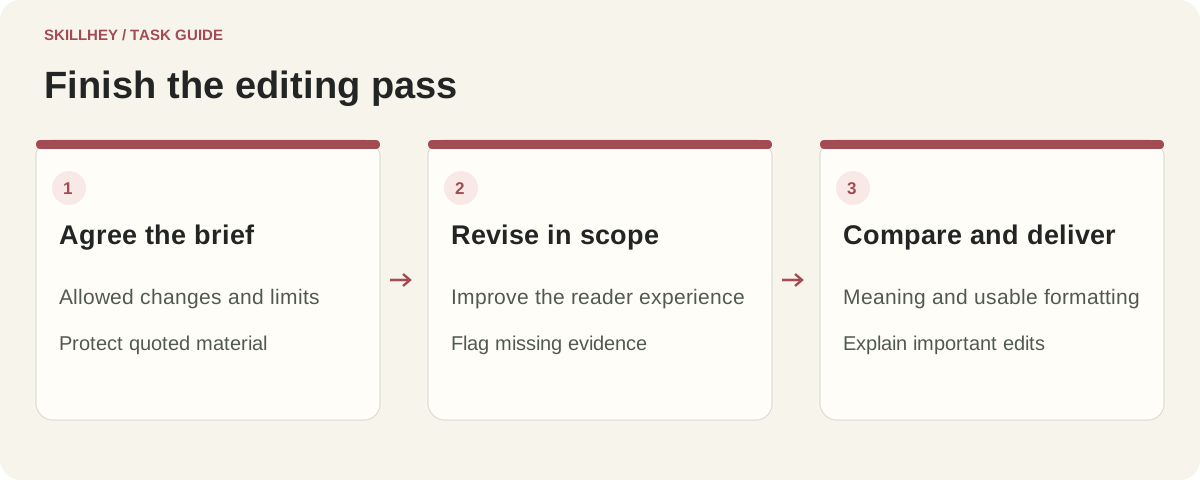
A short contract can state the scope, protected material, output format and stopping point:
Edit this customer update for readers seeing the feature for the first time.
Keep facts, dates, links, direct quotes and the stated uncertainty unchanged.
Improve the opening and remove repetition; preserve the technical explanation.
Return the revised text once, followed by a short account of meaningful edits.
Flag missing evidence instead of inventing it. Stop after the requested pass.
Adapt the scope to the task. A substantive rewrite may legitimately change section order. A copy edit may need to preserve it. If the writer wants an audit first, return findings rather than treating every observation as permission to edit a file.
Review the final piece from its destination. A customer email must work in an inbox. A specification must be precise enough for implementation. A blog needs a useful argument and clear sources. The appropriate finish depends on the reader's use of the text.
Frequently asked questions
Which writing Skill should I use for a blank page?
Document Co-authoring is a useful starting point for a substantial document whose context and structure are still developing. Waza Write also covers drafting tasks. Supply the purpose, reader and source material first; a blank page often reflects missing decisions rather than missing phrasing.
Which Skill helps with an existing English draft?
Inspect Waza Write or Avoid AI Writing, depending on whether you need a general scoped edit or a pattern-focused audit and revision. Give the original text and constraints. Use Preservation Verifier when you need a separate comparison of the revision and its protected content.
Do these Skills prove that text was written by AI?
No. Editing patterns can occur in human and model writing. A pattern-based review can suggest where prose is vague, repetitive or ineffective, but it does not prove authorship. Avoid presenting a detector score as a factual judgment about the writer.
Can the same workflow handle every language?
Read the entrypoint's language scope. Waza Write covers Chinese and English, while Avoid AI Writing's documented rules and checks are calibrated for English. Examples, idioms and editorial expectations do not transfer automatically between languages. Choose and review the workflow accordingly.
Should I install only the rewriting entrypoint?
Keep the resources its instructions reference. Anti Slop's copywriting task uses shared core material, and the Avoid AI Writing tasks share patterns and supporting tools. A separate catalog card identifies the task; it does not guarantee that copying one file creates a complete installation.
What is the most useful final review?
Compare the draft with the original evidence and the intended reader's task. Check facts, qualifications, promises, links and protected structure. Then read it as a complete piece. A shorter draft is useful only when it still tells the reader what they need to know.
Open a child Skill above, bring a real draft or source brief, and define one useful editing outcome. If the material needs stronger evidence first, begin with the research Skills guide.