Best SEO Skills for Claude Code and AI Website Audits
Latest update at: 2026-10-22
SEO skills at a glance
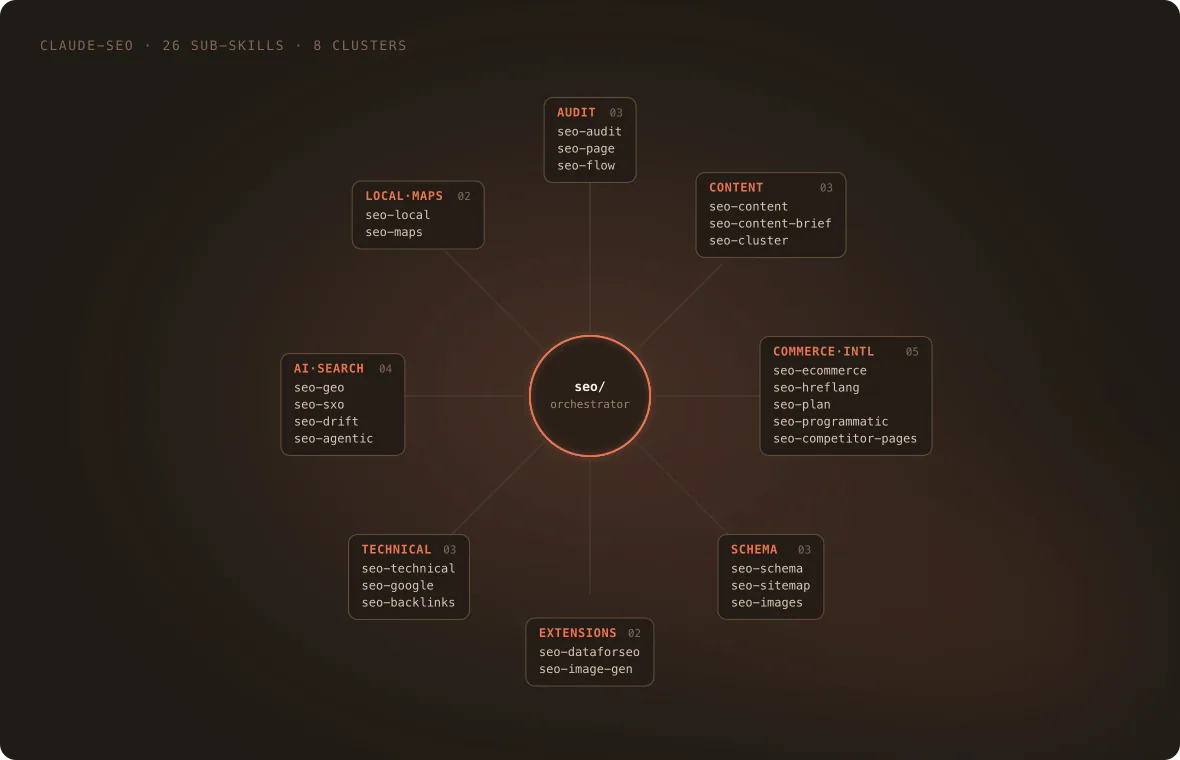
Claude SEO
Audit websites with Claude Code: technical SEO, content quality, schema, AI search, backlinks, and local SEO. Get prioritized findings and an action plan, with optional live-data integrations.
19KStars
SEO Audit
Review crawlability, indexing, on-page content and technical issues with prioritized findings.
54.9KStarsAI SEO
Audit AI search visibility, content extractability and sources that support brand citations.
54.9KStarsSchema Markup
Choose appropriate JSON-LD types, implement truthful markup and validate against page content.
54.9KStarsChoose the SEO job first
The best SEO skill depends on the question you need to answer. A site-wide audit, an investigation into missing AI citations and a broken Product schema are different jobs. They need different inputs, produce different reports and have different ways to check whether the work helped.
An agent skill supplies a repeatable method: what to inspect, which evidence to collect and how to turn findings into work. The agent still needs access to the website and any private analytics you want it to use. Installing instructions alone does not provide search-volume data, a complete backlink index or your Search Console history.
This guide compares published workflows and their documented requirements. The briefs are suggested tasks, not results from a shared performance benchmark. Claude SEO is a broader toolkit; SEO Audit, AI SEO and Schema Markup are focused entries from Corey Haines's Marketing Skills project. Those three share a source repository and should not be mistaken for three unrelated vendors.
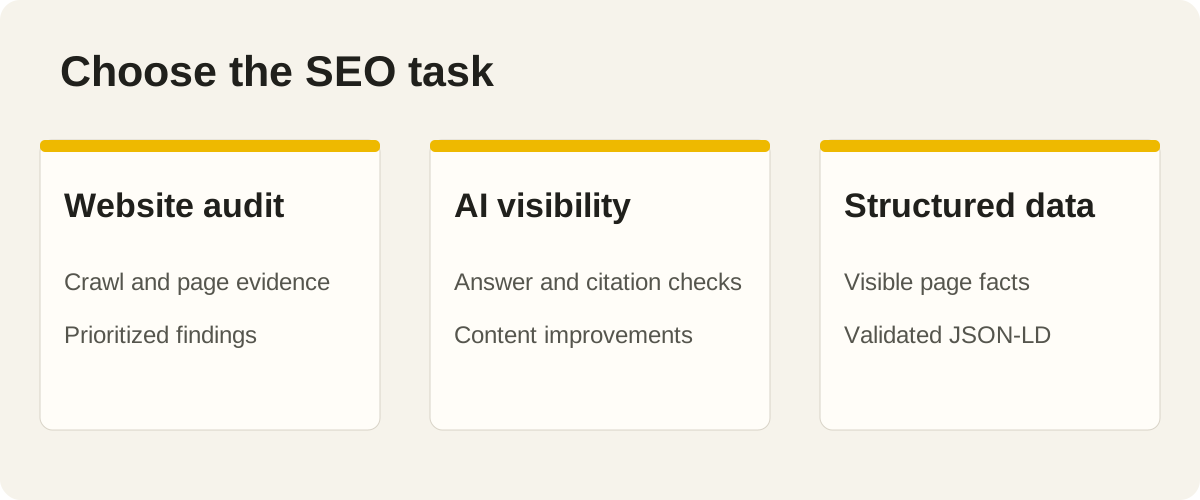
| Your immediate task | Start with | Useful deliverable | Evidence to provide |
|---|---|---|---|
| Investigate a website across several SEO areas | Claude SEO | An audit report and prioritized follow-up work | Website URL, business context and relevant data access |
| Find technical and on-page problems in a defined scope | SEO Audit | Findings tied to URLs, impact and recommended fixes | Representative pages, crawl output or rendered HTML |
| Understand discovery and citation in AI answers | AI SEO | Query observations and content or source improvements | A question set, target audience and observed answers |
| Add or correct structured data | Schema Markup | JSON-LD matched to visible page facts | Page content, existing markup and the intended page type |
1. Claude SEO: investigate a website across disciplines
Claude SEO is the broadest starting point in this selection. Its central entry routes work into specialist areas such as technical checks, content review, schema, sitemaps, AI search and local SEO. The official project documents a Claude Code plugin, supporting runtime files and optional data integrations.
Choose it when you need to connect several kinds of findings. For example, an important landing page might have a canonical problem, unclear content and weak links from related pages. A combined investigation helps you decide which issue to address first and what needs further measurement.
The tradeoff is setup and scope. A larger toolkit has more supporting files and workflows than a single checklist. Follow the current installation and runtime instructions rather than copying just one SKILL.md. Optional services require their own configuration and can have separate usage costs. Ask the agent to state which data sources actually worked before accepting the report.
A first brief could be:
Use Claude SEO to audit our English product website. Start with the homepage, one category page and two product pages. Record the URL and evidence for every finding. Separate confirmed issues from checks that need Search Console or another service. Give us five prioritized actions with an owner, reason and validation step. Keep the scope to these pages until we review the findings.
That produces a manageable first investigation. Expand after you understand the results, rather than treating a large health score as the final objective.
2. SEO Audit: turn page evidence into a repair list
SEO Audit is the focused option from Marketing Skills for technical and on-page investigation. Its published instructions organize checks around discovery, indexation, technical behavior and page content. They also call out a practical limitation: a text extraction can miss structured data that exists in the underlying or rendered page.
Use it when you already have a defined problem or a set of pages to review. A useful result should identify the affected URLs, show what the agent observed and propose an action you can verify. An unsupported statement that a site has “poor SEO” does not help a developer decide what to change.
For a catalog, start with one category and a few representative details. Include an empty state, a filtered URL and a paginated result if those are relevant. This helps the agent distinguish an intentional noindex policy from an accidental block and a normal canonical choice from inconsistent signals.
A practical brief:
Review this category page and three linked detail pages. Inspect their status codes, rendered titles, canonical URLs, robots directives, main headings and internal links. We intentionally exclude translated detail pages from indexing. Respect that policy. Produce a table of confirmed problems, evidence, proposed changes and the check we should run after each change.
The main benefit is a smaller decision surface. You can resolve one category's issues, review the changes and then apply the same checks to another part of the site. Keep the original evidence so a later reader can understand why a change was proposed.
3. AI SEO: examine answers, citations and extractable content
AI SEO focuses on visibility in AI-assisted discovery. The author's workflow includes checking answers for important questions, examining cited sources and reviewing whether a page presents information clearly enough to extract and attribute.
Choose it when your question is specific: which sources appear for a buying question, whether your product is described accurately, or which missing explanation makes a page less useful. Start with observations. Record the question, product, date and available citations so the next check has a meaningful reference.
This work overlaps with ordinary content quality. A page with a clear definition, original evidence, explicit limitations and useful source links is easier for people to assess as well. Google's guidance for AI features says that established SEO practices remain relevant; do not interpret an “AI SEO” label as a promise of inclusion or a guaranteed citation.
Try this brief:
Review how a first-time buyer researches our invoice software. Use the attached question list and saved AI answers. Identify factual errors, missing buying information and competing sources that answer the questions well. Recommend specific changes to our existing pages. Label observations separately from hypotheses, and explain how we can repeat the checks next month.
Keep access and measurement limits visible. If the agent cannot query a product or inspect citations, provide saved answers or mark that part unobserved. Plausible invented citations make a report less useful than an honest gap.
4. Schema Markup: describe what the page actually contains
Schema Markup handles a narrower implementation job: selecting a suitable type, creating or repairing JSON-LD and validating it against the page. The current upstream entry is named schema.
Use it after the page's facts are settled. For a product page, that means the real product identity, price and availability. For an article, it means the actual headline, author and publication information. A correct-looking object that contradicts visible content is not a sound implementation.
Two checks matter. The markup must be valid for the vocabulary, and any intended Google search appearance must meet Google's current requirements. Those are different questions. Google's structured-data introduction explains how markup can help it understand content; it does not make every valid type eligible for a special display.
A bounded implementation brief:
Inspect the JSON-LD on this English product page. Compare each property with the visible product information and our actual purchase flow. Propose corrections using the existing schema helper. Keep price and availability connected to the same data source as the page. Validate the rendered result, then list anything that still needs a business decision.
Keep schema generation close to the code that owns the facts. That reduces the chance of a future price, author or availability update changing the page while leaving a second hardcoded version inside the markup.
Prepare the inputs before installing more skills
A useful SEO brief includes your business model, audience, important pages and current concern. Explain which actions count as success: a qualified signup, a product purchase, a download or a useful contact. That context prevents a generic checklist from treating every page as equally valuable.
Supply relevant evidence in a form the agent can inspect. Useful inputs include a crawl export, a short list of Search Console queries, rendered HTML and screenshots of a page state. Date the files and identify the property or section they cover. If a report only contains one country's traffic or one language, say so.
Keep the scope explicit. “Review our three most important English product pages” is easier to validate than “fix all SEO.” Ask the agent to separate observations, assumptions and missing checks. A finding with a reproduction step is more useful than a confident paragraph without a source.
For installation, use the SkillHey getting-started guide and the selected project's current instructions. Full toolkits may need scripts, runtimes or plugin files in addition to their entry document. Compatibility with one agent does not establish that every command works identically in another host.
Start with one skill and one concrete task. Add a second workflow when it answers a different question, such as generating structured data after an audit has identified the affected page.
Review the output before changing the site
Ask for a repair list that someone else can execute. Each item should connect an observation to a consequence, a proposed change and a validation step. Include affected URLs and distinguish a site-wide rule from an issue on one page.
For example, “this URL returns noindex, although the page is intended for English search traffic” is actionable when supported by the response. “Every noindex page is an error” ignores intentional policies for private, duplicate or translated pages. The business's indexing policy is part of the evidence.
Prioritize by the importance of the affected journey and the confidence in the finding. A broken purchase landing page can deserve attention before a minor wording improvement across a large archive. Do not let an aggregate score hide those differences.
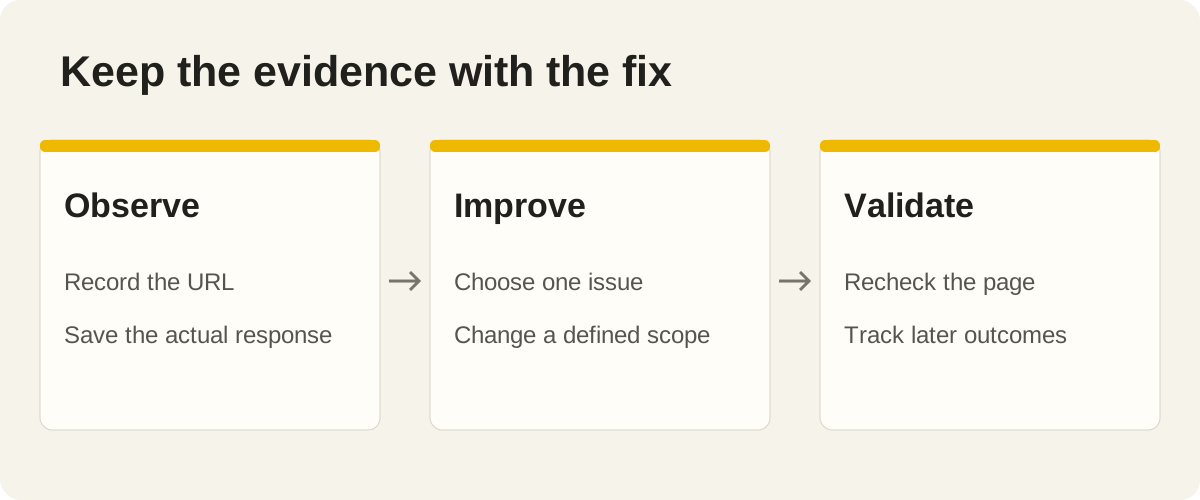
After a change, recheck the rendered page, relevant response headers, internal links and structured data. Then use your search reporting to observe what happens over time. A deployment can fix the implementation immediately; search visibility is a separate outcome to measure. Keep both records so the next audit starts from evidence rather than repeating the same recommendations.
Frequently asked questions
Which SEO skill should I start with?
Start with Claude SEO for a broader website investigation. Choose SEO Audit for a defined technical or on-page review, AI SEO for questions about AI answers and citations, or Schema Markup for structured-data implementation.
Are these four independent SEO projects?
No. Claude SEO is one project. SEO Audit, AI SEO and Schema Markup are focused entries from Corey Haines's Marketing Skills repository. They address different tasks within the same collection.
Do SEO skills include live keyword and backlink data?
Not automatically. Instructions can explain how to analyze data, but live services, private analytics and commercial datasets need access or configuration. Check which sources the agent actually used before accepting measurements.
Can I use these skills with Codex?
Check the selected project's current installation and host instructions. Some workflows use portable skill files, while others depend on Claude Code plugin commands, runtime files or integrations. Do not assume identical behavior across agents.
Will a skill guarantee rankings or AI citations?
No. A skill can help organize investigation, improve content and implement verified changes. Search rankings, AI citations and business outcomes still need separate measurement and cannot be guaranteed by installing a workflow.
Should I install the entire Marketing Skills collection?
Choose the task entries you need first. A focused audit, citation review or schema task is easier to assess than loading every workflow at once. Use the full collection when your work spans its other marketing tasks.
Choose a first task
Pick one important page, write down the question and gather the evidence needed to answer it. Open the relevant skill above, check its current setup and ask for a report you can reproduce.
Browse SEO and marketing skills, or continue with our guides to design skills, presentation skills and video skills.