Research Skills for AI Agents: Sources, Papers and Evidence
Last updated: 2026-10-26
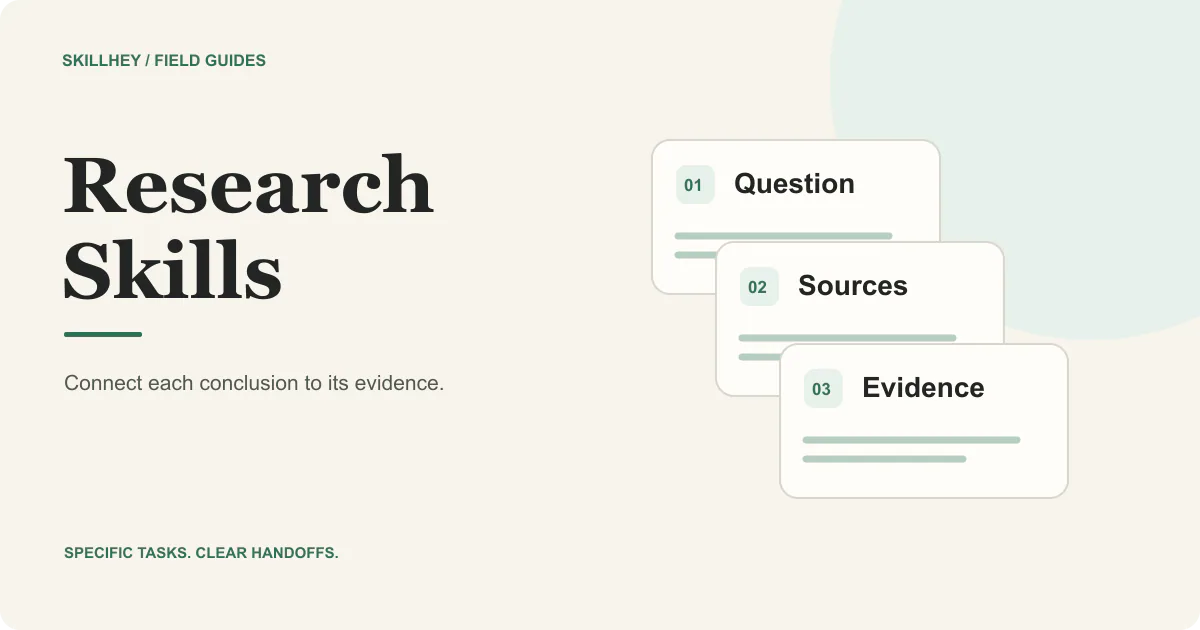
A research assistant can produce a convincing document while leaving the important question unanswered. The search may be too broad, the references may be incomplete, or the conclusion may reach beyond what the studies measured. Choosing a research Skill starts with identifying which part of that chain needs work.
The entries below are specific child workflows: framing a question, coordinating an investigation, finding literature, explaining a paper, checking references and screening studies. Several belong to the same source collections. The cards point to individual task pages so you can inspect the appropriate instructions without mistaking each task for an unrelated research product.
This guide uses the authors' published methods and documented dependencies. It does not report a comparative benchmark of research quality or claim that an installed Skill grants access to every academic database. Access, source coverage and human review remain part of the work.
Research task entrypoints
dbs-good-question · Research Question Design
Rewrite a vague question into a brief an agent can reason about, critique, and verify, and assess how much of it can be automated.
10.7KStarsAcademic Deep Research
Form research questions, search and verify literature, synthesize evidence, and produce a referenced research report.
52.3KStars
Nature Academic Search
Search literature across sources, manage references, verify citations and audit citation impact with explicit evidence.
48.5KStarsNature Paper X-Ray
Reconstruct a paper’s reasoning, experimental design and evidence limits, with worked examples for key formulas.
48.5KStarsNature Reference Verifier
Cross-check reference authors, titles, years, volumes and pages across sources, and report bibliographic inconsistencies.
48.5KStarsSystematic Review Screener
Screen study titles, abstracts and full texts against confirmed eligibility criteria, with adjudication, PRISMA counts and an Excel log.
52.3KStars| Where the work is stuck | Child Skill | Useful result |
|---|---|---|
| The question is broad or hard to evaluate | Research Question Design | A constrained question and a description of needed evidence |
| The investigation needs an organized process | Academic Deep Research | A research plan and a referenced synthesis |
| You need relevant literature and reference records | Nature Academic Search | A documented search and organized sources |
| A paper's reasoning is difficult to follow | Nature Paper X-Ray | An explanation of the argument, methods and evidence limits |
| Bibliographic details are uncertain | Nature Reference Verifier | Field-level checks and unresolved reference issues |
| A systematic review needs eligibility decisions | Systematic Review Screener | Recorded decisions against confirmed criteria |
Frame the question before collecting papers
Begin with the decision or uncertainty that prompted the research. “Research remote work” leaves the agent to choose the population, outcome, period and definition of success. “What evidence connects hybrid schedules with voluntary employee turnover in software teams?” offers a more useful starting boundary, even though its terms still need refinement.
Write down what would count as an answer. Do you need a map of competing explanations, an estimate, a historical account, or a recommendation under stated constraints? A literature overview can explain a field without resolving a particular organizational decision. Naming the intended use helps you avoid collecting impressive but irrelevant sources.
Research Question Design works on that early framing. Its upstream instructions turn a vague problem into something an agent can reason about and challenge. Supply the observed phenomenon, existing explanations, constraints and what a useful result would change. Keep unresolved assumptions visible instead of polishing them into certainty.
The method is especially useful when a request mixes several tasks. A team might ask for “the best retention strategy” when it first needs to identify which employees are leaving and why. A well-framed investigation can expose that missing input before the search begins.
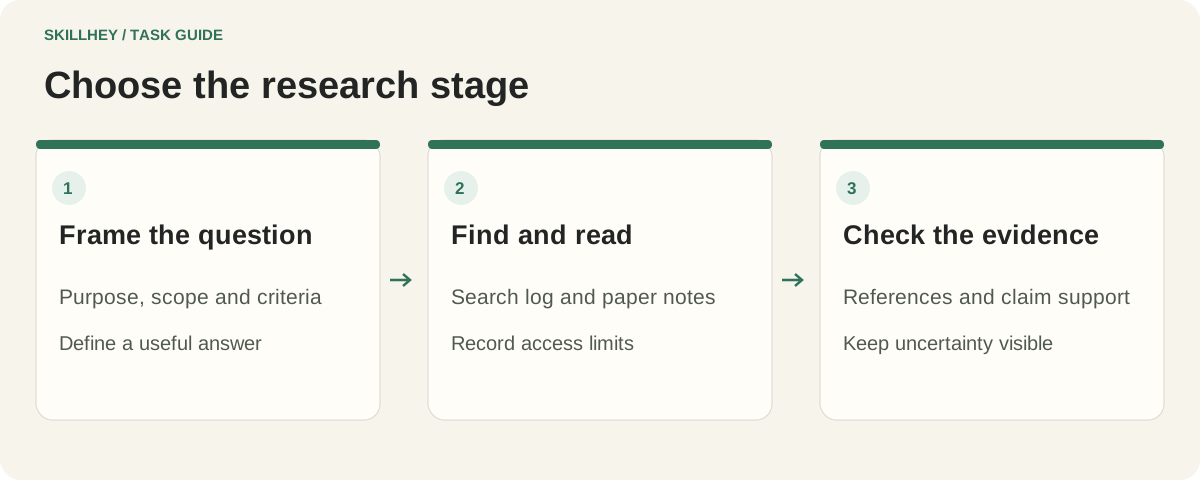
Academic Deep Research: coordinate the investigation
Academic Deep Research provides a structured academic investigation workflow. It covers research questions, literature work, evidence synthesis and a referenced output. Its documented process uses coordinated roles; the actual execution depends on your host's capabilities and the configured tools.
Read the task's official instructions before choosing the scope. A larger orchestration method creates more setup and coordination than a single paper-reading task. Specify the sources available, the intended depth, the time or tool budget, and the form of the final report.
A useful brief requests an evidence table alongside the narrative. For each important claim, keep the source, study or evidence type, relevant population, limitation and connection to the research question. That table lets a reviewer inspect the argument without treating the prose's confidence as a substitute for support.
Treat unavailable sources as a constraint. A title, abstract and full paper expose different levels of detail. If the workflow can only access an abstract, the report should identify that boundary instead of implying that the methods and supplementary material have been examined.
Nature Academic Search: find and organize literature
Nature Academic Search routes literature discovery and reference-management tasks through its supporting workflow fragments. The entrypoint distinguishes different jobs rather than loading every reference for every request. Follow the selected route and its current setup requirements.
Record the search terms, sources, date and filters. Those details allow another person to understand why the resulting set contains some papers and misses others. A list of links is a useful starting artifact, but it does not show whether the search covered the question adequately.
Search vocabulary should reflect the field's language. One concept may be discussed under several terms, and a familiar everyday phrase can have a narrower technical meaning. Keep useful synonyms and document the choices. When revising a query, note why the change improved relevance rather than silently replacing the earlier search.
The Nature collection marks these workflows with their upstream maturity and dependencies. Keep the referenced resources and shared components where required. Search services, model access and external APIs are configured separately from the Skill files, so check what is available in your environment before promising coverage.
Nature Paper X-Ray: examine the argument inside a paper
Finding a relevant paper creates a reading task. Nature Paper X-Ray is aimed at reconstructing the authors' reasoning, experimental design and evidence limits. Its published workflow asks for an explanation suited to the paper's type and structure.
Give the agent the full paper when you can, together with the question you want to understand. Ask it to identify what was measured, the comparison being made, the assumptions connecting observations to conclusions, and the important limitations. Keep the paper's own claim separate from a broader implication you are considering.
For a quantitative paper, an explanation of a central equation should retain the meaning of its variables and conditions. For a qualitative study, inspect sampling, context and interpretation. A single fixed summary template can hide these differences. The useful output is an account of how this particular paper supports its conclusions.
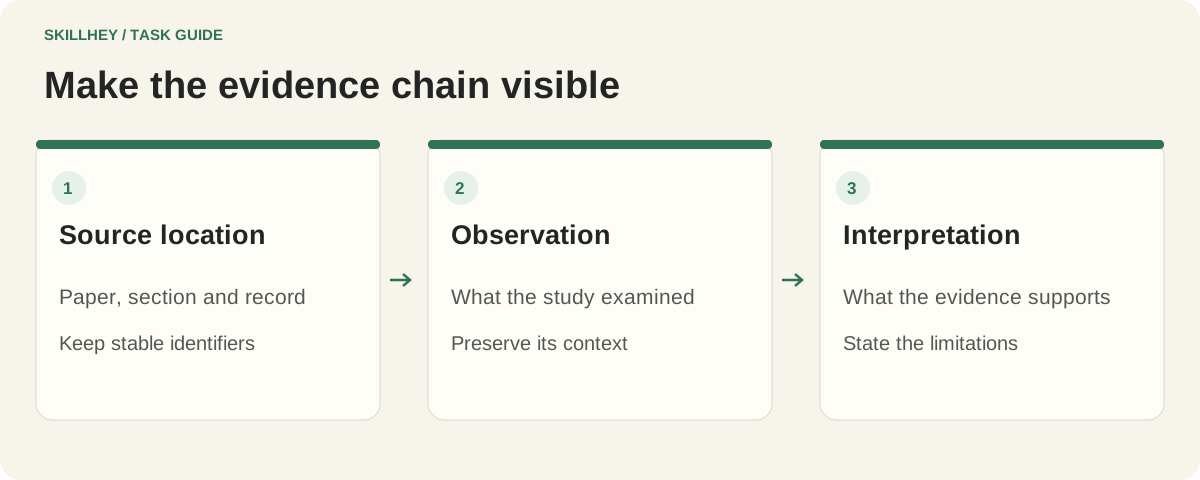
Reference Verifier: check the bibliography's records
Nature Reference Verifier compares reference details across sources and records discrepancies. Its official instructions focus on fields such as titles, identifiers, authors and publication information. This is useful when imported references, copied citations or draft bibliographies contain inconsistencies.
Provide the original records and keep their identifiers during the review. Ask for a result that distinguishes verified fields, corrected fields and unresolved conflicts. If two sources disagree, retain enough information for a person to adjudicate rather than merging them into a record that no source actually contains.
Bibliographic accuracy answers a limited question. A correct title and DOI can establish that a reference points to a particular work. They do not establish that the paper supports the sentence citing it. Checking that relationship requires reading the relevant passage, identifying its context and comparing it with the draft's claim.
That distinction matters in a writing workflow. Keep a reference audit and a claim-to-source review as separate artifacts, even if the same agent helps with both. Each needs a clear stopping condition and a visible list of unresolved questions.
Systematic Review Screener: apply agreed eligibility criteria
Systematic Review Screener is a protocol-driven screening workflow. Its task instructions cover study records, explicit eligibility criteria, decisions, adjudication and screening logs. It is designed for a specific research stage, rather than a casual request to “find the best papers.”
Confirm the criteria before processing the set. Include the population, intervention or exposure where applicable, outcomes, study types and any date or language restrictions. Decide how uncertain cases will be handled. A title or abstract that does not provide enough information should not receive an invented rationale.
Preserve stable study identifiers and record the reason for each exclusion. When the protocol changes, retain the change and identify records that need another pass. Counts in a screening report should be derived from those decisions, with duplicates and unresolved records handled consistently.
Automated assistance can organize the work, but a formal review's methodological requirements still apply. Human reviewers should own the protocol and resolve disagreements. The presence of a screening Skill does not by itself establish that a review follows a particular reporting standard.
A small research brief you can reuse
Describe the problem, intended reader, scope and output together. For example:
Question: What evidence links hybrid work arrangements with voluntary
turnover in software teams?
Use: prepare a decision memo, not a causal claim from one study.
Scope: distinguish software-team evidence from broader office populations.
Output: search log, evidence table, competing explanations and open questions.
For each conclusion: name the source and the limit of the supporting evidence.
Do not invent missing methods or treat abstract-only access as full-text review.
This is an illustrative brief, not a completed research result. Adapt its boundaries to the actual decision. If the investigation is exploratory, say so. If a protocol is already fixed, supply it directly and identify which choices the agent is allowed to revisit.
When a PDF needs preparation before it can be read, use a focused document workflow from the PDF Skills guide. Keep the extracted text and the source pages connected. A clean transcript makes analysis easier, but it does not resolve questions of interpretation or evidence quality.
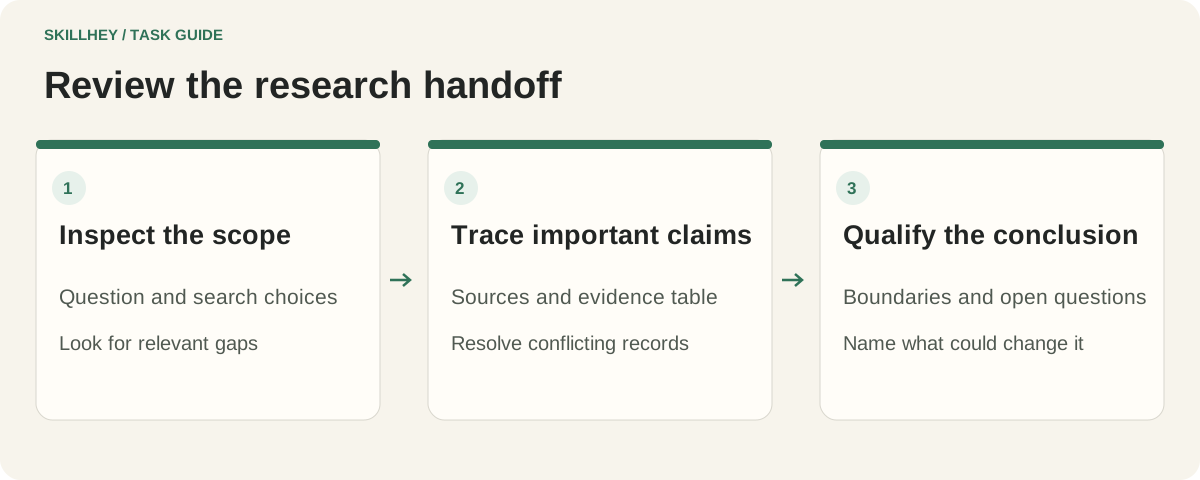
Review the handoff before using the conclusion
Read the report's central claims beside the evidence table. Look for changes in population, outcome, period or certainty between the source and the summary. A result from one setting may be relevant to another without directly proving the same outcome there.
Check whether the search included disagreement and negative results, and whether the report distinguishes gaps from contradictions. An unanswered question is a useful finding when the available evidence cannot settle the decision. Keep that uncertainty in the final memo rather than treating a fluent conclusion as a requirement.
Finish with a short list of what would change the answer: a missing source, a more relevant population, an additional observation or a different constraint. That makes the research reusable when new information arrives. For the drafting stage, the writing Skills guide explains how to preserve those qualifications while improving readability.
Frequently asked questions
Which research Skill is the best starting point?
Start at the stage that is currently unclear. Frame the question when scope is unsettled, search when sources are missing, read a paper when its argument is difficult, and verify references when records conflict. A larger orchestration workflow is useful when the investigation itself needs coordination.
Will installing a Skill provide paid database access?
No. Skills provide task instructions and sometimes supporting tools. Database subscriptions, browser sessions, APIs, model access and local runtimes are separate dependencies. Read the selected child Skill's setup and state which sources the agent can actually access.
Does a verified citation prove a claim is true?
A reference check can confirm bibliographic details. Whether that reference supports a particular claim requires reading its evidence and context. Keep the record check, the interpretation of the paper and the strength of the final conclusion separate.
Can a paper summary be used as a systematic review?
A summary and a systematic review answer different needs. A systematic review needs an explicit method for finding, screening and synthesizing studies. A screening task can support part of that process, but a collection of summaries does not establish complete coverage or protocol compliance.
Why do several entries come from the same collection?
They are different task entrypoints within shared source projects. Nature Academic Search, Paper X-Ray and Reference Verifier cover different stages. Their presence in one guide explains how to route work; it does not imply that they are independent vendors or separately benchmarked research systems.
What should a useful research handoff include?
Keep the question, search scope, source list, evidence table, qualified conclusions and unresolved issues together. Include enough identifiers and source locations to check important claims. The receiving person should be able to inspect the reasoning without reconstructing the agent's conversation.
Choose a child Skill from the cards above and give it one bounded research task. Open the linked upstream instructions before expanding the workflow to additional stages.