8 Anti AI Slop Skills for Editing Writing
Last updated: 2026-11-01
An AI draft can be grammatically clean and still leave the reader with very little. It may announce that a change is important without explaining what changed, repeat the same three-part rhythm, or turn an uncertain observation into a confident result. A useful edit should make the text clearer while keeping the facts, intent and voice that made it worth writing.
These eight Skills approach that job differently. Some inspect a draft before changing it; others rewrite prose, focus on Chinese, or apply rules to product copy. The descriptions below follow their published instructions. They are not a ranking from a shared benchmark, and a writing pattern cannot establish whether a human or an AI wrote a text.
Humanizer
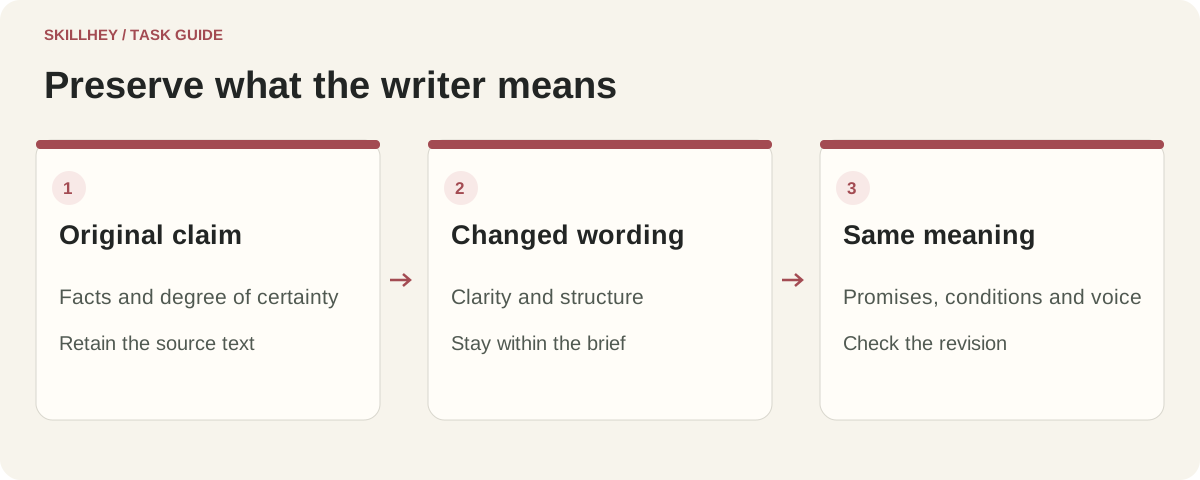
Edit formulaic AI prose while preserving the original facts, meaning, uncertainty and author voice.
57.4KStarsHumanizer Chinese Editing
Edit vague, repetitive and formulaic Chinese prose while preserving facts, qualifications and the writer’s voice.
19.8KStarsqu-ai-wei — Simplified Chinese Editing
Revise formulaic Simplified Chinese while preserving the author’s facts, voice and register.
707Stars
dbs-ai-check · AI Writing Pattern Review
Scan writing for patterns associated with machine-generated prose and deliver a diagnostic report; rewriting is outside the default task.
10.7KStarsAvoid AI Writing — Audit and Rewrite English
Audit and revise formulaic English writing while preserving facts, structure and the author voice.
5KStars
Stop Slop Writing
Draft and revise prose to remove stock AI phrasing, predictable structures and unnecessary verbal padding.
18.4KStars
Anti Slop — Clear Copywriting
Improve headlines, prose, tone and calls to action with the core antislop writing rules.
6.2KStarsSepia Writing Skills
Writing and editing workflows for fiction and professional prose, from diagnosis to focused revision and full rewrites.
3.6KStarsChoose by language and task
| If you need to… | Start with | What to know |
|---|---|---|
| Edit formulaic English prose | Humanizer | Reviews patterns and rewrites while keeping supported claims and voice. |
| Polish an existing Chinese draft | Humanizer Chinese Editing | Focuses on preserving meaning, register and file structure. |
| Restructure a Simplified Chinese draft | qu-ai-wei | Can work across sentences, paragraphs and long-form structure; editing scope matters. |
| Get a Chinese writing-pattern report first | dbs-ai-check | Diagnoses by default; the author decides whether to pursue changes. |
| Audit or revise English with an explicit editing contract | Avoid AI Writing | Offers detection and revision modes, with separate preservation tools. |
| Apply a strict, direct prose style | Stop Slop Writing | Its rules are deliberately prescriptive; review them against the intended voice. |
| Improve a headline, offer or call to action | Anti Slop Clear Copywriting | Uses shared Anti Slop core rules alongside copy-specific instructions. |
| Choose a review, light edit or full rewrite | Sepia | Routes fiction and professional writing differently; its task entries share a core Skill. |
Before choosing a Skill, decide how much change the draft can tolerate. A customer update may need its dates and qualifications preserved. An essay may also need its author’s digressions and point of view. A product headline has a different job again: it must accurately tell a prospective customer what is offered.
Humanizer: edit patterns without inventing details
Humanizer is a general prose-editing Skill based in part on Wikipedia’s Signs of AI writing. Its instructions cover stock contrasts, staged introductions, repetitive conclusions and inflated claims. They also tell the editor to keep supported claims and avoid adding facts.
Use it when a draft already says what you mean but keeps getting in its own way. Supply the intended reader, the text and, if voice matters, a short writing sample. Ask it to preserve the claims and explain substantive changes. Humanizer considers patterns in paragraphs as well as individual sentences; simply replacing a few suspect words may leave the same structure in place.
The examples and vocabulary in its instructions are predominantly English. A deliberate turn of phrase, a quotation or a technical term may have a good reason to remain, even if it resembles a listed pattern.
Humanizer Chinese Editing: polish while protecting the file
Humanizer Chinese Editing adapts the task to existing Chinese prose. Its upstream instructions prioritize information, certainty and the requested editing scope before stylistic cleanup. They explicitly protect terms such as “可能” and “计划” when they carry meaning, even if the final wording changes.
This is a practical choice for polishing a Chinese article, comment or document without turning it into a summary. Tell it which parts may change and provide a voice sample if you have one. Its file-editing instructions also protect code, links, frontmatter and, by default, heading structure. A Skill can preserve the contents of a claim without verifying that the claim is true; check sources separately when accuracy is in question.
qu-ai-wei: work on Simplified Chinese structure
qu-ai-wei focuses on existing Simplified Chinese text. The project instructions allow a requested rewrite to change sentence order, paragraphs and longer information structures, while protecting facts, attribution, evidence strength and the author’s voice.
Choose it for a Chinese draft whose problems extend beyond word choice: the main point comes late, several paragraphs repeat the same idea, or a sentence’s subject is buried under a long introduction. Specify whether you want polishing or a broader rewrite. The Skill’s default output includes an initial assessment, a final draft and a short editing report; ask for only the final text if that fits your workflow.
It is not a translation tool or a tool for writing a new article from scratch. Keep its referenced files when installing it, and provide the destination and audience when those affect the desired register.
dbs-ai-check: identify passages before deciding what to change
dbs-ai-check takes a diagnostic-first approach. Its instructions ask it to quote passages and explain the observed writing patterns in a report. It does not rewrite by default; subsequent changes are guided by the writer’s intent and preferences.
Use it when you can feel that a Chinese draft sounds repetitive but want to see the specific passages before authorizing a rewrite. Provide the genre as well as the text: a repeated phrase in a speech or a tightly structured list in a tutorial may be intentional.
Treat its severity labels as editorial judgments, not evidence of authorship. A report can be useful even when you disagree with a finding. The project lists a noncommercial license for this Skill; check its license terms and any required commercial permission before use.
Avoid AI Writing: set the editing contract first
Avoid AI Writing provides an English-focused workflow for auditing and revising formulaic prose. Its main entrypoint distinguishes detection from authorization to edit and sets boundaries around facts, protected content and voice.
Choose a mode before starting: report findings, return revised text, or edit a named file. For a routine cleanup, specify whether quotations, headings, links, code and the order of sections must remain unchanged. The project also includes a Preservation Verifier to compare a revision with protected material. A separate comparison is especially useful when several people will review the result.
The project’s pattern rules and detector are calibrated for English. It includes supporting references and tools, so follow the installation instructions rather than assuming that a copied entrypoint is the entire package. Report a scripted check as run only if the relevant tool actually executed.
Stop Slop Writing: a stricter editorial style
Stop Slop Writing aims for direct prose and applies a stronger set of defaults. Its rules target filler, formulaic contrasts, repetitive rhythm and vague statements. It also tells the writer to remove adverbs and passive constructions and avoid em dashes.
That strictness can be useful when you want a sharp editorial pass on an English draft. It is also a reason to review the output carefully: passive voice can be appropriate when the actor is unknown, and an adverb can change a factual claim. Provide a house style or protected phrases when those matter, and do not let a style rule turn “may reduce delays” into “reduces delays.”
Anti Slop Clear Copywriting: make the offer legible
Anti Slop Clear Copywriting applies anti-slop rules to headlines, landing pages, product copy and calls to action. The copywriting instructions are designed to be used with the project’s shared core rules. They emphasize concrete language, preserving voice and not inventing facts or testimonials.
Give the Skill the actual product behavior, audience and evidence. If a button downloads a CSV file, “Download CSV” tells the reader more than “Unlock your data.” Do not ask the editor to fill an evidence gap with an invented customer, metric or promise. A stronger claim requires a source, not a stronger adjective.
Sepia: choose the depth of the edit
Sepia separates four operations: write new material, review without editing, refactor with focused changes, or recreate a draft through a more substantial rewrite. Its instructions route fiction differently from professional formats such as release notes, technical articles and postmortems; they also include Chinese-language style guidance.
Use review when you want findings first. Choose refactor when the structure and voice should mostly stay in place, or recreate when you have authorized a deeper rewrite. Sepia also offers a separate fiction entry using an optional Hemingway profile. A style profile is a choice, not a requirement for every piece.
The direct task entries depend on the shared Sepia core and its references. Install the complete package, including the core and the entries you intend to use; a copied task wrapper alone is not supported. Its diagnostic rules are editing guidance, not a guarantee of any detector result.
A small example: edit the claim, not the evidence
Imagine a team’s original note says:
We interviewed six workshop attendees. Four found the printed schedule hard to scan. We have not measured whether a redesign would reduce missed sessions.
A draft expands it into: “Our transformative schedule redesign will help attendees navigate every session effortlessly.” That sentence drops the interview context, promises a redesign outcome and adds a claim about every session. Removing “transformative” alone would leave the unsupported promise behind.
A faithful edit could say: “Four of six attendees we interviewed found the printed schedule hard to scan. We have not measured whether a redesign would reduce missed sessions.” The example illustrates the review principle; it is not presented as the output of a test run of these Skills.
Give the Skill a useful brief
Use one primary workflow for the task instead of running every Skill over the same paragraph. A second, independent comparison can help when preservation matters. A practical brief is:
Edit this draft for [reader and destination].
The goal is [specific reading problem to fix].
You may change [sentences / paragraphs / section order].
Keep facts, numbers, quotations, links and stated uncertainty unchanged.
Preserve [voice, terminology, formatting or other protected material].
Flag missing evidence rather than inventing details.
Return [findings only / the revision and a short change note].
Afterward, compare the draft with the source for changes to numbers, negation, conditions, quotations, attribution and certainty. Read it in the place it will appear: an onboarding email, an academic article and a product landing page have different needs. The goal is prose that helps its reader, not a lower count of words from a list.
Frequently asked questions
Which Skill should I use for a Chinese draft?
Start with Humanizer Chinese Editing for a scoped edit of existing prose, qu-ai-wei when a Simplified Chinese draft needs restructuring, or dbs-ai-check when you want a diagnostic report first. Give any of them the intended audience and the degree of editing you authorize.
Can these Skills prove a text was written by AI?
No. People and models can use the same phrases, structures and punctuation. A pattern can suggest a passage to inspect; it cannot establish authorship or justify an accusation.
Should I remove every phrase on a pattern list?
No. A phrase may communicate a real contrast, a needed qualification or a writer’s deliberate voice. Judge whether it serves the reader in context, and keep quotations and protected material intact.
Can a rewrite add examples or stronger claims?
Only when the author supplies or explicitly authorizes the new material. A plausible example is not evidence. When an important detail is missing, ask for it or mark the gap for review.
Do these Skills work without their supporting files?
Not always. Sepia’s direct task entries require the shared core, and other projects refer to rule files or tools. Read each repository’s installation instructions and keep the resources its entrypoint requires.