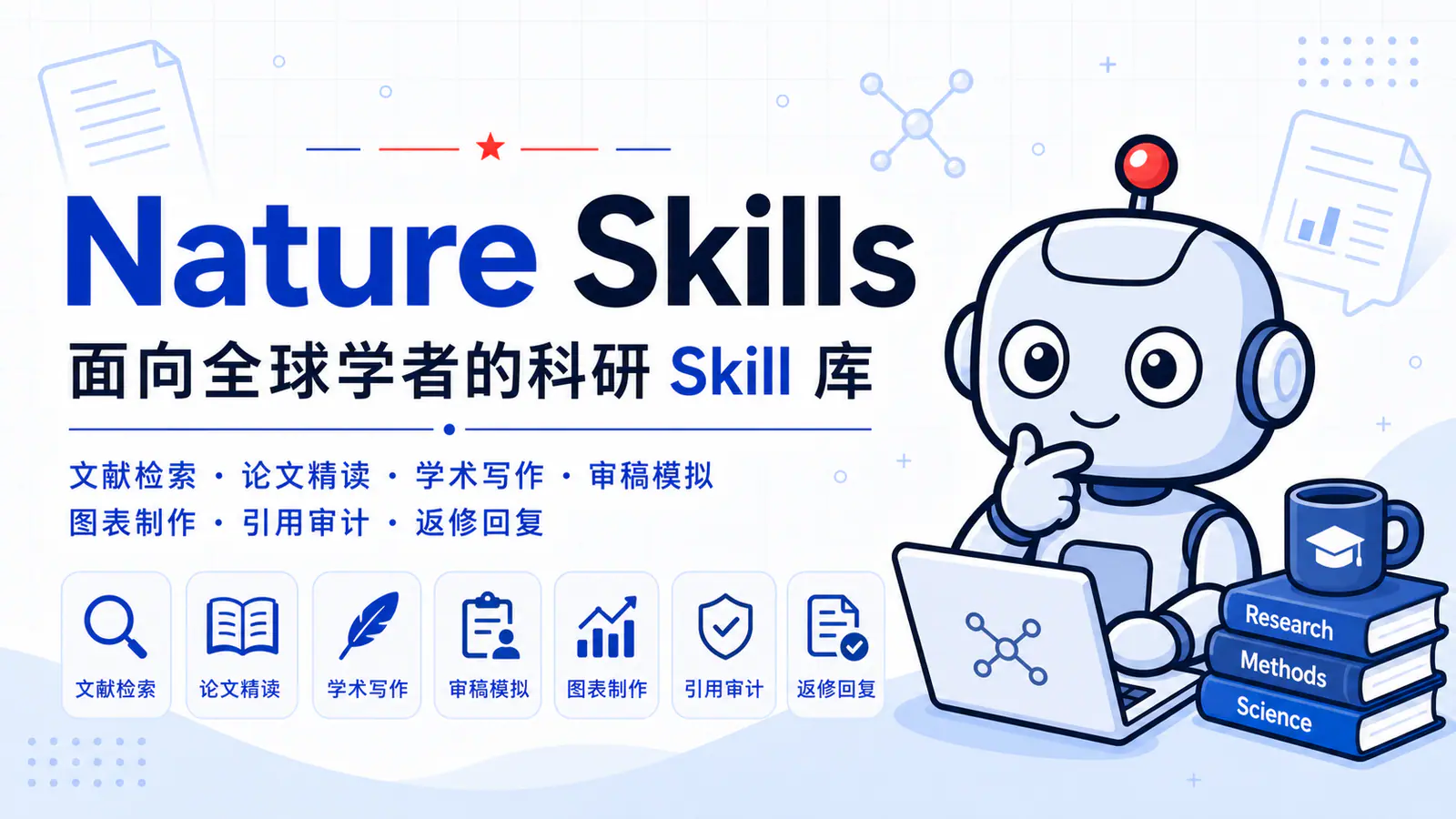
Nature Skills repository banner with a research robot and its literature, writing, review and figure workflows.
Project screenshotsAbout this Skill
Nature Skills is a community-maintained repository founded by Yizhe Yuan. It organizes research tasks as full Skill folders, from finding and reading papers through drafting, figures, statistical reporting and reviewer responses. Each workflow has its own instructions and supporting files. This collection lists 22 user-facing Skills from the reviewed repository; nature-shared supplies shared references.
Why we picked it
Separate, task-focused workflows cover the research cycle, with source checks, editable deliverables and shared references. This listing follows the repository’s 22 triggerable Skills; nature-shared is documented as a supporting dependency.
Skills in this collection
22 skills- View →
Nature Figure
Create scientific figures in Python or R, with multi-panel layout checks, editable outputs and optional AI schematic drafts.
- View →
Nature Polishing
Polish or translate academic prose while preserving facts, terminology, numerical precision and the scope of the evidence.
- View →
Nature Writing
Draft manuscript sections and initial-submission materials from supplied evidence, or restructure a scientific argument.
- View →
Nature Reviewer
Simulate evidence-grounded peer review with independent reviewer reports and prioritized major and minor concerns.
- View →
Nature Citation
Find Nature and CNS-family papers that support specific manuscript claims, verify sources and export reference-manager files.
- View →
Nature Data
Prepare Data and Code Availability statements, repository plans, dataset citations and FAIR metadata checks.
- View →
Nature Statistics
Audit statistical reporting across methods, results and figure legends, including replication, uncertainty and multiple comparisons.
- View →
Nature Reader
Create source-linked Chinese-English Markdown paper readers with aligned text, figures, tables and equations.
- View →
Nature Paper X-Ray
Reconstruct a paper’s reasoning, experimental design and evidence limits, with worked examples for key formulas.
- View →
Nature Paper Translation
Translate an English paper PDF into a Chinese image-based PDF, preserving page layout and checking each translated page.
- View →
Nature Paper Card
Build a structured paper-reading card covering methods, evidence chains, limitations and testable research ideas.
- View →
Nature Response
Prepare point-by-point reviewer responses, revision cover letters, marked manuscripts and consistent revision packages.
- View →
Nature Paper to PPT
Turn scientific papers or reading notes into Chinese PPTX research presentations with source figures and speaker notes.
- View →
Nature Image to PPT
Reconstruct slide images, scanned PDFs and image-only decks as object-level editable PowerPoint, with render comparisons.
- View →
Nature Paper to Patent
Draft Chinese invention patent and technical disclosure materials from research evidence, including claims and prior-art comparisons.
- View →
Nature Reference Verifier
Cross-check reference authors, titles, years, volumes and pages across sources, and report bibliographic inconsistencies.
- View →
Nature Academic Search
Search literature across sources, manage references, verify citations and audit citation impact with explicit evidence.
- View →
Nature Downloader
Retrieve academic full text through open-access, publisher API and authorized institutional or browser access.
- View →
Nature Literature Pipeline
Automate literature discovery, configurable scoring, reading, delivery and local archival through a scheduled workflow.
- View →
Nature Experiment Log
Turn experiment images, voice notes and text into structured Markdown logs with YAML metadata and optional Obsidian or Feishu integration.
- View →
Nature Proposal Writer (researchwrite)
Develop or audit research proposals and plans through evidence, argument and section contracts before drafting.
- View →
Nature Social Science
Frame social-science research questions, literature maps, evidence routes and defensible claims, then review novelty and feasibility.
What it helps with
- Researchers reading papers, checking references and preparing manuscript drafts.
- Research groups preparing scientific figures, journal-club slides and review responses.
- Teams organizing literature discovery, research proposals and experiment records.
Choose a workflow for the task
Read and search
Academic Search, Citation, Reference Verifier, Downloader and Literature Pipeline find or audit sources. Reader, Paper X-Ray, Paper Card and Paper Translation offer different reading outputs.
Write and review
Polishing improves existing prose; Writing drafts or restructures manuscripts; Reviewer simulates peer review; Response prepares revision correspondence. Proposal Writer is invoked as researchwrite.
Figures, slides and records
Figure supports Python/R plots and optional AI schematics. Paper to PPT and Image to PPT create presentations through different inputs. Data, Statistics, Experiment Log, Social Science and Paper to Patent address specific research outputs.
Install the selected Skill and its dependencies
The npx installer needs Node.js 18+. List the frontmatter names first, then choose the workflow. For a reader installation, include nature-shared. Omit --global for the current project or add it when you want an installation shared across projects. Restart the agent session after installing.
| Command | What it helps with |
|---|---|
npx skills add Yuan1z0825/nature-skills --list | List installable names without installing files. |
npx skills add Yuan1z0825/nature-skills --agent codex --skill nature-reader --skill nature-shared --yes --copy | Install a paper reader and its shared support for Codex in the current project. |
npx skills add Yuan1z0825/nature-skills --agent claude-code --skill nature-reader --skill nature-shared --yes --copy | Install the same pair for Claude Code. |
git clone https://github.com/Yuan1z0825/nature-skills.git | Keep a complete clone for the upstream OpenCode/Hermes integration instructions. |
Upstream installation instructionsOpenCode and Hermes integrationShared reference package
Runtime tools and external costs
The repository files are free to access. Agent subscriptions, model calls, image services and licensed databases have separate access requirements or costs. Python/R plotting, PowerPoint reconstruction and patent document tools need their respective local dependencies. Academic Search may require PUBMED_EMAIL or provider credentials; Downloader requires authorized access for protected sources.
The upstream index marks workflows Stable, Beta or Draft. Those are upstream development labels. Generated scientific claims, figures, translations and references still require the researcher’s review.
Upstream Skill indexAcademic Search dependenciesDownloader prerequisitesFigure workflow
Banner and Nature Figure screenshot
The first image is the requested repository banner. The second is the supplied Nature Figure web interface screenshot showing a three-panel ROC figure and download choices. It illustrates the author’s web product; this catalog entry links to the open-source repository and does not bundle or test that separate hosted service.
Original repository bannerAuthor’s hosted Nature Skills application
Authors and licensing
The repository is maintained by Yuan1z0825 and contributors under Apache-2.0. The frontmatter of Experiment Log, Literature Pipeline and Proposal Writer declares MIT; check the relevant file and third-party asset terms when reusing material.
Before you use it
- An agent that can read complete local Skill directories and run the tools required by the selected workflow. Upstream documents Claude Code, Codex, OpenCode and Hermes integrations.
- Keep the whole Skill folder, including scripts, references and assets. Preserve the sibling nature-shared package whenever the workflow references it.
- Model access, Python/R packages, MCP services, browser logins and external API credentials are configured separately when required. Installing Skill files does not install these dependencies.
Supported agents
Frequently asked questions
Should I install nature-shared as a separate workflow?
It is shared-reference support, not a user-facing triggerable workflow. Install it beside workflows that reference its files.
Why does Proposal Writer use the name researchwrite?
The directory is nature-proposal-writer, but its SKILL.md frontmatter declares researchwrite. Use the name returned by --list when selecting it with npx skills.
Sources & references
Original sources are linked below. Practical starting points are editorial suggestions from SkillHey.