Free
SEO & marketing
dbs-script-flow · Spoken Script Flow
Review paragraph transitions, information density, and spoken flow in a short-video script to locate likely viewer drop-off points.
11.4KStars1.3KForks
Repository last pushed
dontbesilent
These skills help an agent edit drafts so they read clearly and sound like a person wrote them. Many target AI writing patterns; others handle Korean, Japanese and Chinese editing.
39 skillsReview paragraph transitions, information density, and spoken flow in a short-video script to locate likely viewer drop-off points.
Review existing marketing copy for clarity, voice, evidence, specificity and perceived risk.
Polish or translate academic prose while preserving facts, terminology, numerical precision and the scope of the evidence.
Route a Korean editing request through the shared pipeline at the selected level of detail.
Revise formulaic prose while preserving the writer voice, facts, intent and protected material.
Diagnose and revise formulaic Korean prose through the shared humanize-korean workflow.
Write and edit Japanese work documents, reports, meeting notes, articles, and emails while preserving the source's facts and level of certainty.
Inspect Korean writing patterns and show a small sample revision before a fuller editing pass.
Make targeted edits in an explicitly selected draft file and verify the resulting text.
Inspect writing patterns without rewriting, with an optional deterministic local Node.js detector.
Make focused revisions while preserving the draft’s structure, voice and intent.
Draft, rewrite, and polish Chinese or English prose, technical instructions, and product copy.

Keep final artifacts, labels, commits, and handoffs focused on accepted requirements after a conversation includes corrections or discarded proposals.
Write and revise technical instructions using Simplified Technical English rules for words, sentence structure, procedural steps, and safety notices.
Write or revise fiction using Sepia’s optional Hemingway voice profile.
Review titles, text, subtitles, spoken lines, profile copy, comments, and video material for potential platform signals and substantive issues, with specific minimal edits.
Draft and revise Chinese articles, commentary, tutorials, narratives, and scripts with attention to evidence, authorial voice, and natural rhythm.
Review Chinese social-media drafts, subtitles, and cover copy for publication risks, with cited findings, meaning-preserving edits, and a reusable local rulebook.
Revise AI-generated Japanese with a structured editorial pass that preserves meaning and improves natural phrasing and readability.
Scan writing for patterns associated with machine-generated prose and deliver a diagnostic report; rewriting is outside the default task.
Diagnose writing patterns and report findings without editing the draft.

Improve headlines, prose, tone and calls to action with the core antislop writing rules.
Audit invisible Unicode and polish authorized prose while preserving facts, citations, quotations and the writer's voice.
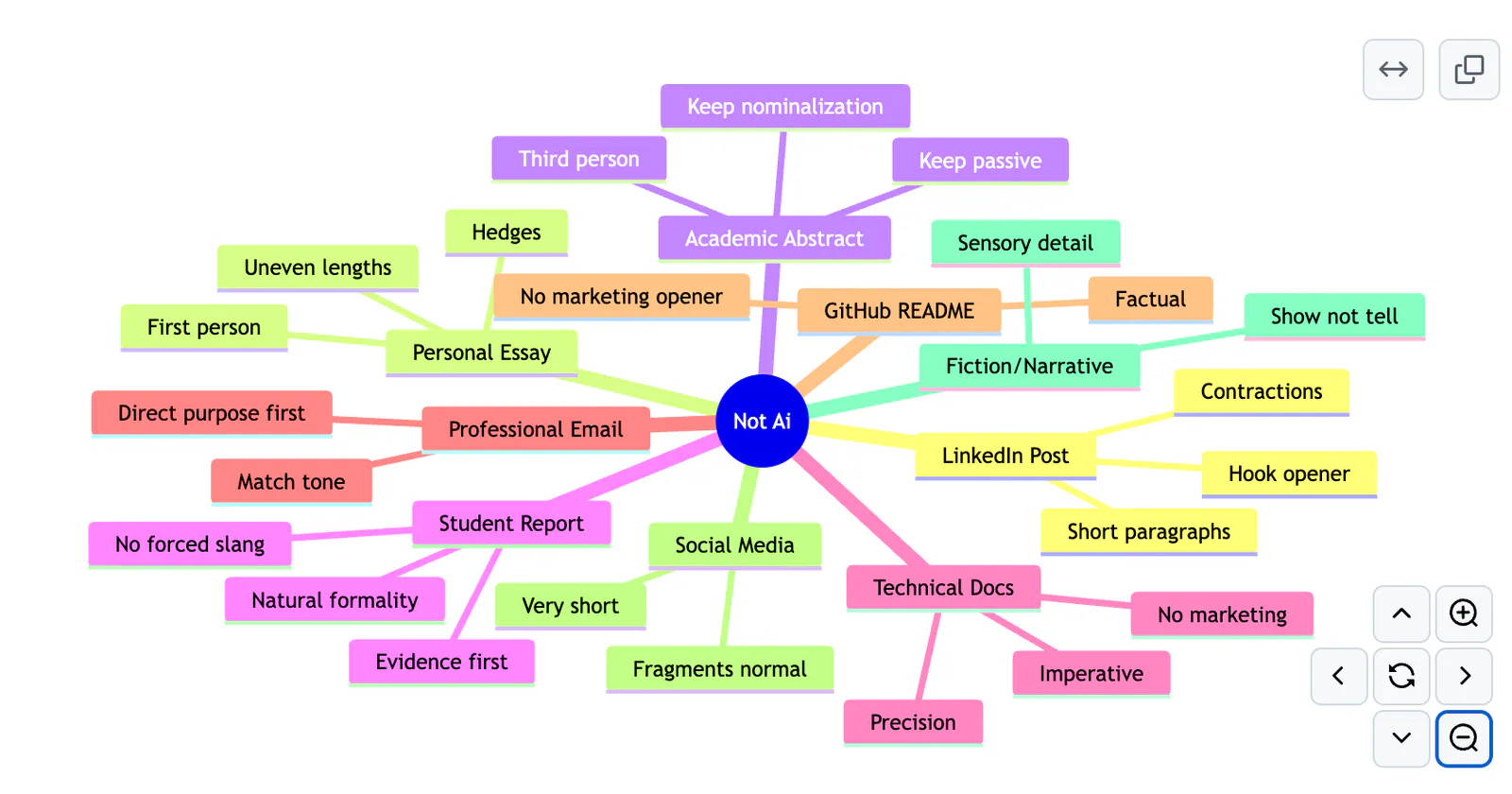
Edit or draft prose for a specific reader while preserving the author’s facts, meaning, and voice. Includes genre-aware guidance and a Python editorial review gate.
Audit and revise formulaic English writing while preserving facts, structure and the author voice.
Revise Korean commit messages into concise, natural developer language.
Compare original and rewritten text to check facts, formatting, numbers, quotes, code and structure.
Refine an existing Korean rewrite and address remaining findings or selected paragraphs.
Choose a writing or editing operation and route prose to its appropriate domain instructions.
Rebuild a draft from its supported facts and intent when deeper rewriting is needed.
Find where a finished draft loses its connection with its intended audience and propose concrete edits tied to the original sentences.
Interpret writing-pattern flags and possible false positives without treating them as proof of authorship.
Coordinate writing-pattern checks, rewrites, file editing and preservation verification for a combined request.
Revise formulaic Simplified Chinese while preserving the author’s facts, voice and register.
Create new fiction or professional prose using the relevant writing route.
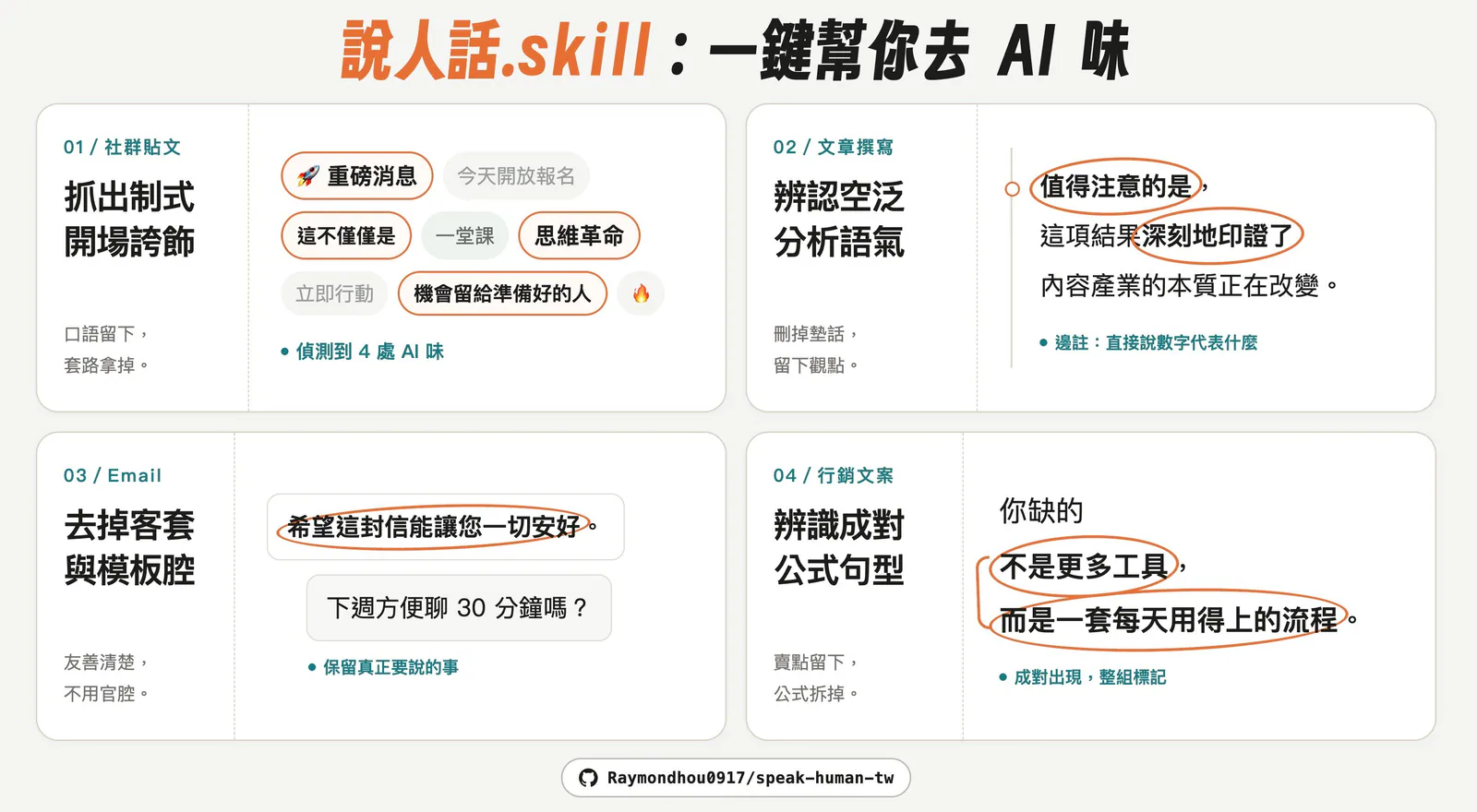
Review and revise Traditional Chinese public-facing copy for natural phrasing, Taiwanese usage, punctuation, and avoidable AI writing patterns.
Edit formulaic AI prose while preserving the original facts, meaning, uncertainty and author voice.
Edit vague, repetitive and formulaic Chinese prose while preserving facts, qualifications and the writer’s voice.
Draft and revise prose to remove stock AI phrasing, predictable structures and unnecessary verbal padding.
Compare eight AI writing skills for English and Chinese: diagnose formulaic prose, preserve the author's voice, revise copy, and check a rewrite.
Pick an anti-AI-writing skill when a draft sounds generated, a language-specific skill for non-English text, and a copy editor for general polish.