Video & Motion
ManimGX
Create mathematical explanations and 3D animations in Python, inspect their layout and timing, and export MP4 videos with editable scene source.
2.7KStars190Forks
Repository last pushed
Academa Labs
These skills let an agent build three.js scenes, model CAD parts from text, prepare files for 3D printing and work with shaders. A large share comes from the text-to-cad collection, so manufacturing and drawings are well covered.
32 skillsCreate mathematical explanations and 3D animations in Python, inspect their layout and timing, and export MP4 videos with editable scene source.
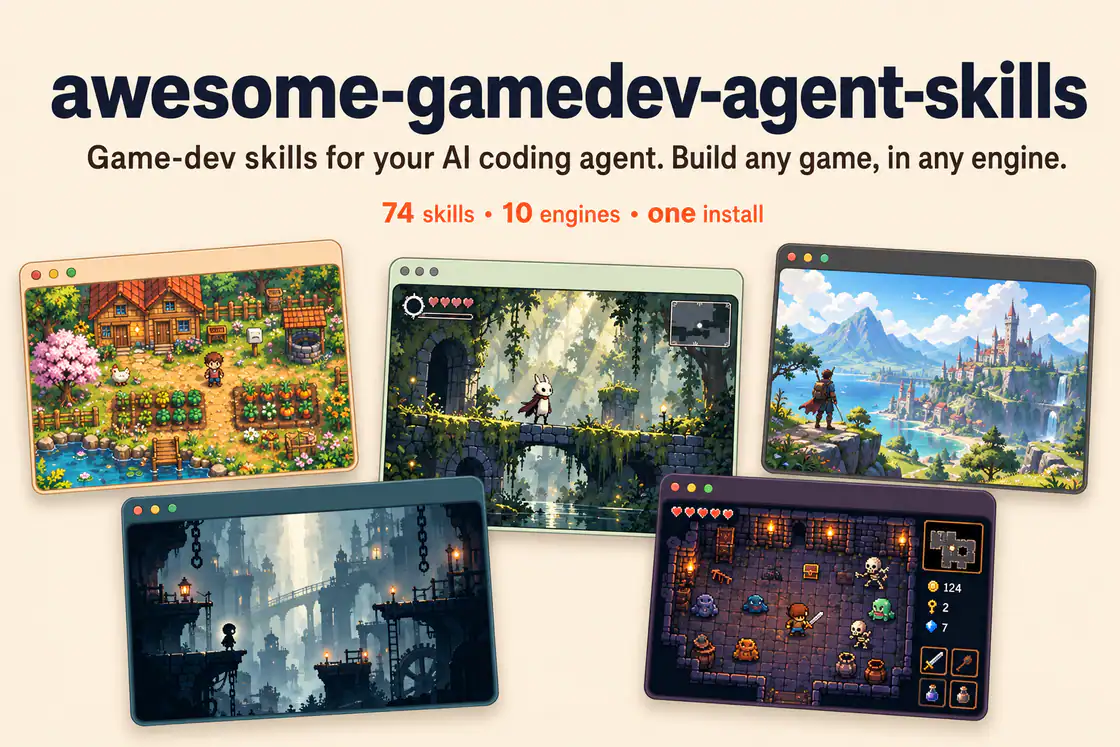
Create a responsive 3D scene with module imports, a camera, WebGL renderer, animation loop, and OrbitControls.
Create and review stylized Roblox R6 and R15 character animations in Blender using an agent and Blender MCP.
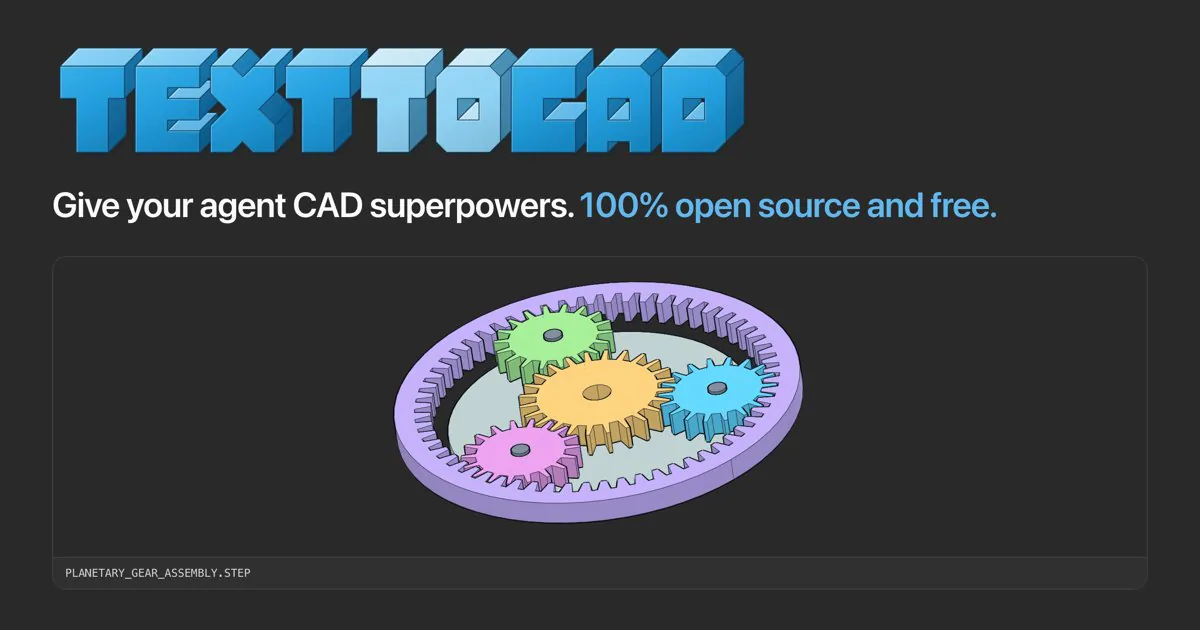
Measure mesh wall thickness, overhangs, support volume and orientation against process-specific 3D-printing limits.
Assemble Node3D scenes, cameras, light rigs, environments, mesh materials, and GridMap-based level blockouts.
Review sheet-metal, CNC and injection-molded parts using measured evidence, process-specific rules and actionable changes.
Slice 3D models with OrcaSlicer using real printer, process and filament presets, then check the exported G-code.
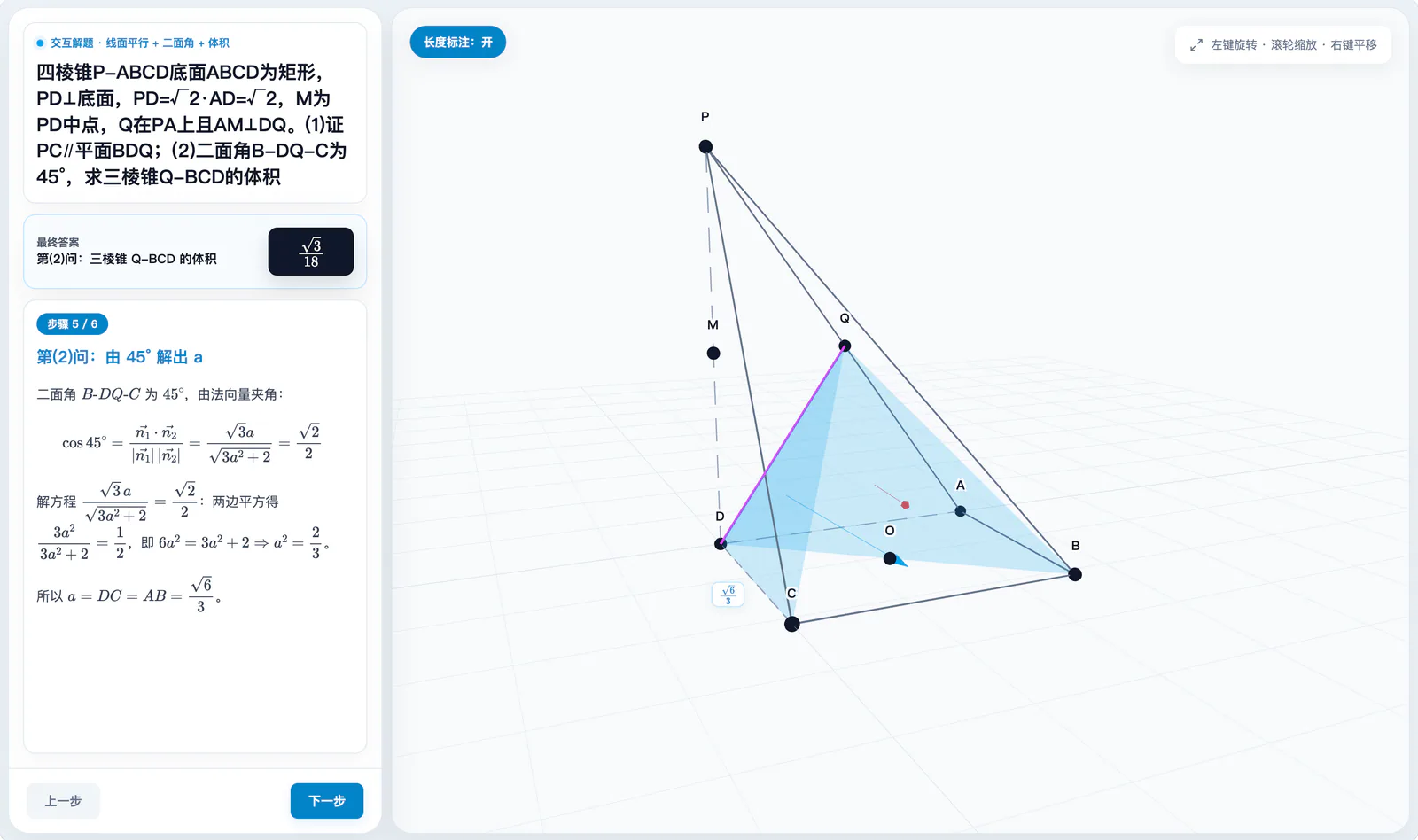
Turn a reaction into a 3D molecular demonstration with balanced equations, bond changes, atom-conservation checks, and a reaction-progress slider.
Comprehensive GLSL shader techniques for creating stunning visual effects — ray marching, SDF modeling, fluid simulation, particle systems, procedural generation, lighting, post-processing, and more.
Write canvas and spatial shaders with editable uniforms, animated UVs, dissolve, rim lighting, and screen effects.
Animate a finished dimensional drawing into an 8–15 second film with progressive strokes, camera moves, and lifted layers, using Claude Motion or a headless renderer.
Reconstruct reference objects and characters as procedural Three.js models with staged quality checks.
Audit Three.js and React Three Fiber applications for frame-loop, GPU resource and visual problems.
Create a self-contained HTML specification sheet with monochrome SVG views, measured variables, exploded layers, and detailed component geometry.
Export Blender models and import them into Unity scenes using BlenderMCP and MCP for Unity.
Build rich, scroll-controlled real-time Three.js experiences as one persistent 3D world whose camera, lighting, atmosphere, materials, objects, DOM story, and interactions evolve across authored chapters. Use for 3D scrollytelling, scroll-driven WebGL worlds, camera journeys, interactive portfolios, product stories, exhibitions, explainers, game or film microsites, spatial narratives, and multi-scene websites where native scroll should travel through one continuous place. Not limited to landing pages.
Three.js scene setup, cameras, renderer, Object3D hierarchy, coordinate systems. Use when setting up 3D scenes, creating cameras, configuring renderers, managing object hierarchies, or working with transforms.
Three.js shaders - GLSL, ShaderMaterial, uniforms, custom effects. Use when creating custom visual effects, modifying vertices, writing fragment shaders, or extending built-in materials.
Create editable Pascal 3D scenes and check furniture dimensions.
Connect to Pascal and use its MCP tools to create, inspect, edit, validate, save, or hand off editable 3D building scenes.
Assess whether furniture fits in a measured Pascal room or layout.
Search step.parts for standard components, compare dimensions, and download traceable STEP files with checksum verification.
Build a PixiJS render layer with asynchronous initialization, textures, scene containers, ticker updates, and pointer events.
Review DXF and STEP uploads against current SendCutSend material, thickness, cutting and finishing requirements.
A library of 12 CAD and fabrication Skills for parametric models, PDF drawings, robot descriptions, manufacturing checks and 3D-printing handoff.
Generate dimensioned PDF engineering drawings from part geometry, with projected views, hole callouts and a title block.
Build and validate DXF profiles, gaskets, panels and cut layouts from Python sources or CAD geometry.
Write shader effects using coordinate spaces, UV math, texture sampling, dissolve, outlines, and Fresnel lighting.
Load glTF or GLB models, play and blend animation clips, and configure compressed geometry and texture decoders.
Create and edit parametric parts or assemblies, export STEP/STL/3MF/GLB, and inspect saved geometry with cadgen.
Choose PBR or unlit materials, build light rigs, fit shadow maps, and use environment lighting and reflections.
Open print files in Bambu Connect or unsliced models in Bambu Studio for the user to select a printer and start the job.
Choose three.js skills for interactive web scenes, text-to-cad skills for physical parts and print preparation, and engine-specific skills when the model is headed into Godot, Unity or Roblox.