Free
Other utilities
Game UI & UX
Build HUDs and menus with responsive anchors, safe areas, focus navigation, screen state, and event-driven updates.
8.8KStars894Forks
Repository last pushed
Abhishek Barali
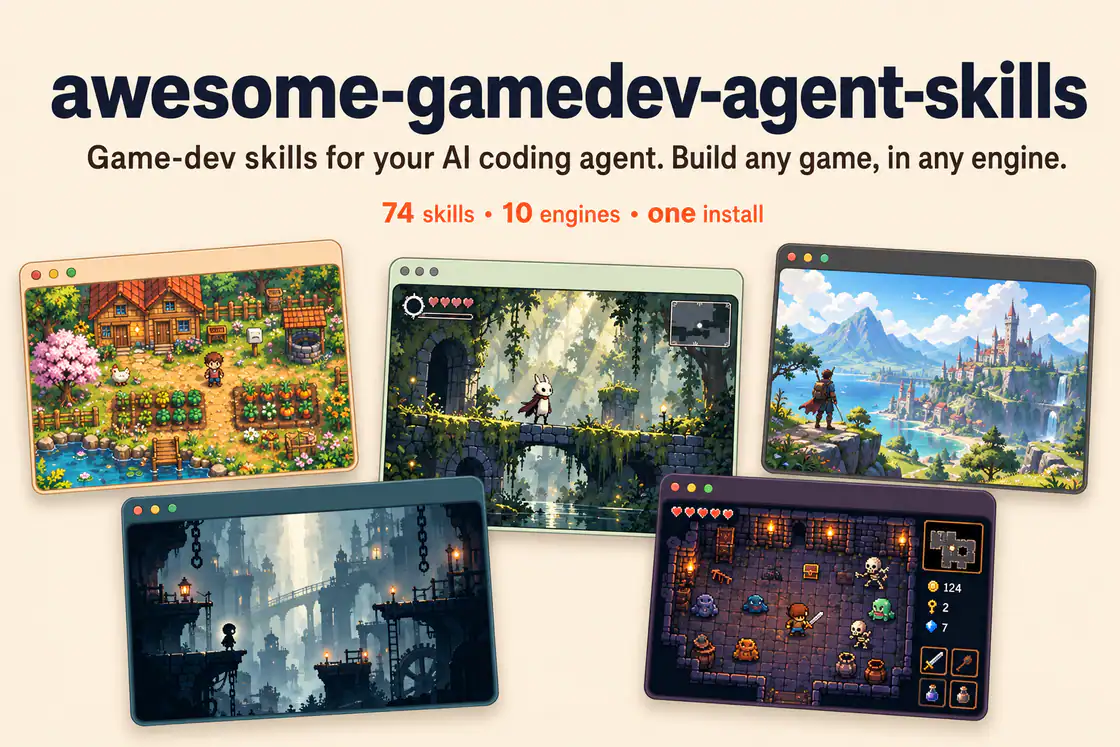
These skills help an agent prototype gameplay, script engine systems and prepare builds for release. Most come from a large open-source game-dev pack that covers Godot, Unity, Unreal, Roblox and 2D frameworks system by system.
76 skillsBuild HUDs and menus with responsive anchors, safe areas, focus navigation, screen state, and event-driven updates.
Create a pixel-art canvas, layers and sprite using drawing primitives and palettes.
Create and review stylized Roblox R6 and R15 character animations in Blender using an agent and Blender MCP.
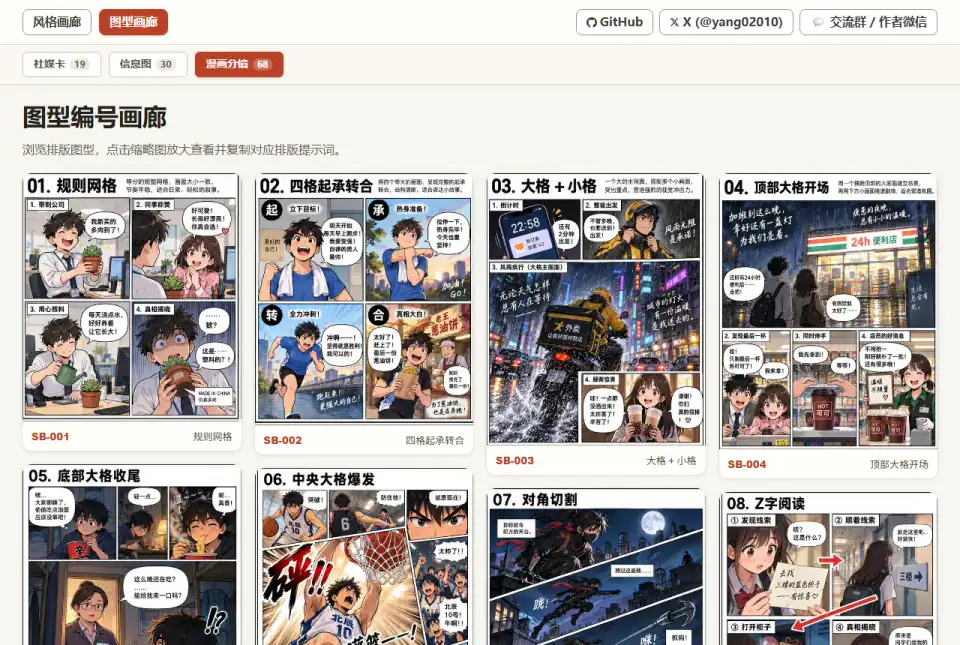
Plan a Character Bible through positioning, character, visual, system and commercial design cards.
Assemble Node3D scenes, cameras, light rigs, environments, mesh materials, and GridMap-based level blockouts.
Turn player movement metrics into blockouts, encounter pacing, gated routes, and a reachable critical path.
Refine existing pixel art using dithering, palette reduction, shading and antialiasing.
Operate Unity Editor scenes, GameObjects, scripts, and tests through MCP tools and resources.
Switch connected Unity projects between released, branch, and local MCP for Unity package sources.
Export Blender models and import them into Unity scenes using BlenderMCP and MCP for Unity.
Four Aseprite workflows for creating, animating, refining and exporting pixel art through Claude Code and pixel-mcp.
Maintain personal character, prop and scene libraries with image replacement, metadata updates and refreshed galleries.
Build visual gameplay graphs and connect Blueprint classes through references, interfaces, and event dispatchers.
Implement CharacterBody2D platformer or top-down controllers with gravity, slopes, jump timing, and collision feedback.
Separate game data and behavior with configuration assets, shared variables, event channels, and runtime registries.
Write reflected C++ Actors and components, configure the Gameplay Framework, and manage module dependencies.
Test one gameplay question with a timeboxed greybox loop, observable playtest criteria, and a keep-or-kill decision.
Choose and implement state machines, behavior trees, steering, and A-star pathfinding for enemies and NPCs.
Generate reproducible terrain, grid dungeons, connected rooms, and weighted loot with seeded random generators.
Create particle systems and emitters, expose user parameters, and spawn or drive Niagara effects from gameplay.
Write canvas and spatial shaders with editable uniforms, animated UVs, dissolve, rim lighting, and screen effects.
Compose an FPS controller, camera aim, hitscan or projectile weapons, health, enemy behavior, and combat balance.
Create or improve Go games with Ebitengine, covering the playable loop, input, rendering, audio, state, tests, and builds.
Model items and configuration as typed Resources, load and save resource files, and isolate mutable instances.
Save player progress and leaderboards with guarded DataStore calls, UpdateAsync, retries, and shutdown handling.
Choose physics bodies, configure collision layers and masks, detect overlaps, apply forces, and cast 2D or 3D rays.
Configure cooking, default maps, packaging settings, build configurations, and automated RunUAT builds.
Compose reusable scenes, instantiate PackedScenes, access nodes safely, manage autoloads, and check resource paths.
Prepare an itch.io project and use Butler channels, version labels, validation, and controlled uploads to publish builds.
Design serializable game state, save slots, crash-safe writes, schema upgrades, and throttled autosave.
Build respawn-safe character logic with scoped cleanup, Humanoids, Animator tracks, rigs, tools, and movement ownership.
Automate player builds, scene selection, scripting backends, quality settings, code stripping, and build-result checks.
Create Lua game loops, delta-time motion, input handling, screen states, and window settings in LÖVE.
Create NPC behavior with AIControllers, blackboard keys, tasks, decorators, services, selectors, and sequences.
Create keyframed clips, character state machines, blend spaces, and procedural UI or gameplay tweens.
Decouple node communication through typed signals, callable connections, one-shot events, bound arguments, and groups.
76 game-development skills and an automatic router for engine-specific coding, game systems, playable genres, asset workflows, prototyping, and publishing.
Tune fixed timesteps, interpolation, mass, gravity, drag, collision masks, and continuous detection for stable motion.
Animate an existing sprite with frames, timing, tags and linked cels.
Implement NPC decision systems with blackboards, reusable behavior-tree nodes, utility scores, response curves, and hybrid agents.
Add layered feedback through trauma-based screen shake, hit-stop, eased motion, squash and stretch, knockback, and audio cues.
Design remote protocols with server authority, argument checks, rate budgets, targeted replication, and lifecycle handling.
Bake navigation surfaces, move NavMeshAgents, check reachable paths, carve obstacles, and connect navigation regions.
Build card data, deck and discard zones, draw and shuffle rules, turn phases, resource costs, and effect resolution.
Wire positional or global audio players, route music and SFX buses, control volume, and synchronize events to beats.
Configure export templates and presets, headless builds, platform requirements, and target-device smoke checks.
Configure Input Actions, action maps, PlayerInput, callbacks, polling, control schemes, and gameplay-to-UI switching.
Build smooth 2D follow cameras and 3D orbit rigs with deadzones, look-ahead, bounds, collision handling, and shake hooks.
Pick the skill for your engine first, then the system you are building, such as movement, physics, save data or UI. Because a single pack dominates this page, compare its approach with the few independent skills before committing.